

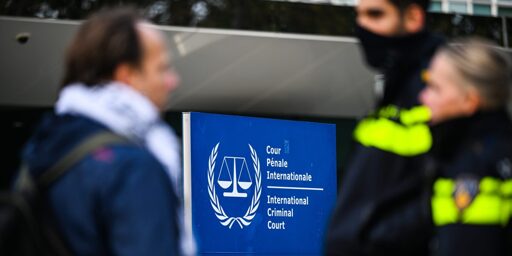
A federal judge on Monday ruled that the Trump administration may not punish Americans for sharing evidence of Israeli war crimes with the International Criminal Court. The ruling also blocked the administration from meting out punishments for sharing information with three sanctioned Palestinian human rights groups and a prominent United Nations official.
The Monday ruling is the broadest challenge yet to an executive order issued by President Donald Trump in the early days of his second term that has been used by U.S. officials to issue sanctions against the ICC; the Palestinian groups al-Haq, al-Mezan, and the Palestinian Center for Human Rights; and U.N. special rapporteur Francesca Albanese.
“It was kind of expected that they would make the preliminary injunction permanent, but the universal part is huge.”
The order, which came as a result of a lawsuit filed in July by Democracy for the Arab World Now, or DAWN, and the Taxpayer Alliance Against Genocide, is the latest setback to efforts by the Trump administration to undermine the efforts by the ICC, Albanese, and others to hold Israel accountable for crimes against humanity.
“This landmark ruling dismantles a core part of Trump’s ICC draconian sanctions regime,” said Omar Shakir, executive director at DAWN. “The court has affirmed that every American has the constitutional right to advocate for justice on Palestine without fear of reprisal.”
While previous rulings against Trump’s executive order applied more narrowly — including an October preliminary injunction in the ICC case that prevented punishments against the plaintiffs — this is the first ruling against the sanctions that protects all Americans.
“The main difference is that this was expanded to be universal, meaning it doesn’t just protect the people who filed the lawsuit in the first place,” Michael Schaeffer Omer-Man, the Israel-Palestine director for DAWN, told The Intercept. “It was kind of expected that they would make the preliminary injunction permanent, but the universal part is huge.”
[
Related
Trump’s Sanctions Against the ICC Are Unconstitutional, Rights Groups Say](https://theintercept.com/2026/07/15/trump-sanctions-international-criminal-court/)
A spokesperson for the White House did not immediately respond to a request for comment, but in a legal filing earlier this month, attorneys for Trump argued that his original executive order did not represent a restriction on free speech.
Another previous ruling that applied narrowly came in a case brought by a pair of university professors who challenged the administration’s prohibition on working with the ICC. Joseph Pace, a lawyer for DAWN and the Taxpayer Alliance Against Genocide, said this ruling also helped overcome some of the limitations in the professors’ successful case.
“It didn’t stop the administration from enforcing the sanctions against anyone else,” he said, of the decision in the professors’ case. “Nor did that decision say anything about the Palestinian NGOs or Albanese” — neither of which had been sanctioned yet at the time of the ruling.
“The permanent injunction, though, is what’s called a ‘universal injunction,’” Pace told The Intercept. “That means the government can’t penalize anyone for providing (or receiving) First Amendment-protected services to or from ICC, Albanese, and the NGOs.”
**“**Challenging These Crimes”
In his ruling, U.S. District Judge Jesse Furman found that the so-called services provision of Trump’s order — which threatened penalties for anyone “providing services” to the ICC, Albanese, or the three Palestinian NGOs — was unconstitutional because it undermined the First Amendment rights of people seeking to provide non-financial services to human rights advocates.
[
Related
Inside the Trump Administration’s War on the International Criminal Court](https://theintercept.com/2026/11/17/trump-icc-sanctions-war-crimes/)
In a statement, Taxpayer Alliance Against Genocide co-founder Anna Marie Stenberg said the ruling by Furman provided immediate clearance for her organization and others to resume work with the ICC, Albanese, and the three Palestinian organizations.
“We challenged Trump’s Executive Order on the ICC because we refused to let his regime intimidate us into silence while it used our tax dollars to fund crimes against humanity,” Stenberg said. “This victory means that others can join us in challenging these crimes without fear of punishment for exercising their First Amendment rights. Ordinary people have a right to seek justice, and our government cannot take that right away.”
[
Read our complete coverage
Chilling Dissent ----------------](https://theintercept.com/collections/chilling-dissent/)
Trump’s Executive Order 14203, issued in February 2025, called for financial penalties against the ICC under the International Emergency Economic Powers Act. It barred Americans from providing financial assistance or services to further the court’s activities. Trump’s order explicitly cited the court’s investigations into Israel as a justification for the sanctions.
The order led to sanctions by the Trump administration against Albanese, who has consistently drawn the ire of pro-Israel officials for pursuing investigations into Israeli war crimes. The sanctions barred her from entry to the U.S. and froze her assets in the country. Albanese challenged the sanctions and a judge threw them out in May, but they were reinstated later that month.
The post Why a Case Against ICC Sanctions Is a Major Victory for Palestine Human Rights Work appeared first on The Intercept.
From The Intercept via This RSS Feed.