

CONMEBOL and Concacaf renewed their strategic alliance to stage the 2028 America Cup in United States, a 16-team tournament set to run from June 9 to July 9.
The South American Football Confederation and its counterpart for North America, Central America, and the Caribbean ratified the agreement through their respective governing councils.
The joint decision assigns United States the 49th edition of the tournament, the third time the country has hosted it after 2016 and 2024.
RELATED: FIFA Approves Women’s World Cup for Mexico, U.S., Costa Rica, Jamaica
The format calls for 16 national teams and 25 days of competition on U.S. soil. The initiative is designed to consolidate integration between the two regions following the cycle of the 2026 World Cup.
Ten CONMEBOL member nations will take part, joined by six representatives from Concacaf. Those six North American, Central American, and Caribbean sides will secure their places through the 2027 Gold Cup, scheduled for June 17 to July 11 of that year.
Alejandro Domínguez, President of CONMEBOL and Vice-president of FIFA, confirmed the host nation through official channels and underscored the scope of the bilateral agreement. “The CONMEBOL America Cup is much more than a tournament. It is part of our identity, our history, and the greatness of South American football,” he said.
Concacaf and CONMEBOL to co-host CONMEBOL Copa América 2028 in the United States 🇺🇸
Six Concacaf teams will participate, all qualifying through the 2027 Gold Cup 🏆
Read more 🔗 https://t.co/p18d4kL610 pic.twitter.com/4S8uLYQTSB
— Concacaf (@Concacaf) November 24, 2026
Six Concacaf Spots
Víctor Montagliani, President of Concacaf and also a FIFA vice- president, emphasized the opportunities the pact creates for his member federations. “This agreement will give six Concacaf national teams a new opportunity to compete against some of the best in the world, while further strengthening the competitive importance of our Gold Cup,” the Canadian official noted.
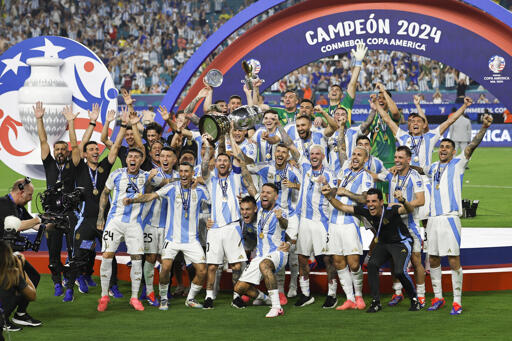
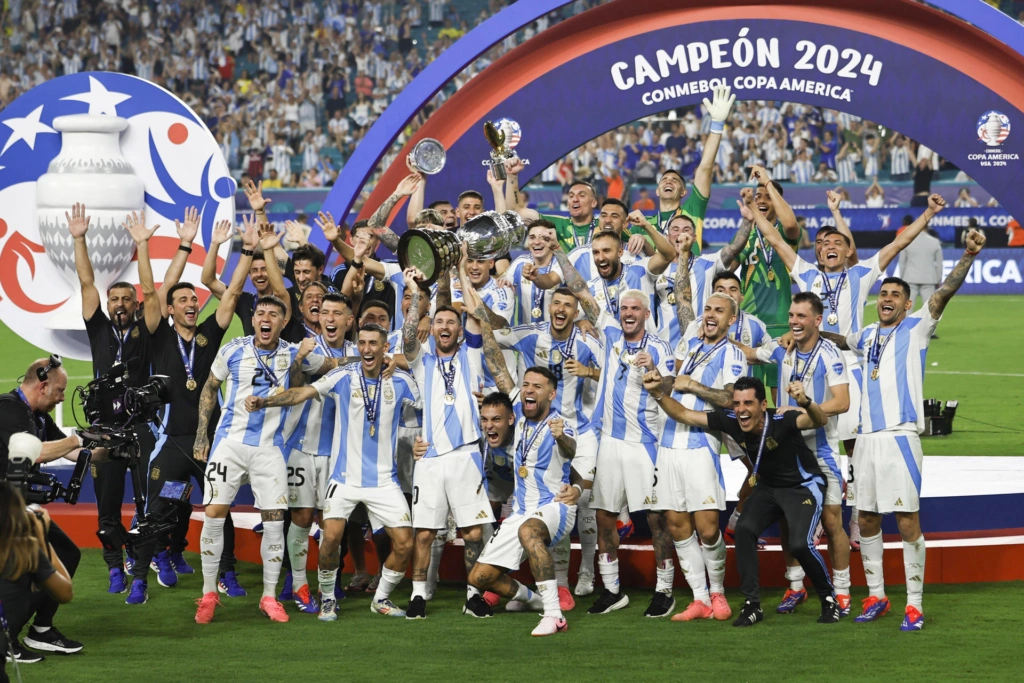
On the sporting side, the 2028 edition will revolve around Argentina’s defense of the title. The reigning two-time champion lifted the trophy in 2021 and 2024, and now seeks a third consecutive crown. That mark has only one precedent in the history of the oldest national team competition in the world. Argentina itself achieved three straight titles in 1945, 1946, and 1947.
The Albiceleste enters as the team to beat, and the format gives it a clear path to pursue history. A third consecutive title would tie the record its own predecessors set nearly eight decades ago.
While both confederations have locked in the dates and the general structure, several operational details remain unresolved. Host cities, designated stadiums, the detailed match schedule, and the specific Concacaf qualification mechanisms will be announced in future institutional communications.
The stage is set for the 2028 CONMEBOL Copa América! The United States will host the next chapter in the history of the world’s oldest national team tournament. 🇺🇸 pic.twitter.com/PmlPN89HhC
— CONMEBOL Copa América™️ ENG (@copaamerica_ENG) November 24, 2026
The 2027 Gold Cup therefore carries added weight. Beyond its own prestige**, the tournament now functions as the gateway through which six Concacaf nations will earn their places in the expanded the America Cup.**
The alliance between the two confederations deepens a model tested in 2016 and repeated in 2024. That framework brought South American powers and Concacaf sides into a single bracket, and the 2028 edition extends the arrangement for a third cycle.
With the World Cup of 2026 as a backdrop, the America Cup arrives two years later as a bridge between regional competitions and a showcase for both confederations. United States, fresh from co-hosting the global tournament, will again provide the stage.
The June-to-July window mirrors the traditional summer slot, and the 25-day competition span keeps the tournament compact. Sixteen teams, ten from the south and six from the north, will contest it. For now, the announcement settles the essentials. The host country, the dates, and the number of participants are fixed. The rest, venues and kickoff times, waits for the next round of official statements.
The renewal of the strategic alliance signals a longer-term partnership between the two governing bodies. What began as a centennial celebration in 2016 has become a recurring event with its own rhythm and stakes.
From teleSUR English via This RSS Feed.