

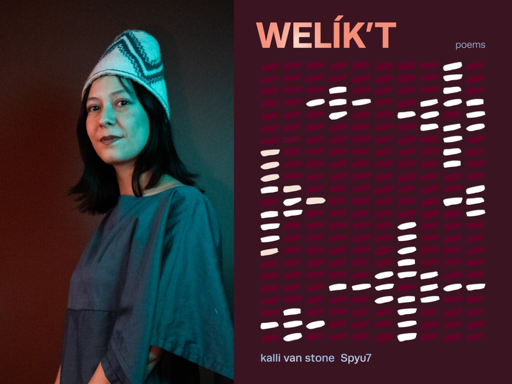

Poet Kalli Van Stone’s new collection ‘welík’t’ was published in September. Submitted images
While exploring nsyilxcn (syilx language) and Secwepemctsín (Shuswap language) dictionaries, Kalli Van Stone (Spyu7) found herself drawn to words that held concepts she couldn’t find in English or Latin dictionaries.
In nsyilxcn, for example, she came across a word for the bending of time, which inspired her two-line poem “sumix kaʔɬis medicine power iii.”
These teachings opened up new worlds for Van Stone, which she began exploring through poetry.
Her debut poetry collection titled welík’t — meaning “sparkle” in Secwepemctsín — was published by Nightwood Editions in September.
The collection is divided into three sections: “nsyilxcn,” “english poems with indian names,” and “secwepemctsín.” Translations accompany her poems, alongside her own artwork.
Van Stone, who is syilx and Secwépemc from the north end of Okanagan Lake in “B.C.,” began reclaiming her ancestral languages a decade ago. This collection grew out of that work.
Across the collection’s 77 poems, Van Stone writes about personal experiences, the lives of her ancestors and the differences between her languages.
“They’re meant to be kind of shorter, more musical phrases, and then to kind of highlight any cool curiosities I find in the language,” she told IndigiNews.
‘I don’t let it stop me if I don’t have the words’
Van Stone is particularly drawn to words in nsyilxcn and Secwepemctsín that “challenge the Western concepts of time and personhood,” as well as those that speak to spirituality and ceremony.
Finding new words that displayed inspiring concepts brought up feelings of excitement and fulfilment for Van Stone. She references the nsyilxcn word kʷu ksq́ʷiɬq́ʷɬt, which translates to “you do wonders.”
Dictionaries are only one place she looks for inspiration. Van Stone also draws on things she’s heard throughout her life, returning to them later when she sits down to write.
“Mostly, it’ll just be like something cool I’ve heard throughout my life, and I’ll kind of tuck it away and then expand on it later in my own time,” she said.
“Or I find something really cool in the dictionary, or just in other documents or videos, and I’ll be like, ‘Whoa, there’s so much in that one sentence,’ and then I’ll kind of make my own thing.”
Writing in languages she’s still learning has, in part, shaped her aesthetic as a poet.
“I thought it was a really cool challenge to make something beautiful using some of the limitations I have. I know enough to do something creative, but it also makes it more simple, very stripped down to core ideas,” she said.
“I don’t let it stop me if I don’t have the words.”
There is also a musical quality to this brevity. In some of her poems, Van Stone experimented with call and response, drawing on musical traditions from her communities.
In the notes accompanying her poem “nt̓aʔlils,” Van Stone draws a parallel between a drumstick striking a drum and a dancer’s feet striking the earth. She relates these movements to syilx teaching about working through different emotions.
‘Our languages are sisters’
Van Stone has found similarities between nsyilxcn and Secwepemctsín, both members of the Salishan language family.
“Our languages are sisters, so I love that there are so many ways where they kind of converge into each other, and then I was really interested in where they’re different,” she explained.
“Then we have really similar but still distinct music styles and a lot of our seasonal round is really similar, so that’s why it just felt so nice to learn both and do both and embrace all my ancestral sides.”
Working between nsyilxcn, Secwepemctsín and English brought its own challenges, particularly when translating and finding words that could convey what she wanted to express.
In “sixteen names of síyaʔ,” Van Stone lists 16 nsyilxcn names for the Saskatoon berry, compared with three English and Latin names. She connects that difference to the relationships her people have developed with the plant over thousands of years. She writes:
ʔupnkst uł taq̓mst skwists iʔ síya
sixteen names of siyaʔ
síyaʔ
sx̌wetl’x̌wítlaʔst
wusxenílheml̓x
t’et’k̓’ílhmel̓x
t’et’íkwt’ekwt
spep’aʕts’álak̓w
slhk̓ilhp
slhak̓
skw’lkw’lk̓in
sk̓w’ets’k̓w’ets’wiʔhálhaʔk̓
sk’ek’sálhaʔk̓
siʔílhp
siyíya
lhek̓’alhpákst
lexwús
kt’etíkws
how many names?
there are sixteen names
síyaʔ
serviceberry
saskatoon berry
Amelanchier alnifolia
“Over time, you just spend so much more time and relationship with these plants and the different conditions they need to grow, the places they are,” she explained.
“We aren’t commodifying the plant as much, so it’s not like someone’s trying to claim it and it gets named and then we’re done with it. Over 1000s of years in the same place, [we] found all these different ways to call the plant.”
Van Stone took language courses that gave her a foundation for writing her poems. The connections she made in those classrooms also became an important part of her learning.
She also turned to the language and culture department in her father’s community, where she could reconnect with others who had grown up there.
Learning her languages has brought Van Stone closer to her ancestors and the histories of places connected to her family.
In “t ̓ík ̓naʔ flood,” she explores the history of a flooded reserve and the feelings of displacement she had experienced while visiting the area, even before learning what had happened there.
“I don’t like going there, and then it was like, ‘oh, it makes so much sense,’” she said.
Her family came from the area, and the poem became a way to explore her relationship with a place she found difficult to visit:
tík naʔ
flood
i trace back
before there was me
my mom’s dad’s dad’s dad’s dad’s dad
i trace back
before the border
when we went back and forth as we pleased
i trace back
before you flooded our village, the trout village
before your hydroelectric dam on ntxʷitkʷ
when we were from the lakes
when we knew true power
when we weren’t extinct
i trace back
before we were baptized
before the french and the jesuits came
when we had Indian names
Groslouis, Grandlouis, born at inninkameep
Aloysius, Ludovicus, renowned warrior, became our latin name
Paul Louis, npaupaukʷikn, a gambling name, born to.ma.as 1852
who went to live on Okanagan Indian Reserve #1 when he
married Mary Anne
daughter of Newilliskut, “Nouhiliskut”
granddaughter of Quihammiken
Pierre Louis
Benjamin Louis
Clarence, Mike Louis
mom
me
She describes the poem as “trying to use art as a way to connect with some of those places that are harder to be in,” while also asking, “How do you relate to that place now, generations later?”
‘We should be supported in learning’
After drafting her poems, Van Stone turned to others for help refining them. Some were people she’d met in language classes, giving her a chance to reconnect and learn how their knowledge of the languages had developed since they’d studied together.
Much of the writing itself, however, happened independently.
“I mostly do a lot of my stuff alone just because it is […] kind of an emotional process or an internal kind of reflection,” she said.
More people across “B.C.” are learning their First Nations languages. According to the 2022 Report on the Status of B.C. First Nations Languages, the number of language learners increased by 3,106 between 2018 and 2022, bringing the total to 17,103.
While Van Stone notes that more people are learning their language, it can still be difficult to find people who are willing to contribute translations.
“It can be, kind of, a little bit lonely,” she said about the process.
“Sometimes it’s hard to find a group of people that want to do that together or support making creative work in [the language].”
She is not yet fluent in nsyilxcn and Secwepemctsín, but believes using the languages is important regardless of fluency.
“If we’re too scared to speak, then it’s like residential school again. We should be supported in learning, and then expressing ourselves and saying difficult things,” she said.
With all the topics covered in her collection, which include the impacts of day and residential “schools,” and her own educational experience discussed, it made the creation of welík’t a delicate process.
“Sometimes people just aren’t ready to hear those things, but I think it’s important to express ourselves,” she said.
In “Higher Learning in the Valley of the Shadow of Death,” Van Stone writes about experiencing racism on a university campus. She felt the experience needed to be included in the collection.
“It had to go somewhere because those things happen,” she said.
Van Stone also questions the lack of support Indigenous students can encounter in higher education, particularly when they’re already doing work connected to their communities.
Throughout the creation of welík’t, Van Stone faced many challenges, from difficult translations to finding publishers willing to publish a trilingual book.
“It was a challenge to find a cool publisher that wanted to work with me and lay it out in new ways and kind of be creative with how it looks on the page,” she said.
‘I want our language to be everywhere’
Van Stone speaks positively about the increasing presence of language in communities, including building names and signs.
“That’s what I want: our language to be everywhere,” she said.
She has also encountered people who are hesitant to pronounce unfamiliar words, something she hopes will change as the languages become more visible and familiar.
“I want to help break through that into something else, where it’s not so jarring for people.”
Creating a poetry collection which centres Indigenous languages is another avenue for people to see what can be done in the language.
With welík’t, she hopes to show other language learners what they can create, even while they’re still developing their fluency.
“We feel pretty safe in our own circles, but sometimes it’s hard to break further and go into new kinds of realms with our language or to talk about it in artistic ways,” she said.
“So it felt good to put [welík’t] out there.”
Alongside the poems, Van Stone included photographs and artwork, some depicting the cultural items and places that inspired her writing. Among them are images of root-digging tools such as pića, knapped arrowheads and knives made by her brother, stemelqín (Eric Van Stone).
“I really pushed for having some of my pictures in there, and different art that I’ve made because sometimes the poems are in response to a cultural item or a place, or a cool image,” she said, adding that digital images are also featured in welík’t.
She’s already thinking about how to experiment further, including with the call-and-response forms she explored in the collection.
“I like experimenting now, a bit more, for maybe a future collection or something,” she said.
Beyond writing, Van Stone sings, dances, and creates performance art, and has begun incorporating poetry and cultural tools into her performances.
Some of those performances have featured the pića (root-digging stick) and other tools pictured in welík’t.
“I’m hoping to fuse performance, visual art, and poetry together. That’s my fun time right now,” she said.
The post From bending time to 16 names for a berry — a poet finds inspiration in her ancestral languages appeared first on Indiginews.
From Indiginews via This RSS Feed.