

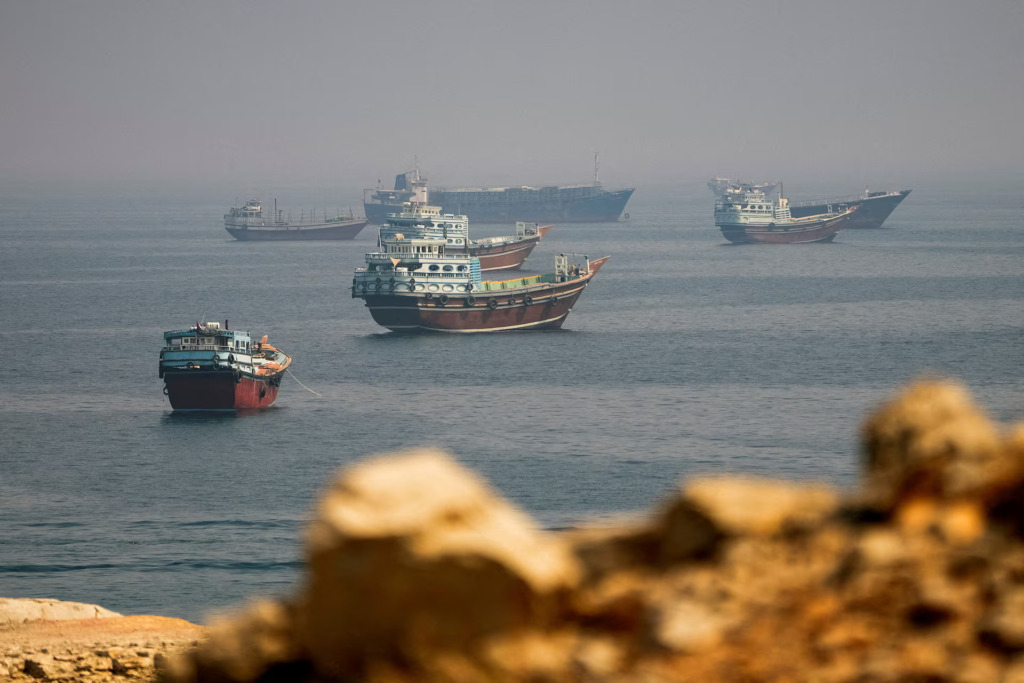
Iran’s Army Commander, Major General Amir Hatami, ordered the navy chief to intensify the closure of the Strait of Hormuz, conditioning the reopening of the strategic waterway on the fulfillment of seven Iranian demands.
The order came directly from the top of Iran’s military command. Major General Amir Hatami instructed the head of the navy, Admiral Shahram Irani, to reinforce the shutdown of the Strait of Hormuz, the maritime route that carries a large share of the world’s oil and gives Iran much of its geopolitical leverage.
“Until the seven conditions of the Islamic Republic of Iran are met, not only will the Strait of Hormuz not be opened, but it must be closed more each day, conditions for the enemy must be hardened, and firmer control will be exercised over it,” Hatami said.
RELATED: Iran Dismisses U.S. Chemical Weapons Allegations as “Fraudulent Script”
His warning did not stop at the waterway. Hatami cautioned that if the enemy commits “a new folly,” its infrastructure would suffer destruction without precedent. The language left no room for interpretation about the consequences Iran claims it can deliver. On the possibility of another war, the Commander promised that the blows of Iran’s armed forces would be “more severe, harder, and more crushing, and without geographic restrictions.”
Any attack on Iranian installations, he said, would trigger “destructive blows against its infrastructure whose losses will be irreparable.” The warning extends the confrontation beyond military targets to the economic foundations of an adversary. Hatami delivered a single line that condensed his position. “Any new war the enemy starts will be a step that drags it into a deeper swamp and ends in its defeat,” he emphasized.
🔴 Iran’s Navy says two oil tankers struck mines and caught fire in the Strait of Hormuz early on Tuesday, according to an army statement
🔴 Iran’s Army Commander-in-Chief Amir Hatami said earlier on Tuesday that the strategic waterway will “be more closed day by day and… pic.twitter.com/0tzuojXOnH
— Al Arabiya English (@AlArabiya_Eng) November 24, 2026
The Iranian General confirmed that Iran has drawn up operational plans for its new defensive strategies and finished its military preparations for a possible confrontation.
Iranian authorities repeated that the armed forces stand ready to respond immediately and forcefully to any threat, regardless of its nature or origin. That formula covers attacks from any direction and of any kind.
Seven Demands Detailed
Hatami’s warning followed a statement from Parliament Speaker and chief negotiator Mohamad Baqer Qalibaf, who ruled out any talks with United States until Iran’s seven conditions are fulfilled. His statement aligns the legislative power with the army’s stance, presenting a unified front in both military and political terms.
Among the demands are an end to the conflict on all fronts, including Lebanon; the release of Iranian assets frozen in third countries; recognition of control over Hormuz shared by Tehran and Muscat; and the lifting of oil sanctions.
Washington has not accepted the proposals despite mediation efforts by Pakistan and Qatar. The two governments remain locked in a dispute over a passage through which a significant portion of the world’s oil moves, while United States tightens sanctions, naval pressure, and trade restrictions.
In recent weeks, attacks on vessels trying to cross the strait without authorization have multiplied, most of them reportedly carried out with mines. The frequency now has no precedent since the war began nearly nine months ago.
October marked at least 30 incidents, the highest monthly count since the start of the conflict, according to the British maritime agency (UKMTO). November brought attacks on an almost daily basis.
Hatami also warned that Iranian forces would deliver blows “more severe, harder, and more crushing, and without geographic restrictions.” An attack on Iranian installations, he added, would bring “destructive blows against its infrastructure whose losses will be irreparable.”
Following this, the Commander confirmed that operational plans for Iran’s new defensive strategies are complete, as are military preparations for a possible confrontation. Iranian authorities repeated that the armed forces will respond immediately and forcefully to any threat, whatever its nature or origin.
The Strait of Hormuz sits at the center of this standoff. A prolonged closure would ripple through global energy markets, and Hatami’s promise to tighten it day by day raises the stakes incrementally rather than all at once.
Iran has now linked the waterway, its military readiness, and its diplomatic posture to the same seven conditions. The threat of geographic limits removed from any response marks an escalation in rhetoric. Where previous statements might have scoped the confrontation, this one explicitly does not.
The navy now carries the order to enforce the closure. Admiral Irani, as the officer named in the command, holds responsibility for turning the general’s threat into a physical blockade of one of the world’s busiest sea lanes.
From teleSUR English via This RSS Feed.