

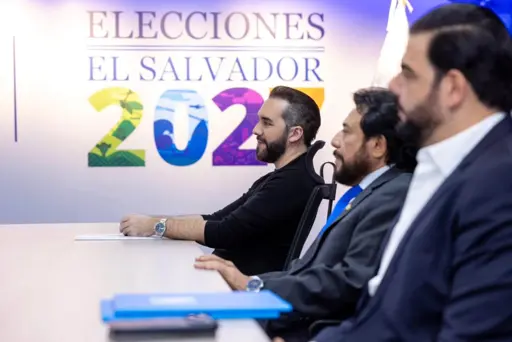
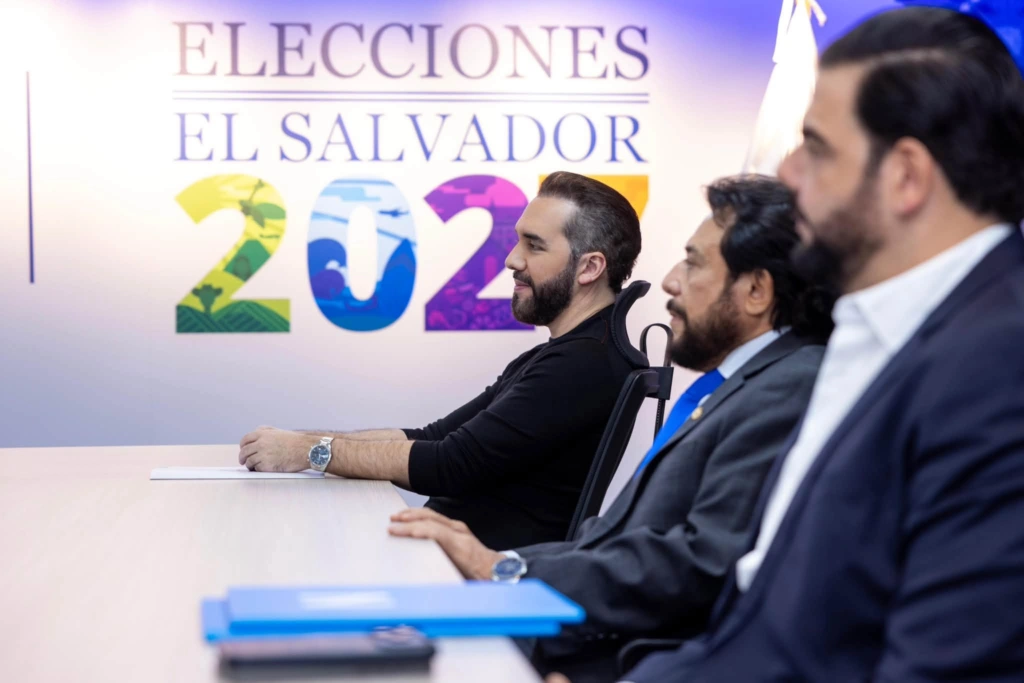
On Monday, El Salvador’s Supreme Electoral Tribunal (TSE) announced via its official website that the candidacies of President Nayib Armando Bukele Ortez and Vice President Félix Ulloa Hijo—representing the ruling party, Nuevas Ideas—had been officially registered. The resolution, issued on November 20, authorizes the ticket to seek a third consecutive term in the general elections scheduled for February 28, 2027.
RELATED:
Salvadoran Military is Teaching Haiti’s Gangs A Lesson: Bukele
The official document bases its decision on Articles 142, 143, 144, 145, 150, 151, 152, and 186 of the Electoral Code, as well as Articles 3 and 37 of the Political Parties Law and Legislative Decree No. 1015 of October 3, 2002. The body ordered the registration of the presidential ticket in the Registry of Candidacies.
Regarding this, the text of the electoral ruling states: “Having verified compliance with the constitutional and legal requirements for the registration of the candidacies, it is appropriate to order the registration of both candidates in the corresponding registry, as well as the publication and notification of this resolution.”
Previously, on November 19, Bukele registered his candidacy just before midnight. Accompanied by Ulloa and nearly 3,000 supporters, the 45-year-old president formalized his bid. “We are going to make history again (…). El Salvador will not return to the past,” the president declared, defending the legitimacy of his candidacy by arguing that the country now truly has democracy, and everyone—all political parties—can participate. The path for Bukele to seek a third term was cleared on July 31, 2025.
🇸🇻 Bukele queda inscrito para buscar la reelección en El Salvador
El Tribunal Supremo Electoral de El Salvador (@TSEElSalvador) publicó la resolución que oficializa la inscripción de la fórmula presidencial del partido Nuevas Ideas, integrada por @nayibbukele y Félix Ulloa… pic.twitter.com/3RYmDfsh1f
— Político Latam (@politico_latam) November 24, 2026
The text reads, “Bukele registered to seek reelection in El Salvador
El Salvador’s Supreme Electoral Tribunal (@TSEElSalvador) has issued a resolution formalizing the registration of the presidential ticket for the Nuevas Ideas party—comprising @nayibbukele and Félix Ulloa (@fulloa51)—to participate in the upcoming presidential elections. With this resolution, the electoral body officially registers both officials as candidates on the presidential ticket.”
On that date, the Legislative Assembly—controlled by the Nuevas Ideas party—approved and ratified amendments to five articles of the Salvadoran Constitution in a single session, without any prior analysis or parliamentary debate. Bukele, who began his second term on June 1, 2024—despite a constitutional prohibition that was in effect as of 2019—is now relying on this amendment.
This legal change eliminated term limits on consecutive re-election, extended the presidential term from five to six years, and abolished the second round of voting. Furthermore, the reform moved the presidential election forward to February 2027—shortening a second term originally set to conclude in 2029—in order to align it with the elections for legislative deputies and mayors.
The formalization of his candidacy, following a constitutional reform passed without debate, consolidates the concentration of political power in El Salvador as the country heads toward 2027. Now that the filing deadline has passed, it falls to the Supreme Electoral Tribunal (TSE) to review the documentation, issue rulings on any necessary corrections, and officially confirm the candidacies.
As the contest approaches, the president maintains a public approval rating of nearly 80 percent, driven by his security policy and the implementation of a state of exception targeting gangs—a situation that positions him as the clear frontrunner.
Nevertheless, this new presidential bid has reignited concerns among opposition groups, the independent press, and international organizations regarding the growing concentration of state power.
The Inter-American Commission on Human Rights (IACHR) has described the 2025 constitutional reform as a serious setback for democracy and the rule of law. Likewise, a group of United Nations (UN) experts warned that the violations and abuses committed during the anti-gang offensive—carried out under a state of exception—constitute crimes against humanity.
In conclusion, the formalization of Nayib Bukele’s candidacy, following the authorization of indefinite reelection, highlights the advancement of a model characterized by the concentration of institutional power and questionable punitive practices in El Salvador as the country heads toward 2027.
From teleSUR English via This RSS Feed.