
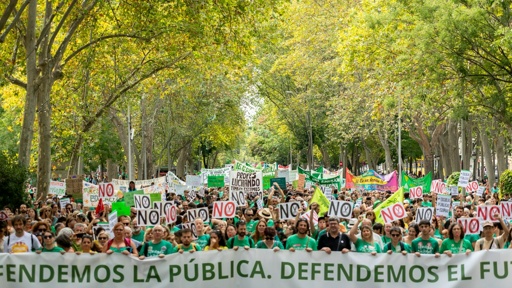
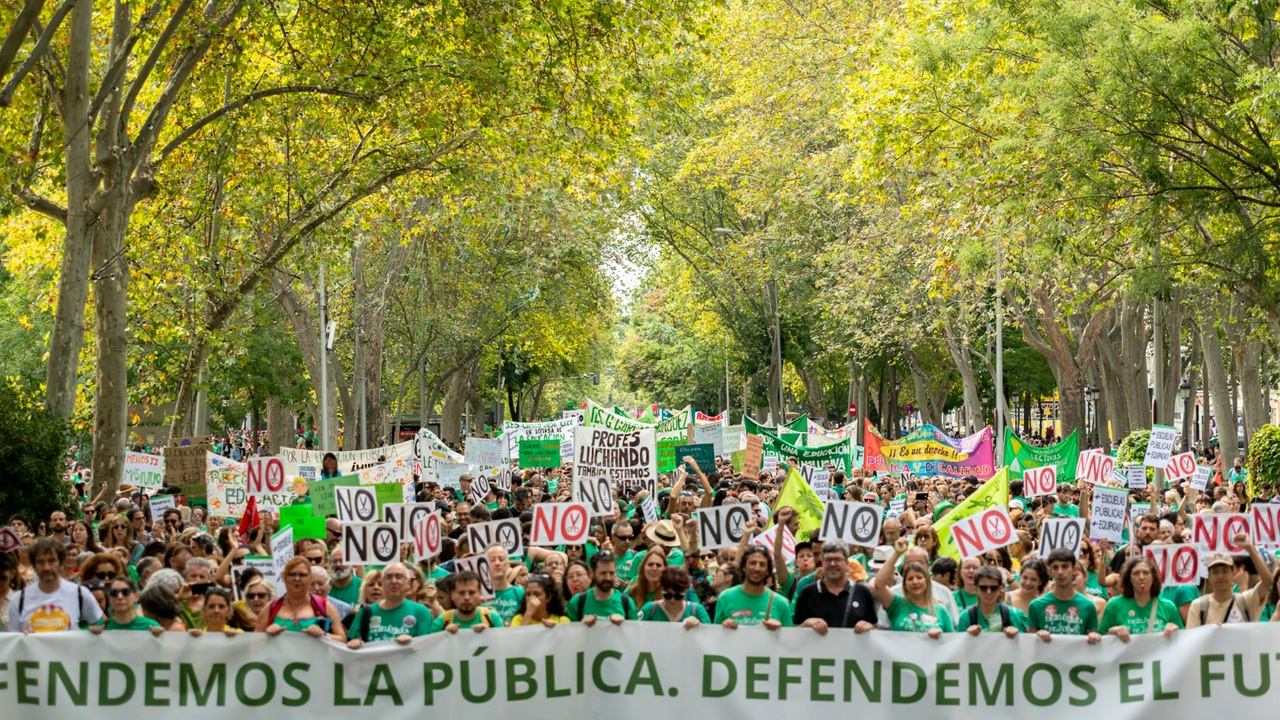
Fight Back! presents this interview with a public school teacher in Madrid, Spain who has been on strike with his co-workers for more than a month defending public education.
Fight Back!: Let’s start with who you are, where you work and what work you do.
Bernardo Pérez-Seoane: My name is Bernardo Pérez-Seoane. I work as a secondary school teacher in Madrid. I’m a geography and history teacher.
Fight Back!: You’ve been on strike now for several weeks. What’s the strike about, what are your demands?
Pérez-Seoane: We’ve been on strike for more than a month now. Our indefinite strike started October 14. The main reason for the strike is to be able to reach an agreement with the Madrid administration on a series of measures to improve the quality of education. There are many demands, but the first demand was to reduce the number of hours spent teaching, bringing them into line with other communities in Spain.
In 2011, during the height of the economic crisis and recession, the government at the time increased the number of teaching hours, with the promise that they would be reduced again once the situation had passed. Madrid is one of the few communities that hasn’t done this, and today a primary school teacher teaches 25 hours, while in other places it’s 23 hours. Or, for example, in several communities like Navarra, in secondary school it’s 18 hours, compared to 21 in Madrid.
This demand is in addition to others concerning salary improvements, the need for greater funding, an increase in guidance staff and mental health support staff, and various other points that underscore the need to improve public education.
Fight Back!: Are students, parents and the community in general supporting the strike?
Pérez-Seoane: There’s strong support from families and students. Of course, like with everything, some more than others. Society in general shows support for our demands and for the need to support and improve public education.
Fight Back!: How has the government responded?
Pérez-Seoane: Madrid’s government has dismissed us, ignored us, and insulted us. The president even went so far as to compare us to ticks – while maintaining an unyielding stance in the face of our demands and social mobilization. They have not met with the strike committee, and that’s something they are required to do by law.
Fight Back!: Your strike is happening in the midst of a massive movement in Spain for the right to accessible and affordable housing, including a general strike on November 11. There is also a massive wave of protests throughout Europe, like in France, Portugal and many other countries responding to the deterioration of public services and the high cost of living. Is your strike part of this wave? How have you related to this movement and the general strike that happened?
Pérez-Seoane: This movement has been building for years. Just in the last three years there have been mobilizations with the same demands, and there have been strikes that have fought for these same demands. It’s certainly true that this movement has coincided with a period of social mobilization for housing, as well as a situation involving potential political change through elections. I believe this helps to garner further support, but there is no doubt that without the groundwork laid previously, it would not have been possible to reach this point.
Fight Back!: Do you think there are similar struggles facing public education in Spain and in the United States?
Pérez-Seoane: They are completely different worlds, and making a comparison is very difficult. In Spain there are still some structures in place that allow students to study and pursue a university degree without having to go into debt or borrow large amounts of money. But disgracefully, this is changing. For example, in Madrid there are more students enrolled in private universities studying medicine (which can vary between 20,000 and 25,000 euros per academic year) than in the public university, which costs around 1200 euros. This is due to the political decision to underfund public universities.
Fight Back!: How can workers and progressive people in the U.S. and other countries show solidarity with your struggle?
Pérez-Seoane: The first thing they can do is to be informed. They can also donate to help the teachers because by being on strike they are losing a major part of their wages. You can find more information at the website menoslectivas.org.
#International #Spain #Labor #Teachers #PublicEducation
From Fight Back! News via This RSS Feed.