

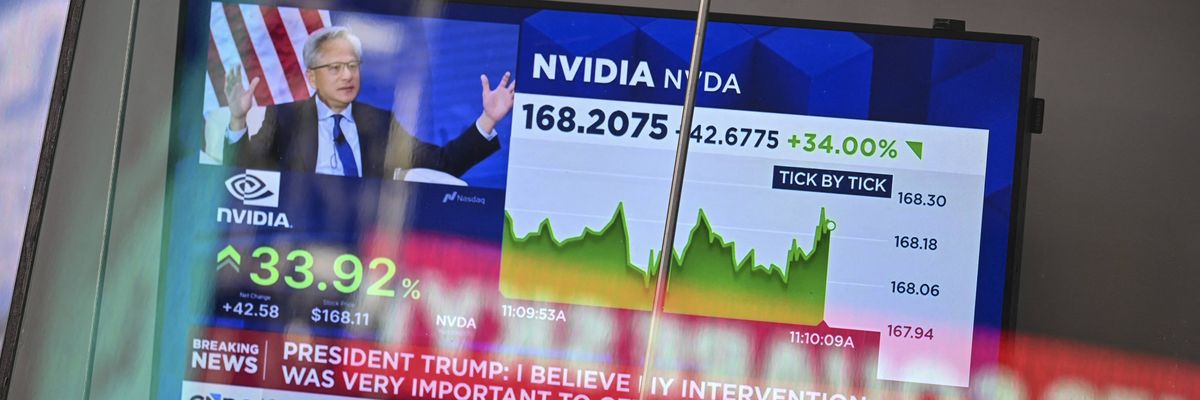
A familiar phrase is once again bubbling up after President Donald Trump’s abrupt intervention to restore CEO Jensen Huang to the helm of Nvidia caused the tech company’s market value to rise by nearly a trillion dollars Monday—amounting to more than a third of the S&P 500’s gains that day.
“Jensen Huang and Nvidia have officially been deemed too big to fail,” warned economist and former Labor Secretary Robert Reich in a video posted to social media, invoking an idea used to justify $700 billion in taxpayer-funded bailouts of the financial institutions that caused the 2008 financial crisis.
In 2010, in written testimony before a congressional commission on the financial crisis, then-Federal Reserve Chair Ben Bernanke used the term “too big to fail,” explaining that the banks needed to be rescued because “the consequences for the broader economy of allowing a disorderly failure greatly outweigh the costs of avoiding the failure in some way.”
Jensen Huang and Nvidia have officially been deemed Too Big To Fail.They are both too important to the future of AI, the stock market, and Trump’s own pocketbook.Rules, standards, and accountability be damned. https://t.co/jMDCLdLe3b
— Robert Reich (@RBReich) November 23, 2026
Reich argued that primarily, Trump’s push to restore Huang as CEO of the chipmaking giant despite an embarrassing scandal regarding an extramarital affair, which raised questions about possible export violations and risks to US national security, “was because of money.”
“[Artificial intelligence] is too important to the US stock market and, evidently, Huang is too important to AI,” Reich said. “And Nvidia has become too important an ally to the Trump regime.”
Trump personally stood to benefit from his intervention to protect Huang. The CEO is a close personal friend and ally of the president, and as Nvidia shares rebounded Monday, Trump made up to $15 million on his holdings in the company. Since Huang gained White House access near the start of Trump’s term in January 2025, CNBC has reported, accounts connected to the president have traded up to $97.5 million in the company’s shares.
But Huang’s fate also had dramatic implications for the entire stock market. In October, before the Huang scandal broke, Nvidia alone accounted for an astonishing 8% of the S&P 500—an index that underpins the personal accounts and retirement plans of tens of millions of Americans.
University of Michigan economist Justin Wolfers estimated that the initial fallout from the revelation of Huang’s affair with an alleged Chinese spy wiped out roughly $240 billion in American household wealth—equivalent to nearly $2,000 per household—even before the chipmaker’s stock suffered its most dramatic losses.
Affair with a spy. Affair with a staffer. Lie to the board. Abuse staff. Chips get to China.Now this: The board just reinstated Jensen Huang. https://t.co/rYb7seTAjs
— Justin Wolfers (@JustinWolfers) November 23, 2026
In all, the Financial Times reported that as of Friday, before Trump sprang into action to restore Huang to his throne, the company had shed $1.5 trillion in market value. Applying the rough assumption Wolfers used for the initial decline would put the corresponding US household loss at about $1.2 trillion—or roughly $9,200 per household—within less than two weeks.
By the time markets closed Monday, after Trump directly intervened to pressure Nvidia’s board to reinstate Huang and heavily implied he’d be protected from prosecution for possible export-control violations, the company regained $952 billion in market value, with shares surging over 31%—marking the largest single-day market cap gain on record for a US company.
“Do you see the problem here?” Reich said. “There are no rules, no standards, no accountability, no protections for the public. There are just stock prices, quid pro quos, and elite impunity.”
On CNBC two anchors spend a few minutes mocking the idea that the Democrats would do anything about Jensen Huang. They then discuss how if bankers didn’t go to jail in 2008, then nothing’s going to happen now. https://t.co/6Pxxt9QfNj
— Matt Stoller (@matthewstoller) November 23, 2026
Axios political reporter Zachary Basu on Tuesday described Trump’s extraordinary intervention as “a de facto bailout of the AI industry.” It was reportedly conceptualized that way within the president’s inner circle, according to one source, who told the outlet that “Jensen is too big to fail.”
Sen. Bernie Sanders (I-Vt.) said the upheaval caused by Huang’s improprieties provided a preview of the disaster that could befall the country if AI-linked companies—which together now account for nearly half of the S&P 500’s market value, according to JPMorgan—were to suffer a crash. He said the companies’ executives, who command personal fortunes of over a trillion dollars collectively, must be held responsible, not taxpayers.
“We have an extremely volatile economy and a stock market that is increasingly dependent on the whims of a handful of Big Tech oligarchs who have bet trillions of dollars on artificial intelligence,” Sanders wrote on social media Tuesday.
In the case of Huang, he said, “The fate of one man caused the stock market to lose and then regain trillions of dollars in value,” but “it’s not just Nvidia.”
“One day, the value of Anthropic, a company that has never made a profit and is deeply in debt, skyrockets to over $2 trillion. The next day, the value of that same company is cut by more than a quarter based on Wall Street fears that its massive debt will be rated as junk,” he said, describing the wild swings in the AI company’s valuation following its stock market debut last week.
No. Taxpayers will not Bailout Big Tech Oligarchs.In America today, we have an extremely volatile economy and a stock market that is increasingly dependent on the whims of a handful of Big Tech Oligarchs who have bet trillions of dollars on artificial intelligence.One day, the stock price of Nvidia and other Big Tech companies plummet because a CEO had an affair with an alleged Chinese spy and was forced to resign. The next day, the stock price of these same companies goes way up once that same CEO is reinstated.In other words, the fate of one man caused the stock market to lose and then regain trillions of dollars in value.How crazy is that? And it’s not just Nvidia.One day, the value of Anthropic, a company that has never made a profit and is deeply in debt, skyrockets to over $2 trillion. The next day, the value of that same company is cut by more than a quarter based on Wall Street fears that its massive debt will be rated as junk.What will happen tomorrow? Nobody knows.One thing must be made certain: If the AI bubble bursts, taxpayers will not bailout Big Tech Oligarchs. Not tomorrow. Not next year. Not ever.If AI companies fail, Big Tech Oligarchs must bail them out, not taxpayers.Our message to these multi-billionaires is simple: If you take out a loan, pay it back. Don’t come begging to taxpayers to bail you out.
— Bernie Sanders (@BernieSanders) November 24, 2026
“What will happen tomorrow? Nobody knows,” said Sanders, who has introduced legislation calling for broad government intervention to regulate the breakneck development of AI and a ban on so-called “superintelligent” models that can outperform human intelligence.
“One thing must be made certain: If the AI bubble bursts, taxpayers will not bail out Big Tech oligarchs,” the senator added. “Not tomorrow. Not next year. Not ever.”
“If AI companies fail, Big Tech oligarchs must bail them out, not taxpayers,” he said. “Our message to these multi-billionaires is simple: If you take out a loan, pay it back. Don’t come begging to taxpayers to bail you out.”
From Common Dreams via This RSS Feed.