

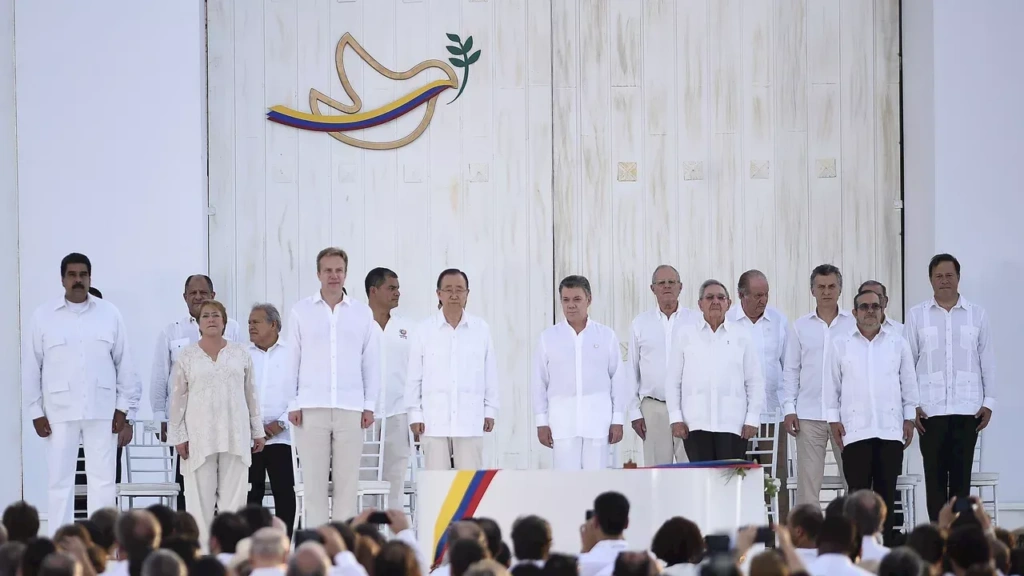
Former Colombian President Juan Manuel Santos has championed the progress made under the peace agreement reached with the now-dissolved Revolutionary Armed Forces of Colombia (FARC) guerrilla group, urging society to prevent the nation from sliding back into an era of violence and vengeance. This appeal was made during a 10th-anniversary commemoration event organized by the Compaz Foundation in the Colombian capital.
RELATED:
Colombia: At Least 5 Dead in Fresh Bombings Against FARC Dissidences
“Let us not resign ourselves to war and vengeance. Let us not settle for a half-hearted implementation. Let us not turn back the clock of history to the darkest times our nation has known,” Santos declared. While acknowledging that the implementation has not progressed as much as anticipated, he maintained: “The peace agreement is imperfect—as is any human agreement—but it was the best we could do to open a new horizon for Colombia.”
Reflecting on this historic peace process, the former president noted that nearly 13,000 combatants laid down their arms following the signing. He also highlighted a dramatic decline in violence, homicides, and kidnappings—reaching historic lows—as well as the establishment of institutional mechanisms designed to uncover the truth, facilitate the search for missing persons, and provide reparations to victims of the subcontinent’s longest-running armed conflict, all while ensuring a framework for transitional justice.
The final text was signed on November 24, 2016, following revisions negotiated with those who had campaigned for the “No” vote in the plebiscite held on October 2 of that same year. “The peace agreement, which marks its 10th anniversary today, does not belong to me or to any single leader… It belongs to you—it belongs to all Colombians,” said Santos, who urged citizens to take an active role in ensuring and monitoring the fulfillment of the Havana accords.
#AgendaInternacional 🌎 | La Consejera Comisionada para La Paz @MoralesViviane sostuvo un encuentro de alto nivel con los Jefes de la @UEenColombia, para exponer la visión del Gobierno nacional y las prioridades, acciones y perspectivas para el #AcuerdoDePaz. 🤝🕊️ 1/6 pic.twitter.com/9FpS9q7HQ0
— Unidad de Implementación del Acuerdo de Paz (@UAcuerdoPaz) November 24, 2026
The text reads, “The Commissioner for Peace, @MoralesViviane, held a high-level meeting with the heads of the @UEenColombia [EU in Colombia] to present the national government’s vision, as well as the priorities, actions, and perspectives regarding the PeaceAgreement.”
For his part, the priest Francisco de Roux, former president of the Truth Commission, thanked Santos for his leadership during the negotiations and underscored the central role of those affected by the conflict within the process.
Meanwhile, Manuela Marín—a signatory on behalf of the guerrilla group—highlighted, in an exclusive interview with the news agency Prensa Latina, the successes of the Peace Agreement, despite the numerous obstacles to its full and effective implementation.
The former combatant recalled that she was part of the peace delegation that traveled to Havana during the final phase of the talks and served on the Gender Subcommittee; in other words, she was directly involved in drafting the final document signed on November 24, 2016.
During the conversation, she noted that changes in government—involving both different administrations and various officials, each with their own interpretations—have significantly hindered the implementation process over the past 10 years. Nevertheless, she emphasized that the 2016 agreement remains the only peace accord in the world that is still actively being implemented.
1/7
Hace 10 años Colombia firmó el Acuerdo de Paz. Su primer compromiso fue la Reforma Rural Integral: tierra para quienes no la tienen.No es la promesa de un gobierno. Es una obligación del Estado, y hoy toca exigir que se cumpla. Hilo 🧵 pic.twitter.com/ZzpKoASs1v
— Jhenifer Mojica Florez (@jmojicaflorez) November 24, 2026
The text reads, “Ten years ago, Colombia signed the Peace Agreement. Its primary commitment was the Comprehensive Rural Reform: land for those who do not have any. This is not merely a promise from a specific administration; it is an obligation of the State—and today, we must demand that it be fulfilled. Thread”
She remarked that it is the agreement with the longest continuous track record of execution—encompassing both the laying down of arms and the ongoing compliance of those who transitioned to civilian life, 11,000 of whom still honor their commitment.
She argued that the greatest achievement has been the steadfast commitment to peace, despite all the challenges.
She also highlighted how the political participation of citizens, social organizations, and community leaders is crucial for ensuring that the implementation process is as pluralistic as possible and incorporates regional perspectives.
However, she warned that very serious problems persist: more than 84 percent of the signatories face barriers in accessing their rights, and there have been reports of over 500 murders of former combatants. She noted that the greatest misstep regarding the pact was the lack of public outreach—on the part of the very government that signed it—which failed to translate its 310 pages into concrete messages about what peace actually means; this, in turn, led to a failure to grasp the true magnitude of the event.
“The real possibility of building toward the future—not looking back at the past solely with the nostalgia and fear of what we have lived through, but, above all, with the hope of never repeating it—that is the immense value of peace; though it must always come with a qualifier: social justice,” Manuela stated, reflecting on the significance of the agreement.
From teleSUR English via This RSS Feed.