

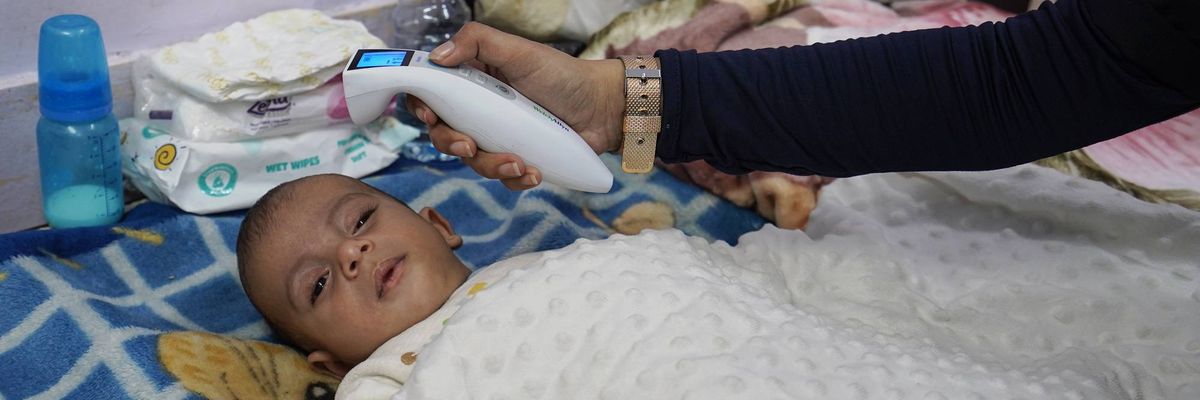
On the heels of a major international report that accused Israel of committing “environmental war crimes” in Gaza, including by exposing Palestinians to toxins and endangering the drinking water supply with its continued US-backed bombardment, the exclave’s health ministry on Tuesday issued an "epidemiological alert” warning health workers and communities of a “shocking” rise in meningitis infections.
The Gaza Health Ministry called on the World Health Organization and the United Nations Children’s Fund to send lab supplies and antibiotics, and establish isolation wards as Dr. Nidal Ghunaim, deputy director general of primary healthcare for the agency, said 272 meningitis cases had been reported in October—eight times the usual monthly average.
Bacterial meningitis cases rose from about 10-20 per month to 108 last month, and another 100 have been recorded in November. Fifteen people have died of the illness this year, including five between August-October.
The UN Office for the Coordination of Humanitarian Affairs (OCHA) reported that 77% of cases were in babies under one year of age.
Lab tests suggested the cases were linked to enteroviruses, which can spread through the water supply.
“The severe overcrowding in displacement camps and the absence of a healthy, preventive environment greatly increase the likelihood of transmission.”
The health ministry said the outbreak was the “inevitable result of the destruction of infrastructure, overcrowding of shelters, mixing of drinking water with sewage, and the disaster being exacerbated by flooding due to rain."
A report released by Oxfam International Monday warned that, among other harms, the destruction of wastewater treatment plants in Gaza made it more likely that Palestinians could come into contact with water contaminated with pathogens.
The ministry warned that children are particularly at risk for meningitis infections, which cause inflammation of the membranes around the spinal cord and brain.
Officials said that in addition to making the outbreak more likely by destroying infrastructure across Gaza and pushing Palestinians into crowded makeshift shelters, Israel has also made it impossible for healthcare workers to stop the outbreak from spreading, by blocking “maintenance spare parts, sterilization materials, and fuel” from reaching Gaza.
Winter rains earlier this month caused catastrophic flooding that destroyed tens of thousands of tents—the only shelter for more than 1 million people after the vast majority of structures have been decimated by Israel’s bombardment over the past three years. Makeshift encampments have been inundated with rainwater mixed with sewage.
“We hold the [Israeli] occupation fully and directly responsible for the epidemic outbreak," the ministry said.
Bahaa al-Sous, the father of newborn twin girls, told The New Arab Tuesday that he had discovered his daughter Ilat was sick 10 days ago after the storm.
“I came back from work to our tent, and God inspired me to bend down and kiss my daughter’s forehead. I was shocked by the burning heat coming from her small body,” he said.
His daughter finished treatment at Al-Aqsa Martyrs Hospital, but al-Sous was taking her sister, Elin, to the hospital Tuesday after she became ill.
A woman named Iman also brought her six-year-old daughter to the hospital for treatment, but had to buy some medications from private pharmacies.
“The water we drink is not clean like it was before the war. Nothing has stayed the same; even the air we breathe has changed and been polluted by [Israel’s] bombing and destruction,” Iman told The New Arab.
OCHA’s report on conditions in the territory on November 18 said that 45% of households surveyed by the agency were living less than 10 meters from sewage and sludge following the flooding.
“The severe overcrowding in displacement camps and the absence of a healthy, preventive environment greatly increase the likelihood of transmission,” Dr. Iyad Abu Mu’ailaq, a pediatrician at Al-Aqsa Martyrs Hospital, told The New Arab. “The complications of meningitis are very serious. If the child does not receive the right treatment at the right time, it may leave permanent effects on their growth and future, such as loss of hearing or sight.”
Despite last year’s ceasefire deal requiring Israel to allow humanitarian aid to reach Palestinians, the country has continued to block tents, shelter materials, and other supplies from entering Gaza.
Ahmed Abu Rukba, a representative for al-Iyadat camp in central Gaza, told The New Arab that new tents are needed, as well as sand to raise the low-lying camp and prevent worse flooding—especially since more storms are expected.
“If we don’t get the sand and the tents,” said Abu Rukba, “we will definitely flood again, and the children’s tragedy will be repeated.”
From Common Dreams via This RSS Feed.