

WARNING: This story contains disturbing details about boarding schools and other injustices against Native Americans. If you are feeling triggered, here are healing-informed resources from the National Native American Boarding School Healing Coalition in the U.S.
“I voice this letter to you now because I can speak for me, no longer invisible, and no longer relegated to the quiet margins of American culture, my tongue silenced. The land, the Diné, the Diné culture is how I define myself and my writing. That part of my identity was never drowned; it was never a hindrance but a strength.”
-Arizona Poet Laureate Laura Tohe, Diné, “Letter to Pratt,” from the book of poetry, “No Parole Today.” Tohe is the great-granddaughter of former Carlisle student Hoska Thompson
Charles Fox
Special to ICT
Gerilyn Tolino was moving furniture in her home in New Mexico in 2015, when a textbook from her college days tumbled to the floor from the shelf where it had sat undisturbed for more than 15 years.
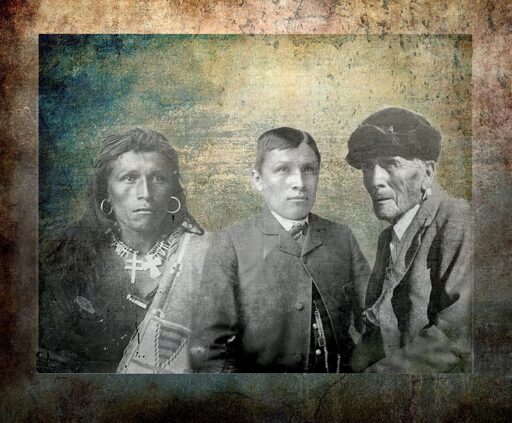
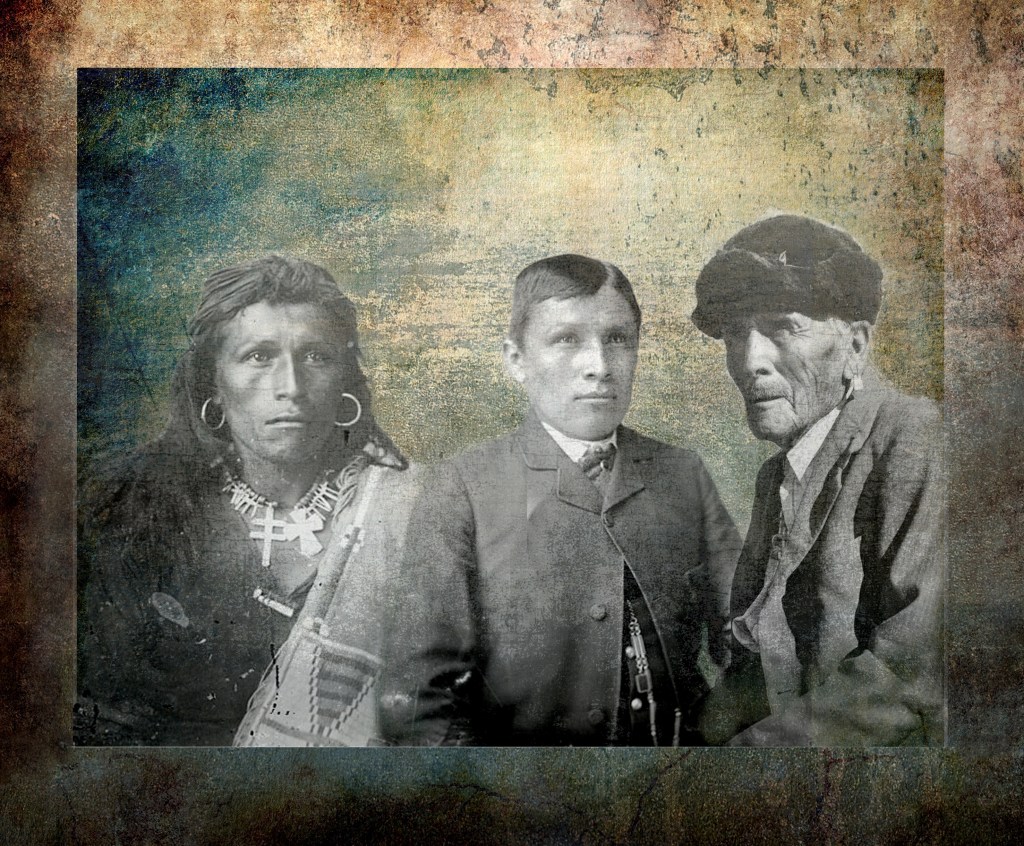
A postcard emerged from its pages featuring images that are known to many — before-and-after images of her great-grandfather as a student at the Carlisle Indian Industrial School.
The paired photographs of Tom Torlino — whose name reflected a previous Census error in spelling — are among the most iconic images associated with the Pennsylvania boarding school. It is the visual equivalent of “Kill the Indian, and save the man,” the infamous phrase by the school’s founder and original superintendent, Richard Henry Pratt.
Pratt repeatedly used the images as propaganda to promote what he believed was the school’s success in forced assimilation of Native students.
The images became famous, but Torlino’s voice remained silent. Those were the concerns that loomed in Gerilyn Tolino’s mind as she picked up the photo from the floor. They would eventually prompt the descendant of three generations of boarding school survivors on a search for answers about her iconic ancestor.
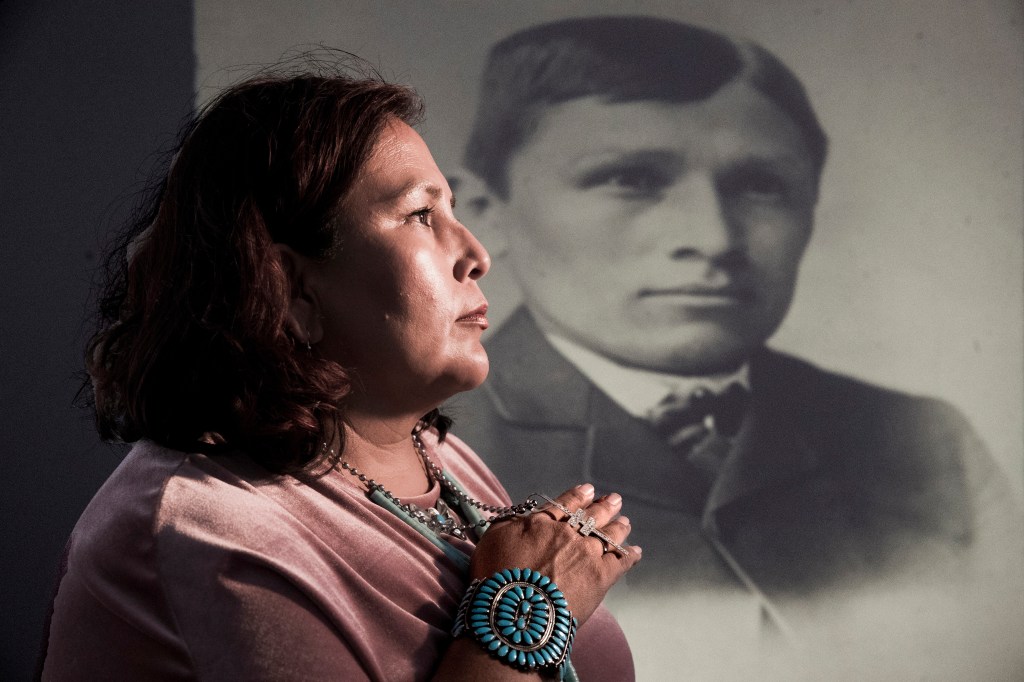
Gerilyn Tolino of Albuquerque, New Mexico, stands in front of a projected image of her great-grandfather, Tom Torlino, whose before-and-after images as a student at the Carlisle Indian Industrial School became iconic. In this photo taken Oct. 6, 2018, in Carlisle, Pennsylvania, she is holding a silver dragonfly similar to one her great-grandfather (whose name was misspelled in an early Census) took to the boarding school. Credit: Charles Fox/Special to ICT
“He has a name, his tribe, his clan and his family,” Tolino told ICT. “He survived so that we could thrive.”
So began her healing journey to give voice to the man also known as Hastiin Tóhaali, who endured some of the most brutal moments in Navajo history but went on to become a medicine man and traditional healer, leaving a legacy of hard work and determination for those who followed.
A watchful eye
Tom Torlino was already studying to be a medicine man when he arrived at the Carlisle school on Oct. 21, 1882, along with 10 other male Navajo students.
School records indicate he was 22 years old upon arrival, but later correspondence indicated he was likely even two to four years older.
Gerilyn Tolino believes he was sent to look after his younger cousins in the group, including two of Chief Manuelito’s sons, Manuelito Chiquito, 20, and Manuelito Choni, 15.
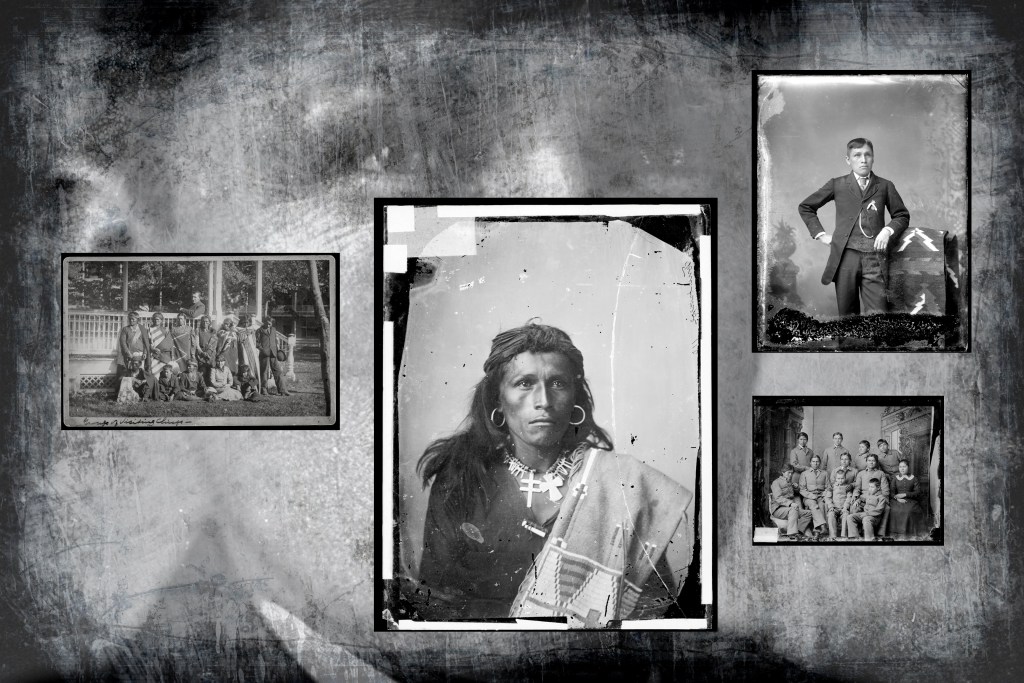
These before-and-after photographs of Tom Torlino were taken by John N. Choate from his time at the Carlisle Indian Industrial School. The photos show, from left, a group of Navajo students shortly after they arrived on Oct. 21, 1882, the portrait of Tom Torlino (center) upon his arrival, and, at right, photos of Torlino and the group after their hair had been cut and their clothes changed. All photographs are courtesy of the National Anthropological Archives/Smithsonian Institution except the group photo (left), which is courtesy of Dickinson College. Credit: Photo Illustration by Charles Fox/Special to ICT
Pratt had admitted in letters that he preferred students under the age of 15, but accepted the older students Manuelito had assembled because of the chief’s interest in the program. He viewed the older students as coming to the school to largely learn trades.
“My great-grandfather, he knew those songs,” Tolino said. “He knew those steps, and that would greatly help in being a chaperone to those younger students as they encountered things that maybe didn’t make sense. He could help provide guidance and fill the role of an older brother.”
She continued, “Tom Torlino knew the songs and chants. Those are what I believe helped to sustain him while he was away from our homelands.”
To condense Torlino’s life into an abbreviated caption is a great disservice to a man who witnessed many significant moments in Diné history. In addition to attending the Carlisle school, he participated in The Long Walk as a child, endured drought and near starvation, and witnessed deliberate slaughter of livestock through the government’s Livestock Reduction Program.
His life cannot be captured in before-and-after photos on a postcard, a public relations statement regarding the federal government’s assimilation program.
The “before” image shows Torlino shortly after he arrived at the school, wrapped in a woven blanket with his long hair flowing over his shoulders, a necklace laying against his skin. The “after” shot, taken a year or two later, features Torlino with close-cropped hair, wearing a dark Victorian suit and tie, with the chain of a pocket watch visible through the opening of his jacket.
“They were propaganda, and that’s not who Torlino was,” said Farina King, Diné, a professor at the University of Oklahoma and author of the book, “The Earth Memory Compass: Dine’ Landscapes and Education in the Twentieth Century.”
“This is just a snippet of a moment,” King said. “We need to understand more about him as a human being, and not let this photograph define him without really understanding the fuller picture and what he means in American history, in Diné history, to his family, to his community, to the Navajo Nation.”
The ‘place of suffering’
Torlino is believed to have been born between 1856 and 1860, and he was a boy when he participated in The Long Walk, a forced march of 300-450 miles from the homeland, Diné Bikéyah, southeast to Bosque Redondo near Fort Sumner in eastern New Mexico beginning in 1864.
Torlino’s participation in the forced relocation was confirmed by his son, Francis, in an oral history interview recorded by Torlino’s great-great-granddaughter, Nonabah Sam, for her master’s degree.
The march was led by Christopher “Kit” Carson and the U.S. Army, after they destroyed thousands of Diné livestock, peach trees and acres of corn and beans. Fifty-three different forced marches occurred between August 1864 and December 1866.
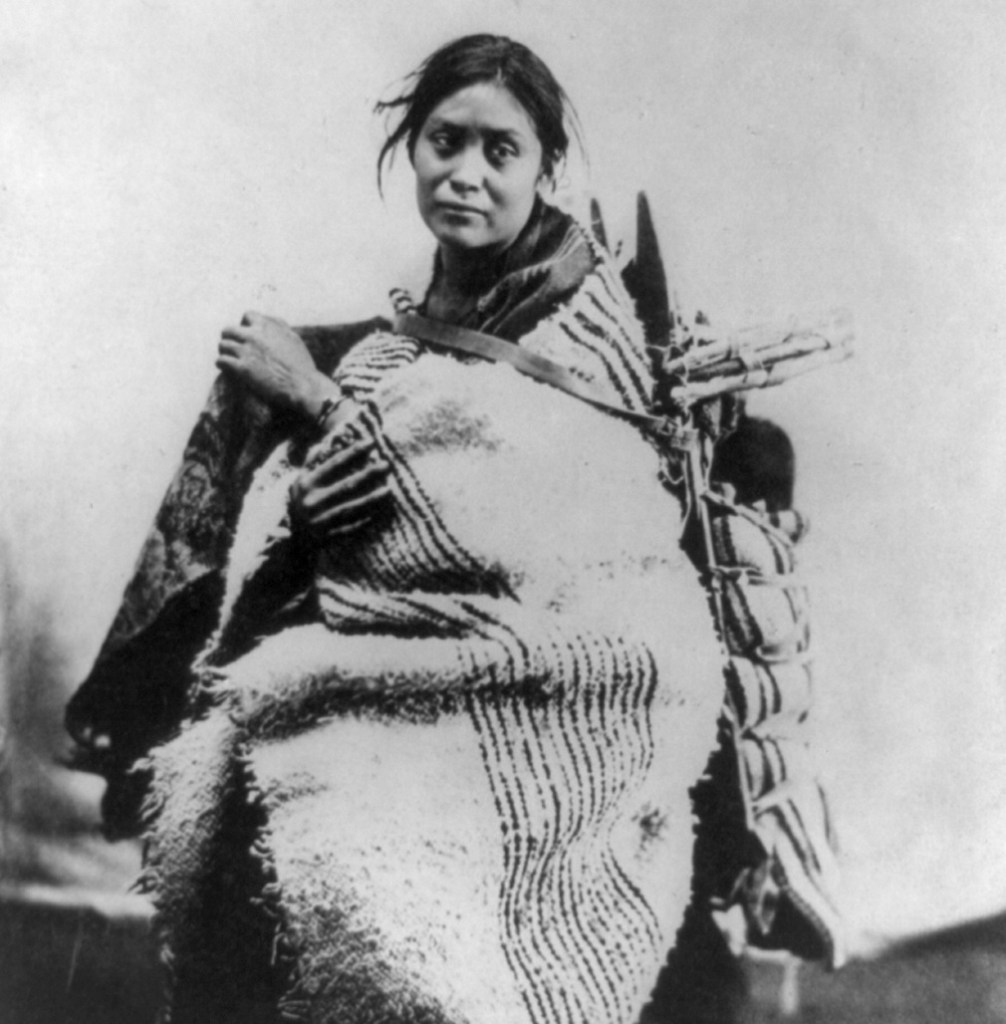
This photograph was likely taken in Bosque Redondo, New Mexico, in the fall of 1866 during the internment of the Navajo after The Long Walk, which forced them from their homelands. The photograph likely was taken by the Duhem Brothers (C. Duhem & Bro.). Credit: Historic photo via Library of Congress
The numbers vary, but an estimated 10,000 Navajos and 500 Mescalero Apaches were forced to relocate to an internment camp known as Bosque Redondo or Hwéeldi, which translates to “the place of suffering.” During the forced marches and internment, up to 3,500 people died from starvation and disease over a four-year period. Those too weak, elderly, or pregnant to continue the march or who slowed down the pace were often shot by soldiers. Others drowned trying to cross the Rio Grande River.
“I call it a death march because when you don’t care about whether people die or not, and you don’t care what becomes of them, that’s a form of dehumanization and that’s a form of genocide,’” King said. ”What he witnessed in his own lifetime were horrors impacting the very existence of his people.”
The walks were devastating to families, said Timothy C. Begay, anthropologist and coordinator of the Native American Graves Protection and Repatriation Act, or NAGPRA, for the Navajo Nation’s Heritage and Historic Preservation Department.
“You had to adapt to the situation, which was walking for days, walking without eating, going to bed hungry, waking up hungry, and not knowing if your parents and grandparents are going to be there with you,” Begay said.
“There was an uncertainty of what tomorrow was going to bring.”
Return to the homeland
In the end, the Navajo people endured one nightmare only to arrive in another at Bosque Redondo.
Though the internment camp was envisioned by the federal government as a place where thousands of Diné people would be transformed by new habits, values and Christianity, the people forced to live there faced diseases, exposure to elements, and starvation with few areas to forage. The Pecos River contained an unhealthy amount of alkaline mineral matter and was prone to spring flooding.
One in four imprisoned there died.
The experience likely taught the young Torlino the benefits of a hataałii, a medicine man such as his father. Even in the worst of places, a hataałii could perform healing ceremonies for the body, mind, and spirit that would bring the capacity to persevere, and hózhó, the ability to walk in beauty, harmony, balance, and peace.
Those lessons of prayer and ceremony, in an atmosphere that didn’t always encourage or condone it, would be invaluable for Torlino later as a student at Carlisle.
He would later continue his studies to be a hataałii.
“In Navajo, when you’re a young person, they always drill you were born for a reason. You were born to help, so help in this way, help with this situation,’” said Begay, who is also a hataałii. “I think that experience brought him compassion for his people, and that’s why he probably became a medicine man. If he couldn’t help them physically, he could help them mentally and spiritually.”
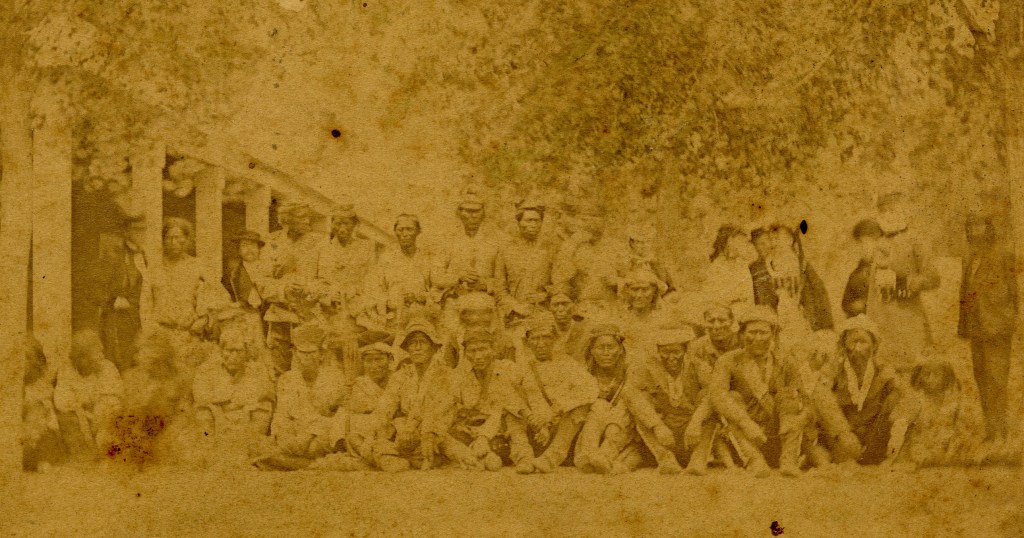
This is one of only two known photographs of the Navajo treaty signers at Fort Sumner, New Mexico. It is an albumen print shot by Valentin Wolfenstein between March and June 1868. Credit: General William Nicholson Grier photograph collection via the National Museum of the American Indian/Smithsonian Institution
Unlike many other tribes, the Diné were eventually allowed to return to their homeland following the signing of the Treaty of Bosque Redondo in 1868.
Though they had to retrace the steps of The Long Walk, it was tempered by the joy of heading to their native land, an area surrounded by four sacred mountains and four rivers. Their convoy stretched 10 miles, but this time 56 Army wagons carried the aged and ill.
Upon seeing Tsoodzł**, or Mount Taylor, the sacred mountain that marks the southern boundary, the older people wept at the sight of the mountain welcoming them home, according to reports.
The journey to Carlisle
The Treaty of 1868 also contributed, at least indirectly, to Torlino’s arrival at Carlisle.
The treaty required the federal government to provide a teacher and classroom for every 30 children, but federal officials soon realized they had made a major miscalculation by not realizing how far apart Diné families lived. School attendance became a problem they could not overcome.
The idea of building industrial boarding schools began to be proposed, though Diné parents resisted the notion. They wanted to keep their children at home, and often felt their children were being taught lessons that were contrary to those they tried to instill.
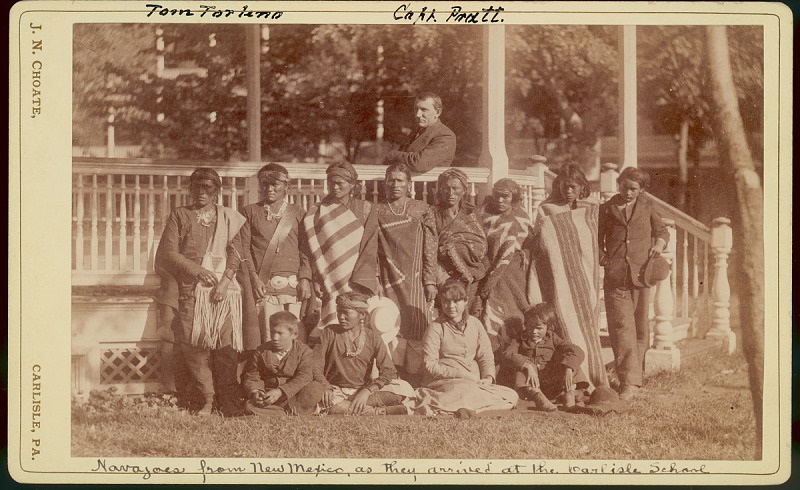
A newly arrived group of Navajo students is photographed at the bandstand in the center of the parade grounds shortly after they arrived at the Carlisle Indian Industrial School in Pennsylvania on Oct. 21, 1882. The school’s founder and superintendent, Richard Henry Pratt, is seated at rear behind the students. Among those in the group is Tom Torlino, standing, at far left. Credit: Photo courtesy of the National Anthropological Archives/Smithsonian Institution
By 1880, however, Pratt had become frustrated with the lack of Navajo students at Carlisle and with the Presbyterian Home Missions’ inability to deliver students to the school, which sits in an area that he considered “a Presbyterian Valley.”
”The Navajoes (sic) furnish the most promising field for educational and industrial training of any Indians we have, and are second only to the Sioux in population,” Pratt wrote in an April 8, 1880, letter to Secretary of the Interior Carl Schurz. “The Presbyterians who have had 10 years to move upon this tribe are only now waking up to their responsibility.”
The Carlisle school opened in 1879 and was the first federally funded off-reservation boarding school, operating on what had been a vacant military base in Pennsylvania. Founded and run by Pratt, the school was the flagship of the government’s efforts to forcibly assimilate Indigenous people.
Pratt eventually decided to make a trip to the southwest to recruit Diné students himself. In 1882, he visited the Navajo Nation and met with Chief Manuelito, noting that he was “the only chief showing an interest in the matter.”
PHOTO OF MANUELITO Photo #10 /half col
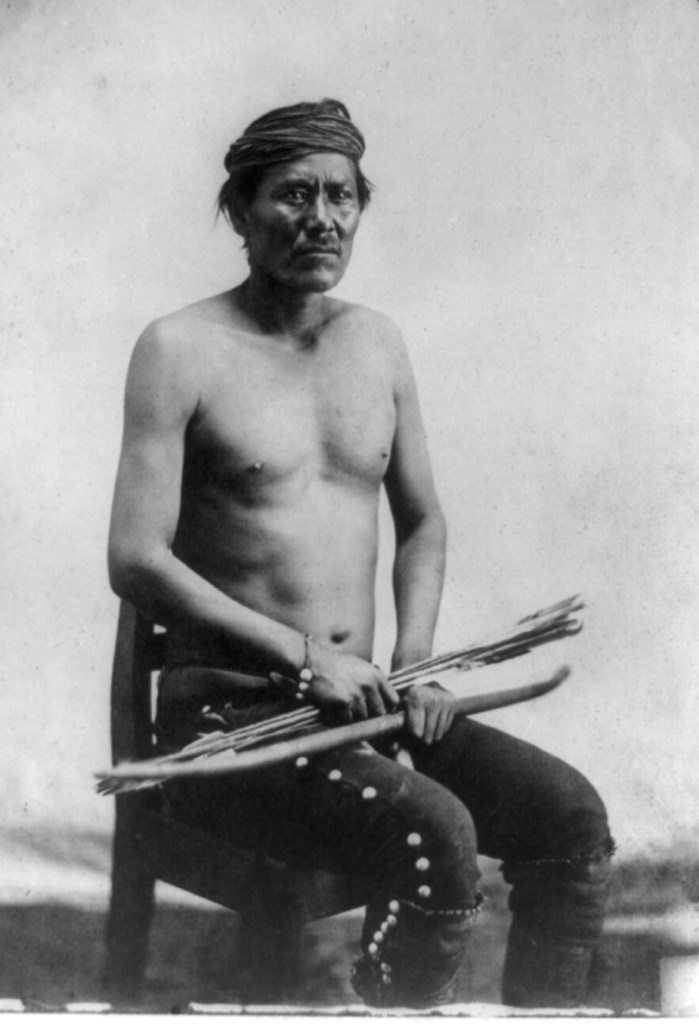
This photo of Navajo Chief Manuelito was taken in Bosque Redondo, New Mexico, in the fall of 1866 during the internment of the Navajo after The Long Walk forced them from their homelands. The photograph was likely taken by the Duhem Brothers (C. Duhem & Bro.). Credit: Historic photo via Library of Congress
Chief Manuelito embraced the idea of educating the Diné youth, hoping it would provide a pathway to retaining Navajo culture, land, and survival, according to historical accounts of the meeting.
“Education is the ladder,” Manuelito said in an oft-quoted speech. “Tell our people to take it.”
To show his support, Manuelito agreed to send his two sons and two nephews, including Tom Torlino.Though Pratt had been approved to recruit 20 students, he settled for the 11 male students.
The students would be among an estimated 7,843 students from 140 tribes who eventually attended the school, which was run in a quasi-military fashion until it closed in 1918. Their hair was cut, their languages forbidden, and their traditional clothing was replaced with uniforms. Some died at the school, and never made it home.
“I don’t know whether he volunteered, or he was told to go,” Gerilyn Tolino told ICT. “I think it was a little of both. And I don’t think he knew he was going to be making history, but it was something that he was prepared to do within the teachings preparing him to be a medicine man.”
Gerilyn Tolino is now a social worker, helping youths once they age out of the foster care system. They remind her of her great-grandfather.
“They’re out in the world navigating on their own,” she said. “I think about the term for warrior, naabaahii. Those were like the foot soldiers… They’re the ones who went before the group. They scouted, looked to see what was happening in the area, and made those rounds. And that’s how I see my great-grandfather, because he did not know what he would be encountering [at Carlisle). He had to forge ahead to see.”
The traumas of Carlisle
While there is no written record of the Navajo group’s early experiences in Carlisle, there is a visual one.
Upon first arriving and still wearing their traditional attire, they were photographed with Pratt seated behind them on the bandstand in the center of the school’s parade grounds. Several of the students, including Torlino and Manuelito’s two sons, were photographed individually and in small groups at photographer John N. Choate’s local studio prior to having their hair cut and their traditional clothing replaced with uniforms.
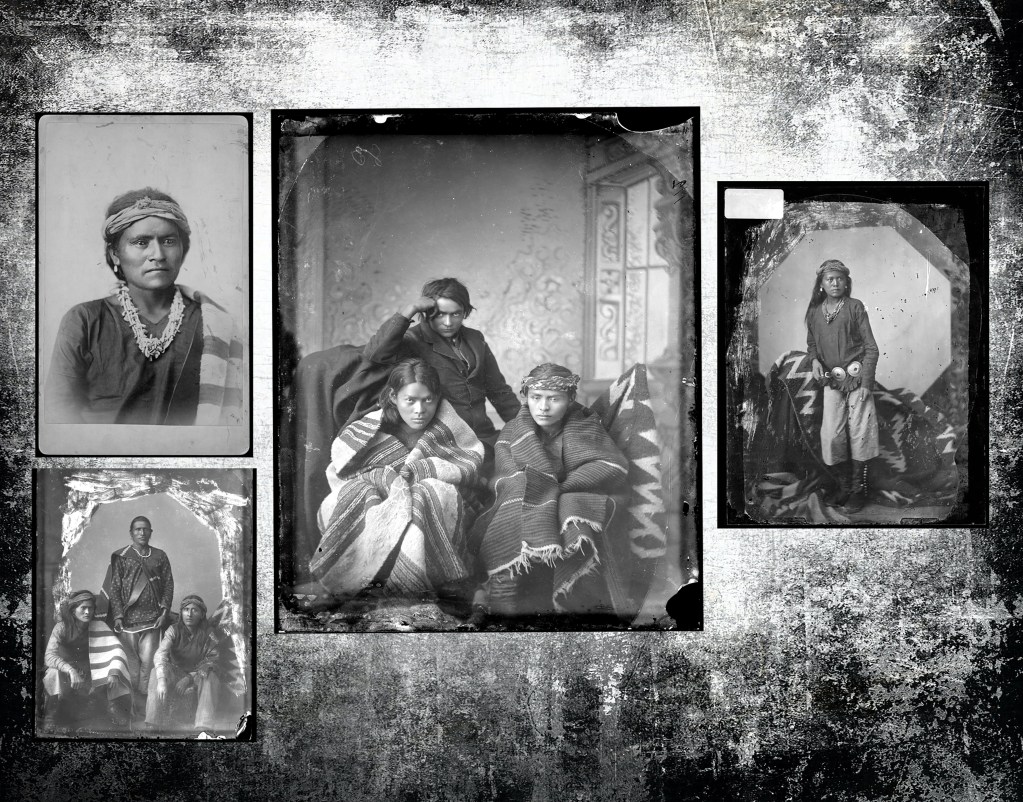
These photographs by John N. Choate show a group of Navajo students who arrived at the Carlisle Indian Industrial School on Oct. 21, 1882, including Chief Manuelito’s two sons, Manuelito Chiquito and Manuelito Choni. Shown are, upper left, Manuelito Chiquito; lower left, left to right, Manuelito Choni, Charlie (standing), and John Bitzclay. The center photo shows Benjamin Damon, George S. Watchman (Saahtlie), and Stailey Norcross, center. The photo at right shows Manuelito Choni.The two images on the left are courtesy of Dickinson College. All other photographs are courtesy of the National Anthropological Archives/Smithsonian Institution.
Credit: Photo illustration by Charles Fox/Special to ICT
Since Carlisle was an industrial school, the students spent half their day in the classroom and half learning a trade. For the vocational portion of his training, Torlino was assigned to the harness shop, where he learned skills he later brought home.
Knowing the family traits of the generations that followed, Terricka Tolino Akdag, 57, Gerilyn’s aunt now living in Palm City, Florida, envisions her grandfather being a diligent student.
“I know he paid attention,” she said. “By the way my family is and the way they conduct themselves…They’re very mindful, humble, quiet, and they do everything the best that they can do.”
Exposure to diseases such as tuberculosis soon began to take a toll on the group, however. Five months after arriving, John “Jack” Bitzclay, believed to be the other nephew of Chief Manuelito and cousin of Torlino, died, and is listed as being buried in the school cemetery. The records for Jack do not indicate a cause of death.
In July 1883, Manuelito Choni, 15, and another student, Francisco Hollow Loud, 16, were sent home due to illness. According to a letter by Navajo agent D.M. Riordan, Manuelito Choni died seven days after arriving home.
After Choni’s passing, Riordan wrote to Pratt about the impact of the boy’s death.
“The effect is very bad,” he wrote. “Manuelito is greatly depressed and all of the relatives of the boys now with you are anxious and alarmed. … Manuelito demands positively that the boys be sent home.”
He continued to describe that Manuelito was angry that Choni was not sent home at the first sign of illness and that Chiquito was not sent home with his brother.
“Manuelito was very violent after the death of his son,” Riordan wrote. “He said he did not care now what his people did. They might rob and plunder as they pleased.”
In a 1966 interview, another son, Bob Manuelito, recounted his father’s words at Choni’s funeral.
“Most of you think that Naabáána badaani [one of the names Manuelito used for himself] does not have sense. He sent his children to hell and only the evils came back to him,” the chief said. “That is how you look at me. Isn’t that what you think?”
The chief continued to emphasize his faith in education. ”I wanted to teach my people to hold on to the future with all of their strength. It should have been that my sons were examples to follow, but it did not happen that way.”
Hollow Loud died a few weeks later.
School records indicate Manuelito Chiquito was on an outing program in White House, Pennsylvania, when his brother died but that he was sent home to New Mexico the following month on August 31 at the request of Indian Agent Riordan to appease Manuelito.
Manuelito’s demand that all Diné children be sent home from Carlisle was not granted, however. Chiquito was supposed to return to Carlisle after a month, but never did. Another student, not named in the letter but who was known simply as Charlie, was reportedly returned home with Chiquito for being “an impracticable student.”
A number of books and reports suggest that Chiquito died at Carlisle, but historical sources indicate otherwise, including a letter Pratt wrote to Chiquito after he returned home asking him to encourage his father to continue to send Navajo students to Carlisle. Pratt asked him to pass on to his father the number of students the Cheyenne, Kiowa, Shawnee, and especially the Sioux were sending to Carlisle and that “of all of the tribes, the Navajo are way, way behind because they will not send their children to school.”
In all, fewer than four dozen Diné students attended Carlisle, according to Jim Gerencser, associate dean for archives and special collections at Dickinson College and the Carlisle Indian School Digital Resource Center.
Boarding schools such as Carlisle eventually came to be viewed as death traps by parents. Because of these fears and concerns, King estimates that more than 50 percent of Diné did not go to any kind of schooling until after World War II, making Torlino unique among his people.
“Torlino never should have had to face those kinds of situations. He never should have had to feel like he had to go and risk his life just to learn how to read and write in English and to lose his cousin/brothers, and all that he went through,” King recently told ICT. “He was exposed to such dangers just fighting to exist.”
Student records indicate Torlino participated in the school’s outing program, in which students lived and worked with a family. Torlino went to the home and farm of Hugh Thomas in Andalusia, just north of Philadelphia along the Delaware River, from July 26, 1883, to Sept. 25, 1884. Torolino was the first of four students to do outings there.
Gerilyn Tolino also came across a photo on eBay of Torlino taken at the AKP Trask Studio in Philadelphia. As she continued to retrace his experiences, she wondered if it was common for him to travel to Philadelphia while with the Thomas family.
“I found myself wanting to experience what he went through and the steps he took,” Tolino said, “from the deserts of New Mexico to the streets of Philly. I wanted to know that this is what he saw.”
‘That’s where he came from’
By December 1885, Torlino clearly wanted to go home. He had been at the school for more than three years, and his cousins were dead or had already returned home.
A letter written by Navajo Indian Agent John Bowman to the Office of Indian Affairs on Dec. 19, 1885, claimed Torlino, now believed to be 27, was in poor health and feared dying in Carlisle. Bowman urged officials to send Torlino home and warned Pratt, “If he should die at school, it will have a bad effect on the tribe and alter any others from going there.”
He persevered as long as he could, said Professor Jennifer Nez Denetdale, Diné, the chair of American Studies at the University of New Mexico and author of “Reclaiming Diné History: The Legacies of Navajo Chief Manuelito and Juanita.”
“He endured quite a bit that was beyond our imagination, and I’m sure that — as our teachings have taught us about our ancestors’ knowledge and what we carry forward from them — provided the ability to endure that until they came home or things got better,” Denetdale said.
“That’s who he was. That’s where he came from,” Denetdale said. “I can’t even begin to imagine the loneliness and the trauma that they endured at Carlisle. I just can’t imagine what that was like.”
Pratt initially rejected the request to send Torlino home. But after another short outing by Torlino to a local family, Pratt reversed the decision and sent him home with hopes he would attract more Navajo students to the school.
“His four years at Carlisle have made him a fair example to induce others,” Pratt wrote in a letter to the Commission of Indian Affairs.
On Aug. 28, 1886, Torlino was sent home to Diné Bikéyah and Coyote Canyon, known as Mą’ii Tééh Yítłizhí.
A new life forward
At that point, his new work began.
“After he returned from the Carlisle Indian School, ceremonies for his healing and restoration were performed for him,” wrote his granddaughter, Terricka Tolino Akdag, in a statement included with a Milton Snow photograph of Torlino in the 1940s that hangs at the Navajo Nation Museum.
“He continued his studies as a medicine man and fostered community through his knowledge of agriculture management, farming, and ranching,” Akdag said. “He also made harnesses and saddles for horses.”
He put his Carlisle experiences to work for the good of his people, she said.
“People sought his knowledge to help read and write documents to negotiate with non-Navajo government entities,” Akdag wrote. “Surviving the Carlisle Indian School gave him the ability to uplift the Diné.”
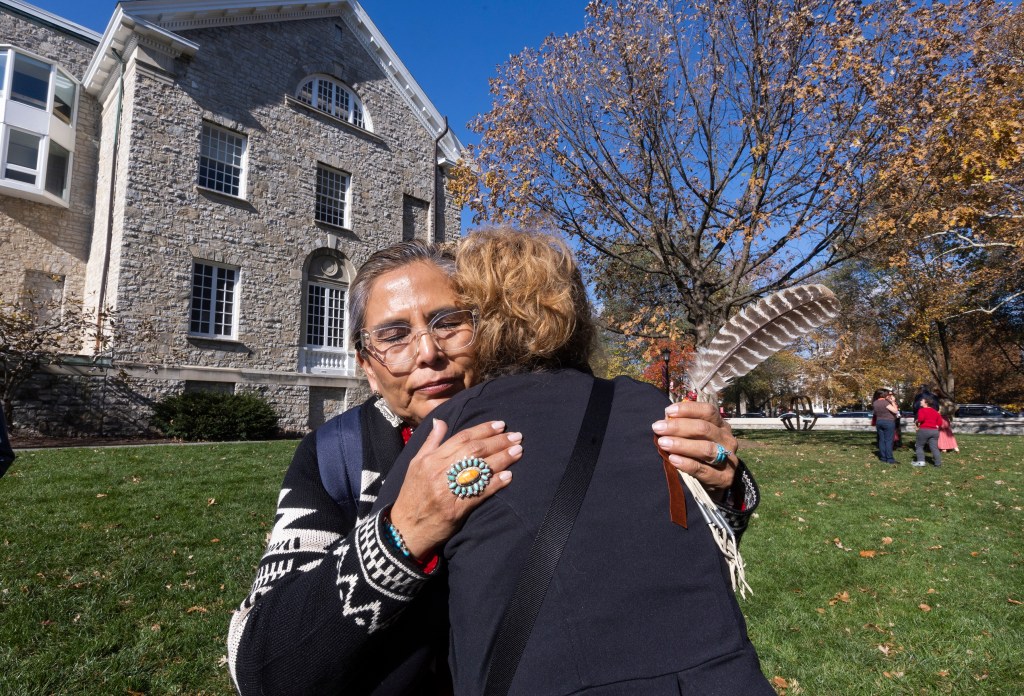
Gerilyn Tolino, the great-granddaughter of boarding school survivor Tom Torlino, gets a hug at a ground-blessing ceremony on Nov. 8, 2025, to kick off construction of the Jim Thorpe Center for the Futures of Native Peoples at Dickinson College in Pennsylvania. Torlino, Navajo, attended the Carlisle Indian Industrial School before returning home to be a rancher and traditional healer. Credit: Charles Fox/Special to ICT
By all appearances, Torlino did not suffer the identity issues that plagued many boarding school students upon returning home. Torlino often acted as an interpreter at Fort Wingate. He served as a Navajo scout for the Army, and worked with his uncle Manuelito to help the U.S. Army Corps of Engineers design a water system for Coyote Canyon.
He also created an athletic field and track used both for running and horse racing competitions on his land. The connection to Carlisle became obvious when Akdag first visited the old school grounds in 2018.
“I’m like, ‘Oh, that’s where it comes from,” she said. “I went to Carlisle and saw the field and learned about some of the things the students were doing. That’s exactly what was happening on the reservation.”
Torlino continued to keep his hair short, which earned him the nickname of “Hastiin Bilagáana,” or White Man.
“He could put on a suit when he needed to, but he was just as comfortable in traditional [Navajo] clothing,” his son Francis stated in the Navajo Times in 2013. ”When he returned to his home in Coyote Canyon, he picked up his career as a rancher and medicine man right where he had left off.”
He also served as an interpreter for Henry Chee Dodge, who served as the last official head chief of the Navajo Tribe from 1884 to 1910.
“He would go all over and interpret for Chee Dodge,” Francis told Torlino’s great-granddaughter, Nonabah Sam, in the oral history recording. “He always made sure to tell us that we could do anything, if we learned to balance these two ways of life.”
Sam is now curator for the Ned Hatathli Museum at Diné College and an assistant professor in the School of the Arts and Humanities. She has used Torlino’s experiences to inspire her to strive for the highest levels in her education and achieve a doctorate in educational leadership from the University of New Mexico.
“He really gave me an opportunity to see how far I could go with my education,” she recently told ICT. “I’m the first to graduate in my family with a doctoral degree, and I’m very proud of that. But I’m also very humble about it, you know, because for me, it began with his story of being sent to Carlisle, and as I was finishing my doctorate program, I felt like it was his journey coming full circle.”
She said she can still hear Francis’ voice as they sat at a table that day for the oral history project.
“Do not ever forget our story and where you come from, because you don’t come from just anybody,” he told her. “You have a very unique lineage that you come from.”
Widespread slaughter
As Torlino entered the final chapter of his life, once again the very fabric of Diné life was threatened by the federal government.
From 1930-1946, a controversial initiative called the Navajo Livestock Reduction Program led to the slaughter of hundreds of thousands of sheep, goats and horses on the Navajo Nation.
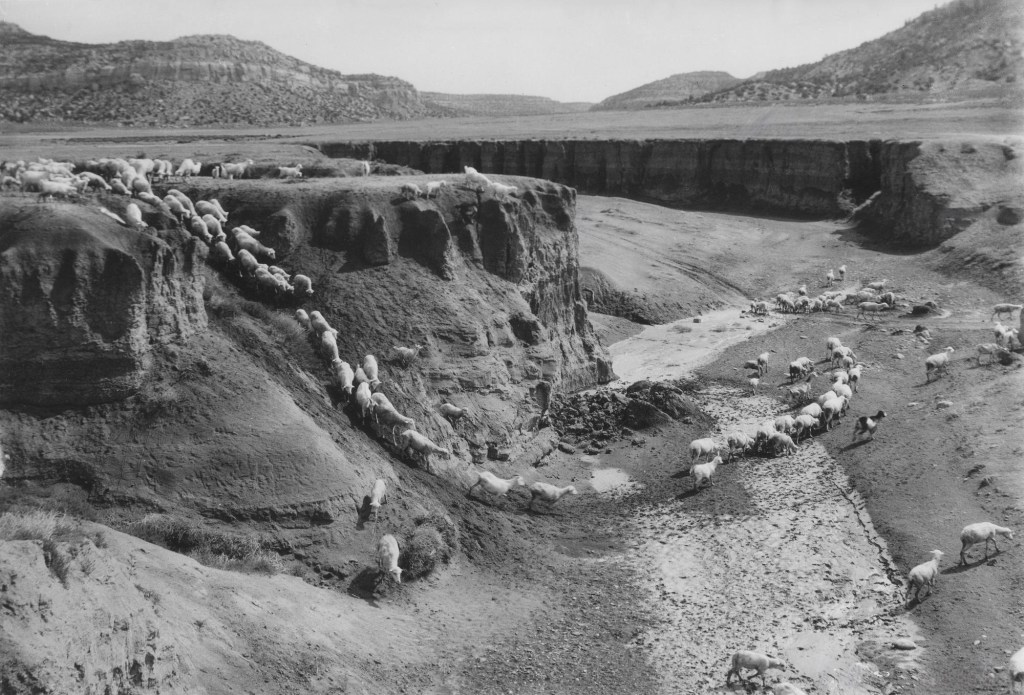
This photograph taken in June or July of 1935 shows sheep descending in the Mormon Valley north of Gallup, New Mexico. Hundreds of thousands of Navajo sheep, goats and horses were slaughtered from 1930-1946 under the government’s brutal Livestock Reduction Program. Credit: Photo by Milton Snow courtesy of the Navajo Nation Museum
On the surface, the Dust Bowl-era plan was aimed to stop soil erosion caused by the overgrazing of livestock and prevent the buildup of silt in dams such as Hoover Dam. But the forced reduction severely damaged the Diné economy and deeply impacted their cultural traditions, as livestock was central to their diet, wealth, and societal structure.
The Navajo marketed their wool, both as a raw material and woven into the blankets and rugs.
“Some Diné have said that the livestock reduction was just as bad, even worse than The Long Walk in ways. It was so devastating to see all that they accumulated, a sense of wealth in the livestock,” King said. “And then to see the U.S. officials round them up and brutally kill them in mass in very abhorrent ways. … It felt like you’re seeing your relatives, your way of life, mowed down in front of you, and you’re powerless to it. …This was just an onslaught on a people who had been so resilient, survived so much, and they get attacked again in this way.”
Since traditional Diné hataałii like Torlino frequently received payment in livestock as the primary form of currency, it is likely he had acquired significant herds prior to the start of the program and would have been deeply affected.
The animal slaughter not only drove the Navajo-Churro sheep into near-extinction, devastating the livelihoods of the Diné, but also forced many men to give up ranching as their livelihood and take on jobs as laborers.
Begay recalls hearing the stories.
“I remember a lot of the old-timers that I used to talk to, they would say, ‘Well, that’s when you went from being a livestock person to finding a job,’” he said. “They would have to work on the railroad, and that’s how they made their money. That’s how they made ends meet.”
Begay reflected on Torlino’s life.
“It’s a lot to endure — going from [Bosque] Redondo to coming home, reestablishing his life, and then going off to Carlisle, and then coming back and dealing with essentially the government taking away your assets,” Bejay said. “You know, that had to be pretty frightening.”
Tom Torlino died on Oct. 2, 1944. He was buried in Coyote Canyon among the deep canyons, the juniper and pinion, and the Chuska Mountains.
The sendoff
As Gerilyn prepared to leave Coyote Canyon, New Mexico, to return to Cornell College in Iowa in 1997, her great-uncle, Tom C. Tolino, as was his custom, would pull the family members together to hold a prayer ceremony to help her remain strong and safe before she made the four-hour journey by herself
It was that day he chose to present her with the postcard of Tom Torlino, and to share with her the story of his father.
Thinking back all these years later she realizes the parallels between herself, being a first-generation college student, and her great-grandfather making the journey to the unknowns that would await him in Carlisle.
“I think the connection was that I was going away to school and I was off by myself,” she said. “He wanted to put in my heart that this was a journey that had started years before and carried on through the generations, whether it was my dad and uncle going off to war or my school trips…
“That’s when I felt the connection,” she said. “It had even more meaning with what he was saying and the advice and the instruction that he was giving me.”
Seeing the postcard fall to the floor in 2015 rekindled Gerilyn’s desire to find out more about her iconic great-grandfather. The proliferation of the internet, the creation of the Carlisle Indian School Digital Resource Center by Dickinson College in 2013, and paying closer attention to publications such as Indian Country Today, now ICT, facilitated her search.
“I remember talking with my mom about it, and she was like, ‘Yeah, you should do it…. Who’s going to do it if you don’t?’” Gerilyn recalled. “I was a new mom, and I had two kids. I was working. And so I was like, ‘Okay, yeah, I will do it.’ But you know, it did take some time.”
In April 2017, Gerilyn received an email from Cherokee artist Shan Goshorn, who was trying to locate relatives of Tom Torlino. Goshorn was preparing for a solo exhibition, “Resisting the Mission: Filling the Silence,” of her work at Dickinson College’s Trout Gallery in 2018 that would coincide with two conferences to commemorate the 100-year anniversary of the closing of the Carlisle Indian Industrial School.
The artist made use of John Choate’s historic Carlisle photos and asked relatives of the students to write messages on the photos before they were cut into strips and woven into intricate baskets.
“I am looking for writing that illustrates Torlino’s voluntary return to his people, and his loyalty to his Native culture,” Goshorn wrote.
The message caught Gerilyn’s attention.
“That’s how it started,” she said. “I saw the message that she was looking for family members of Tom Torlino.”
Nonabah Sam wrote a statement about her great-great-grandfather that was used in Goshorn’s basket featuring Torlino’s before-and-after photos.
“His everlasting love and strength to continue life as a Navajo man, gave him an opportunity to lead by example,” Sam wrote. “Though the experience [at Carlisle] was bad, he helped me define my own identity and what I would come to do today…I wanted to make sure that one day when I came home to work for my nation, that it would be one of the greatest things I could contribute for my people.”
Goshorn invited the family to attend the conference, and Gerilyn and her Aunt Terricka Tolino, a granddaughter of Tom Torlino, attended.
Phillip Earenfight, a retired professor and former curator of the Trout Gallery at Dickinson College, wrote an entry for the catalog accompanying Goshorn’s exhibit, “Resisting the Mission,” which was shown at the Trout Gallery in 2018-2019.
“According to Pratt, Choate’s before-and-after photographs offered indisputable visual proof that his school was physically and culturally transforming ‘blanket’ Indians into ‘civilized’ members of White society,” Earenfight wrote.
“In an age when photography was new, trust in its veracity was high, and its potential to sway opinion was at its peak, it is difficult to overestimate the persuasive power of the medium,” he wrote.
‘I’m here, grandfather’
Gerilyn arrived in Pennsylvania after several flight delays to speak at the 2018 conference. Driving from Harrisburg to Carlisle, she spotted a cornfield along the way and quickly pulled to the side of the road. Corn pollen is a sacred element in Diné culture and is used in prayers and blessings.
“This was the farthest east I had ever traveled,” she said. “I wanted to introduce myself and explain why I was there and give something to the land. I had my white corn meal from the Southwest, and I went out and prayed.”
It was early October and the stalks were still high, so she stood amid the corn and put down her offering.
“I’m here, grandfather,” she said. “I don’t know what I’m going to encounter, but I know you were here first and put down these prayers. Those prayers, they’ll still protect me.’”
She arrived at the Carlisle Journeys conference at the Cumberland County Historical Society shortly before it was time to give her presentation. The day marked the 139th anniversary of the first class arriving in Carlisle on Oct. 6, 1879.
“I didn’t realize how emotional it was going to be. I thought I was alright, but once I started speaking, the tears started to come,” she recalled, eight years later. “My heart was heavy … I wanted the spirits and ancestors to know who I was and that I had a family member who was there before me.”
The following day, she soaked in the terrain, toured the former school grounds at the Carlisle Barracks and attempted to walk in her ancestor’s footsteps. She took a photo at the reproduction of the original bandstand, where a photo of the Diné students was taken.
“I did more praying,” she said, “and then I took a photo where the [1882] photo was taken. I knelt down just like he did. And then replied, ‘I’m here.’”
Goshorn, though ill, attended the exhibit opening, but died on Dec. 1, 2018, after a battle with cancer. She was 61.
Looking ahead
Gerilyn has now traveled to Carlisle four times. Some visits are more emotional than others, and make it hard for her to sleep.
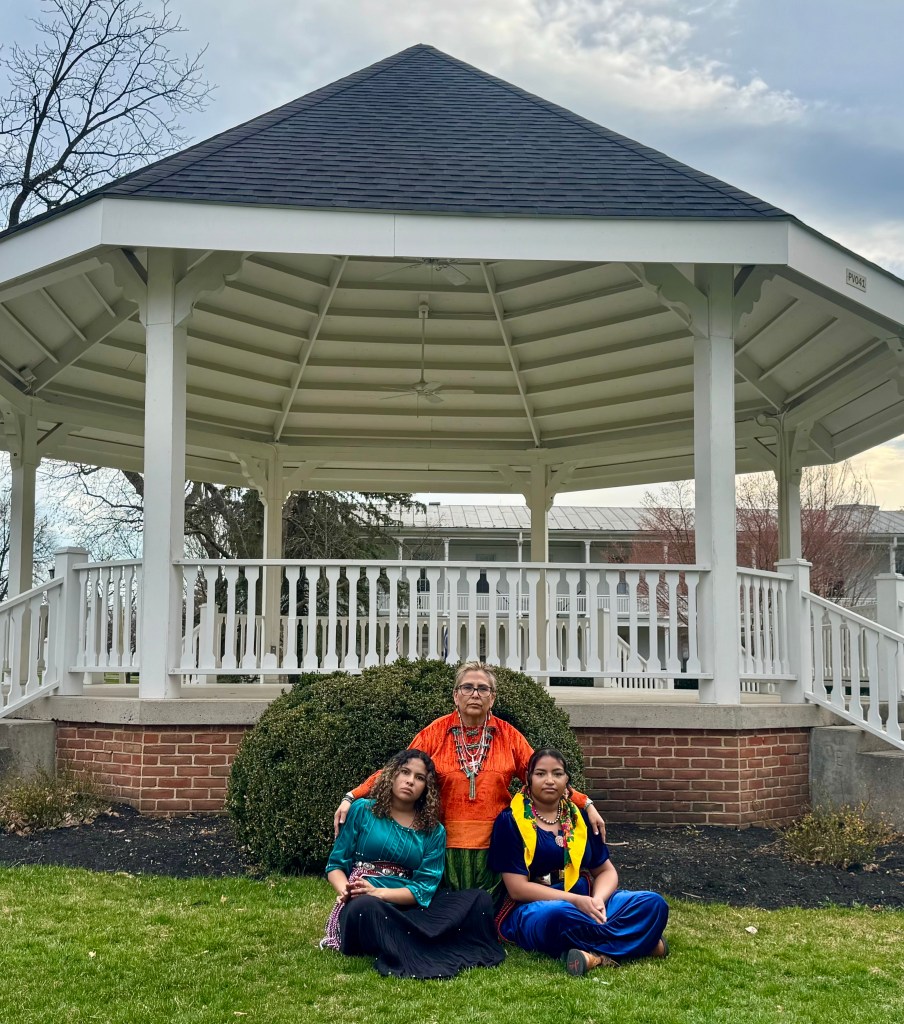
Gerilyn Tolino is shown at the bandstand on the grounds of the former Carlisle Indian Industrial School with her daughters Maya Tolino-Minefee, 16, left, and Zora Tolino-Minefee, 22. They kneel where her great-grandfather, Tom Torlino, and his Diné classmates were photographed as a group in 1882. Credit: Photo courtesy of Gerilyn Tolino
In March 2025, she made the trip with her husband, Marcus Minefee, and two daughters, Maya Tolino-Minefee and Zora Tolino-Minefee, now 16 and 22 respectively. She wanted her daughters to have the knowledge and experience. Gerilyn was the keynote speaker that year at a symposium held at what is now the Jim Thorpe Center for the Futures of Native Peoples at Dickinson College, and currently serves on its advisory board.
Standing at the same bandstand to pray and make an offering, the two young women hugged their mother and told her how proud they were of her.
“I started this, but the journey continues with you guys,” she told her daughters. “You are descendants, and it’s important that you know that and you know these stories…
“We pay homage to him and what he went through.”
The post Tom Torlino: The real life story behind the Carlisle photographs appeared first on ICT.
From ICT via This RSS Feed.