

Climate activists around the country saw this month’s midterm elections as a win. From congressional seats to governors’ mansions to local offices, progressive candidates leveraged voters’ frustration with the rising cost of living, especially high power bills, to defeat fossil fuel-friendly challengers.
But voters in two communities — Ann Arbor, Michigan, and Kitsap County, Washington — also rejected an idea that some say can address both climate change and affordability: replacing for-profit utilities with publicly owned ones.
On average, public utilities in the country charge lower electric rates and offer more reliable service than for-profit providers. Advocates contend that by being accountable to communities, they could transition to cleaner forms of energy faster than their counterparts beholden to shareholders and bottom lines.
Despite being in different regions of the country, the two community efforts unfolded in eerily similar ways. In each, private utilities spent roughly $2 million on local opposition campaigns, even using identical terms, like “too costly” and “too risky.” In the end, both initiatives failed by single-digit margins, sharing the same fate as the vast majority of recent public power efforts around the country.
These results highlight the unique challenges of creating a new public power utility in the 21st century. A century ago, building a new public utility meant building a new grid. Today, it means buying out the poles and wires already owned by a for-profit utility, a process that more closely resembles a hostile takeover.
Kitsap County, Washington
Public power has been an important part of Washington’s history for almost as long as Washington has been a state. But the movement really took off in the 1930s, triggered by two major events. First, a citizen-led state ballot initiative gave every community the right to form its own public utility district, or PUD. These new public agencies, run by elected commissioners, were empowered to provide power, water, and eventually internet to their constituents without taking a profit. Soon after, Congress created the Bonneville Power Administration, a New Deal-era agency that sold hydropower from the Columbia River. The new agency was required to give public utilities first dibs on its cheap hydropower, causing dozens of power districts to pop up around the state in the following decades.
The Kitsap Public Utility District oversees water and internet services, but it would need a public vote to start providing power.
Jesse Nichols / Grist
It was in this golden age that Kitsap County — a community on the small peninsula across the Puget Sound from Seattle — formed its own public utility district intended to provide electricity. But the outbreak of World War II a few years later delayed that effort for long enough that its authorization expired. Today, the utility district oversees water and internet infrastructure but allows a private utility called Puget Sound Energy to provide power.
By the 1950s, the red-scare movement took aim at public power. Private utility groups ran ads in national magazines. “It was ‘creeping communism,’ and had pictures of Russian dictators,” said Steve Johnson, the former executive director of the Washington Public Utility Association. Since then, public power has been in a dry spell, with most community efforts failing in Washington and across the U.S.
There was a notable exception in 2008, when Jefferson County — Kitsap’s rural neighbor to the west — passed a ballot initiative to create a new public utility that would take over power service from Puget Sound Energy. “I think that was a big wake-up call for the company, because there had not been a new PUD since the 1950s,” said Johnson. Today, Jefferson County runs entirely on carbon-free electricity from Bonneville Power, and typical bills there are roughly 19 percent lower than for Puget Sound Energy’s 1.24 million customers in surrounding areas.
Meanwhile, in neighboring Kitsap County, which today is home to about 280,000 people, Puget Sound Energy’s power rates continued to rise. Over the last five years, the average power bill has nearly doubled, and the company is proposing a series of increases totaling 32 percent by 2029. Puget Sound Energy told Grist that its rates reflect rising demand, infrastructure costs, and the challenge of meeting Washington’s clean electricity targets. State law requires utilities to be carbon neutral by 2030, leaving Puget Sound Energy, which still gets about half its energy from fossil fuels, scrambling to meet deadlines.
Earlier this year, as bills with new rates arrived in mailboxes, Kitsap utility commissioners started to hear from residents struggling to make ends meet. “Not being able to decide between feeding your kids and paying your electric bill — it’s not OK,” said commissioner Heather Pauley. This led the utility district to put forward a ballot initiative asking voters to give it the authority to take over power service from Puget Sound Energy.
The initiative’s design had, in one commissioner’s words, an “Achilles’ heel.” Voters would be approving the proposal without an official feasibility study. If the measure passed, the district would pay for an extensive study on the plan’s costs and benefits. Only if it penciled out would the commissioners move ahead with taking over the grid. While this was intended as a gesture of fiscal responsibility, it also left voters with few details to vote on.
This ended up being the opening for Puget Sound Energy’s opposition campaign: “Too Costly. Too Risky. No Plan,” their flyers and yard signs read. The campaign spent $2.3 million, making it one of the most expensive local ballot measure fights in state history.
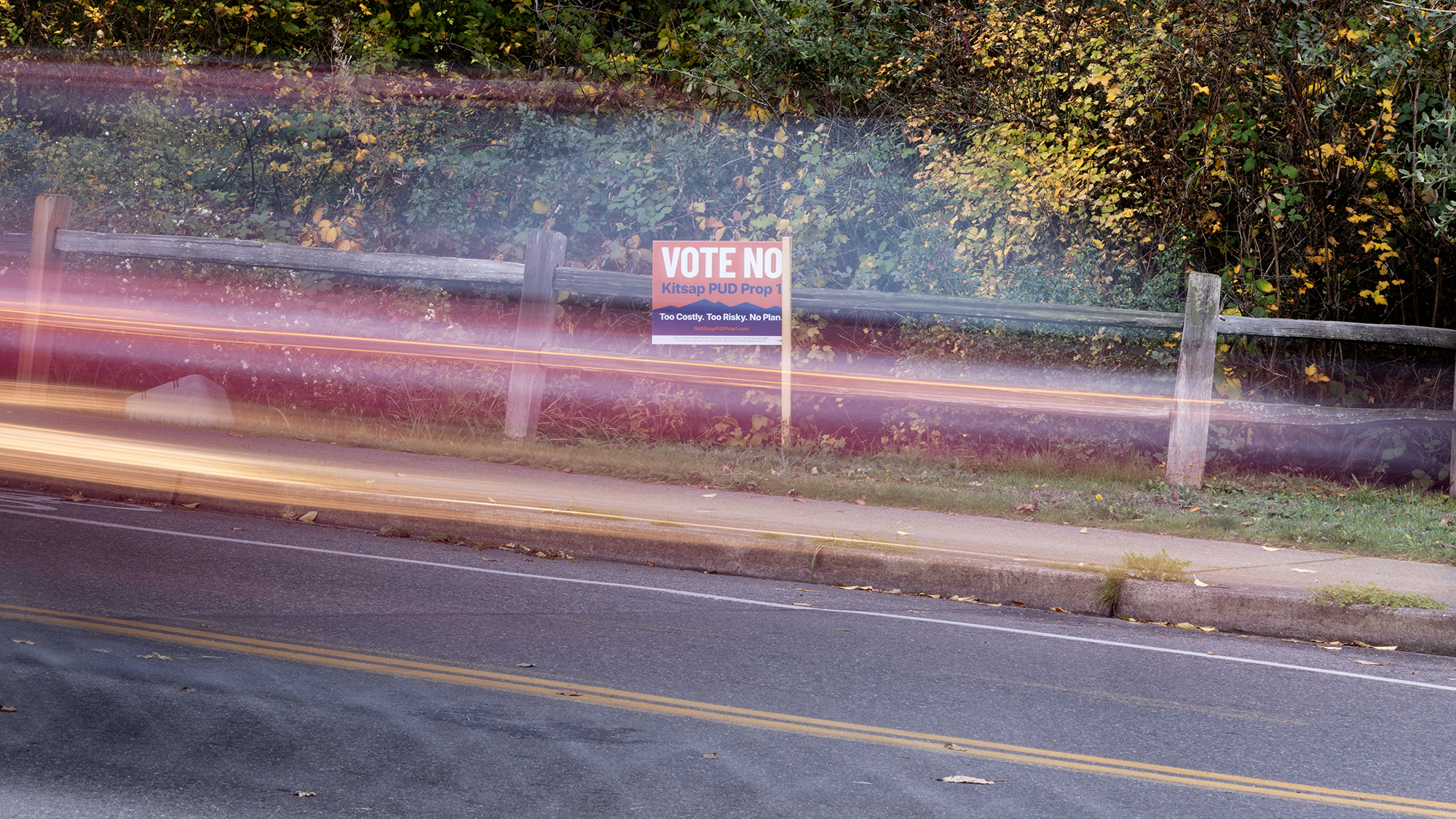
Cars pass by a sign from Puget Sound Energy’s opposition campaign against Kitsap County’s public power initiative. Jesse Nichols / Grist
Meanwhile, the public utility district was strictly prohibited from any form of advocacy. “Was there misinformation out there? Absolutely,” said Angela Bennink, the district’s general manager. “But we were limited in what we could do.”
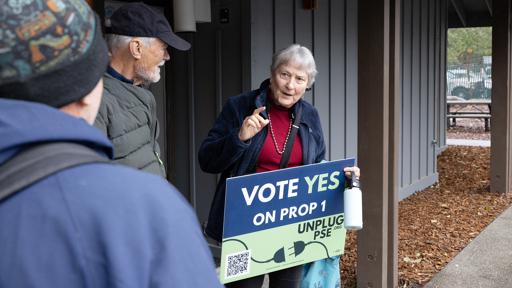
Unplug PSE, a grassroots campaign organized by Johnson and other Kitsap residents, took on the mantle of advocating for the initiative. But with a total budget of $9,000, they were thoroughly outmatched.
Puget Sound Energy also argued that a utility takeover would be too expensive — though much of that expense would come from the private utility itself. During Jefferson County’s buyout negotiations, Puget Sound Energy had demanded $109 million for all its power lines and transformers, more than double their assessed value. The private company was later ordered to return nearly $53 million of those extra proceeds back to its ratepayers. This time, Puget Sound Energy told Grist that it might not even agree to sell in the first place, meaning the public utility would have to pick an eminent domain fight.
With so many voters motivated by affordability concerns, the lack of financial details made the initiative a tough sell. “The ‘No Plan’ of that argument certainly sank in with a lot of people that we talked with,” said Fran Korten, chair of Unplug PSE. In the end, the proposition received only 42 percent approval from voters.
The utility district still has the authority to do a feasibility study, and could potentially make another try for public power in 2028. But Bennink thinks a critical window might be closing. Bonneville Power’s legacy dams and nuclear resources — the resources a theoretical Kitsap County public utility would rely on to provide affordable power to residents — are stretched pretty thin. The administration currently has enough cheap power to cover about 60 percent of the county’s electricity needs, Bennink said, but if another county set up a new public utility, it could claim that power first. This would mean the district could face many of the same market challenges as Puget Sound Energy, the private utility said.
Ann Arbor, Michigan
As in much of the rest of the country, public power in Michigan was born out of necessity. For-profit utilities in the late 19th century had little incentive to serve small remote communities, so cities and towns across the Mitten State built their own power systems.
Today, the state has 41 municipally owned electric utilities in small and midsized cities. Almost all of them have been around for decades.
But two years ago, voters in Ann Arbor passed a ballot measure to create a municipal renewable power utility that residents could opt in to. It wouldn’t replace the city’s sole power utility, the for-profit company DTE Energy, but instead would pay for solar panels, batteries, and other infrastructure to feed into the existing grid. As of November, 92 homes in one neighborhood are participating in the pilot phase of the public utility, which aims to expand citywide next year.
But some said this plan didn’t go far enough. The dual-utility model still hinges on DTE’s aging infrastructure, and an analysis by the city indicates that the for-profit utility won’t add renewable energy fast enough to help Ann Arbor reach its 100 percent renewable energy goal by the end of the decade.
So public power advocates in Ann Arbor last year decided to go a step further and push for cutting out DTE, which would allow the city to transition to clean energy faster. They put a proposal on the ballot this year to ask voters whether Ann Arbor should establish a board to lead a transition away from DTE, with the goal of completely replacing the for-profit utility with a brand-new one that’s owned and operated by the city.
“We could make electricity more affordable for people in Ann Arbor. We could make it more reliable,” said Fiona Dunlop, a field organizer for the group Ann Arbor for Public Power, which wrote and advocated for the ballot proposal. “We could take real steps toward good climate policies.”

People wait in line at the The University of Michigan in Ann Arbor to vote during the midterm elections.
Jeff Kowalsky / AFP via Getty Images
Supporters of the ballot measure were up against fierce opposition from DTE, labor unions and even the city itself. “The complexity of our proposal made it easier for our opponents to find inroads to attack,” said Brian Geiringer, the executive director of Ann Arbor for Public Power. DTE poured $1.8 million into a group called the Ann Arbor Responsible Energy Coalition, which campaigned against the proposal.
Using the same words as Puget Sound Energy, it argued that movement toward public power would be “too costly and too risky” for Ann Arbor and its roughly 125,000 residents. A board could be made up of people with little to no technical experience and ultimately leave residents with higher costs, the coalition said.
“The people of Ann Arbor saw this proposal for exactly what it was: a mandate that would have made life in Ann Arbor even more expensive by eventually forcing working families to carry the burden of a billion-dollar debt,” the coalition said in a statement after the election, referencing the cost of buying out and maintaining the infrastructure. The $1 billion refers to the coalition’s estimate of how much it would cost the city to buy DTE’s poles and wires, plus how much to maintain that infrastructure. The city estimated in a 2023 early-phase feasibility study that a buyout could cost anywhere from $281 million to $1.15 billion, noting that there’s no modern precedent in Michigan to point to. It could be paid for by issuing bonds, but further financing options would require another feasibility study.
Ultimately, the ballot proposal failed by a slim margin of 3.6 percent, or 2,003 votes.
Like the rest of the country, Ann Arbor residents are frustrated with rising power bills and unreliable service, said Mike Shriberg, a professor of practice and engagement at the University of Michigan’s School for Environment and Sustainability. But the high, uncertain costs of public power might have edged out these concerns, for now. And as in Kitsap County, voters did not have a full feasibility study to consider.
“I don’t think it was actually a debate about the fundamentals of whether public power would be a good thing here in concept,” Shriberg said. “It was really about the details.”
What’s next for public power
The challenge of creating a new electric utility in the 21st century is “fundamentally different” than it was in the 1930s, Bennink said. A century ago, the power grid was in its infancy, and public utilities were largely building networks from the ground up. Today, creating a public utility instead involves billion-dollar buyouts, well-funded opposition campaigns, and uphill battles with powerful private companies that have every incentive to not cooperate. “It would have been very, very hard,” Bennink said. “Herculean. Monumental.”
Despite the challenges, some say interest in public power will likely keep growing across the country as frustration with utilities continues to mount. “As we’ve seen across the country, there’s an incredible amount of pent-up frustration with our electric utilities,” said Shriberg at the University of Michigan. “Costs are too high, the service is too unreliable and too dirty.”
The lack of details may have been the downfall for the public power ballot questions in Washington and Michigan. But there are signs that government leaders are willing to consider the option if there’s more planning involved. The City Council in Milwaukee, Wisconsin, voted unanimously this month to fund a $1.35 million feasibility study to explore replacing investor-owned We Energies with a city utility. The decision came after the state’s public service commission approved a rate increase for We Energies.
In Kitsap County, many public power supporters are now pushing for a similar plan. At a post-election utility district meeting, the small conference room was unusually packed with residents asking commissioners to perform a feasibility study.
Election Day was “bittersweet” for Ann Arbor organizers going up against utilities. While the public power proposal failed locally, an ambitious statewide ballot measure that would amend Michigan campaign finance laws to rein in utilities’ influence in elections overwhelmingly passed — including among Ann Arbor voters. And public power supporters still see opportunities to move the needle on a grid takeover: The newly elected mayor of Ann Arbor endorsed the public power ballot measure during his campaign, and the City Council saw turnover that could result in a new look at funding for a deeper feasibility study, which failed to pass last year.
“The movement is still very much alive, probably stronger than ever,” Geiringer said.
This story was originally published by Grist with the headline Voters are fed up with for-profit utilities, but they keep rejecting ‘public power’ on Nov 24, 2026.
From Grist via This RSS Feed.
That’s socialism!! 😤😡