

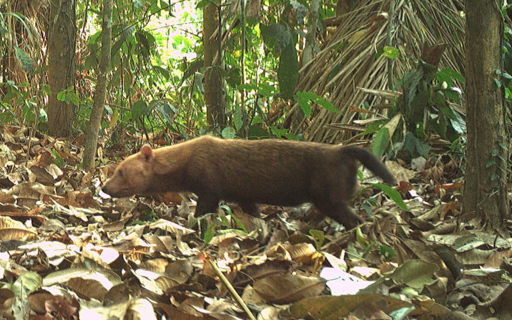
Founder’s Briefs: An occasional series where Mongabay founder Rhett Ayers Butler shares analysis, perspectives and story summaries. Biologists can spend decades working in the Amazon without seeing a bush dog. A new study quantifies just how rare the wild canids are. Writing in Canid Biology & Conservation, Robert Wallace and his colleagues at the Wildlife Conservation Society analyzed 25 years of camera-trap data from 97 sites across seven South American countries. In more than 2.1 million photographs, taken over 611,159 camera-trap nights, bush dogs (Speothos venaticus) appeared on just 12 occasions. Jaguars (Panthera onca) turned up about 100 times as often, and ocelots nearly 280 times. Even the short-eared dog (Atelocynus microtis), so fleetingly rare that it’s been nicknamed the “ghost dog,” was recorded 50 times as often as the bush dog. Bush dogs are found from Costa Rica to northeastern Argentina. They have short legs, weigh up to 7 kilograms (about 15 pounds), and sometimes hunt in packs of a dozen. In Brazil’s Cerrado, a single family group was found to occupy a home range of 140 square kilometers (54 square miles). In the latest study, the researchers analyzed footage from cameras mostly set 40–50 centimeters (16-20 inches) above the ground to photograph jaguars, which may have been a little high for bush dogs. Yet they readily photographed pacas, rodents of much the same size and shape as bush dogs, on nearly 40,000 occasions. A pack of dogs should also be easier to photograph than a solitary animal. The…This article was originally published on Mongabay
From Conservation news via This RSS Feed.