

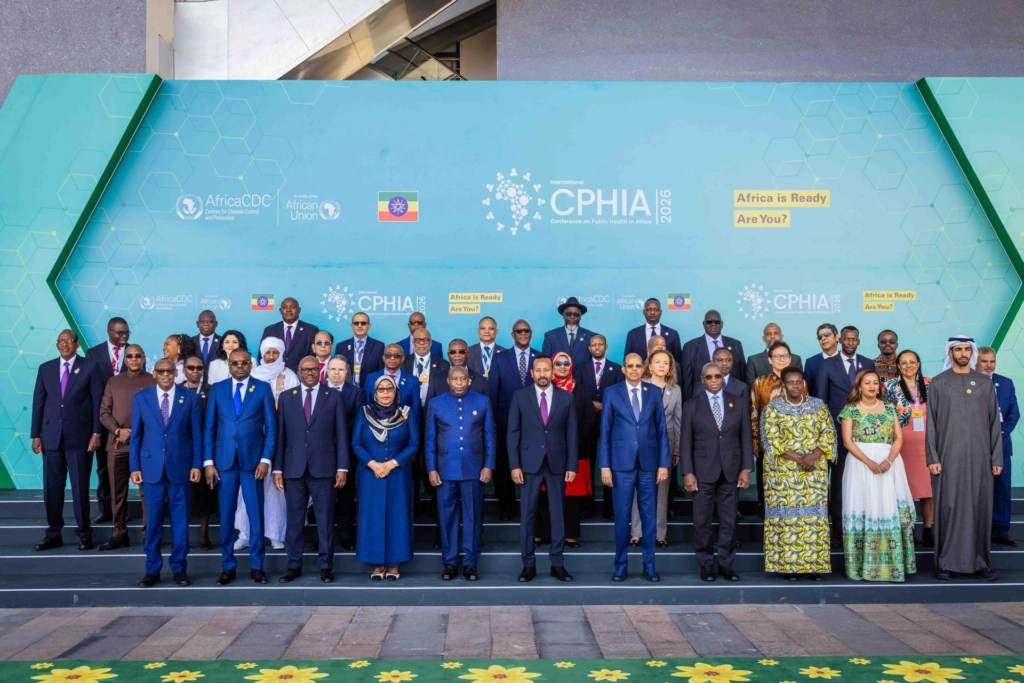
African leaders opened the 5th International Conference on Public Health (CPHIA 2026) in Africa on Monday in Addis Ababa, Ethiopia, calling for stronger local capacity, greater pharmaceutical production and reduced dependence on imported medicines, vaccines and medical supplies.
The gathering brings together heads of state and government, health ministers, scientists, innovators and international partners. Its theme centers on transforming Africa’s health dependence and vulnerability into autonomy and resilience.
On the opening day of the continent’s flagship health forum, participants reviewed progress toward regional priorities, identified remaining gaps and put forward practical solutions for a self-sustaining future.
RELATED: Third Russia-Africa Summit Ends With AI Deal, 2027-29 Action Plan
Authorities agreed that recent health emergencies and sharp cuts in international funding have exposed Africa’s structural weaknesses, particularly in the supply of essential medicines, vaccines and medical inputs.
🇪🇹 Addis-Abeba accueille, du 23 au 27 novembre 2026, la 5ᵉ édition de la Conférence internationale sur la santé publique en Afrique (CPHIA), organisée par @AfricaCDC. La cérémonie officielle d’ouverture s’est tenue ce lundi.#MMC #CPHIA2026 #AfricaCDC #LightDigitalConsulting pic.twitter.com/VoVpthIdAJ
— MMC (@MMCrdc243) November 23, 2026
Text reads: “Addis Ababa is hosting, from November 23 to 27, 2026, the 5th edition of the International Conference on Public Health in Africa (CPHIA), organized by @AfricaCDC. The official opening ceremony was held this Monday.”
Following this, Mahmoud Ali Youssouf, President of the African Union Commission, urged member states, regional institutions and development partners to sustain collective action aimed at accelerating the health sovereignty agenda and keeping no citizen out of medical care. “Africa cannot afford to continue depending on external sources for the medicines, vaccines and essential medical supplies needed to protect the health of its population,” Youssouf said.
“We must move decisively toward greater self-sufficiency, greater continental autonomy and resilient health systems,” he affirmed.
The diplomat argued that the bloc’s results should be judged by their direct impact on people rather than by the volume of agreements signed. “Our success, ultimately, should not be measured by the declarations we adopt, but by the difference we make in the lives of our citizens,” he added. Every child should receive essential vaccines, every pregnant woman should access proper care and every African should reach timely, quality medical attention, he demanded.
From Dependency to Self-Reliance: AU Commission Chairperson Urges Africa to Take Charge of Its #Health Future.
At the 5th International Conference on Public Health in Africa (CPHIA 2026), held in Addis Ababa, Ethiopia, H.E. Mahmoud Ali Youssouf, Chairperson of the African Union… pic.twitter.com/7tyG7NM6kr
— African Union (@_AfricanUnion) November 23, 2026
Financing at Home
Évariste Ndayishimiye, President of Burundi and current chairperson of the African Union, demanded an urgent shift from political declarations toward greater national investment. Health sovereignty, he insisted, begins with domestic financing. The continent, in his view, must move from commitments to execution, from dependence to self-sufficiency and from vulnerability to resilience.
The urgency of that call is rooted in painful experience. More than 1,700 children have died from Ebola in the Democratic Republic of Congo, a reminder of how quickly weak supply chains and external reliance turn outbreaks into humanitarian disasters. Reduced donor financing has compounded the pressure on already fragile health systems, forcing governments to reassess where medicines and vaccines will come from in the next crisis.
Local pharmaceutical manufacturing sits at the center of the proposed response. Several leaders pointed to regional production hubs and pooled procurement as concrete paths to guarantee supply without waiting on foreign markets. The goal is not only to buy more cheaply but to build capacity that stays on the continent.
The conference continues with working sessions focused on financing mechanisms and manufacturing partnerships until November 27. Concrete commitments are expected by the closing plenary, though Youssouf warned that only outcomes that change daily life for ordinary Africans will count as real progress.
From teleSUR English via This RSS Feed.