
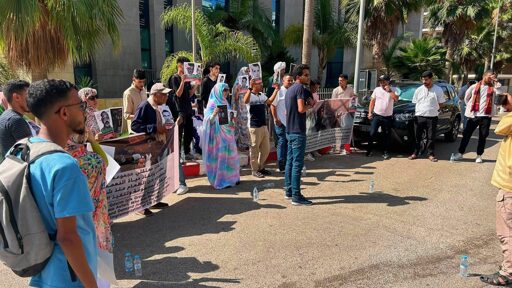

Condemning the sentencing of four Sahrawi students for taking part in a peaceful demonstration in solidarity with Sahrawi political prisoners, human rights groups in Western Sahara have called for greater international scrutiny of Morocco as an occupying power.
The four jailed students are Brahim Babit, Salah Eddine Sbar, El Hussein Chihab, and Mohamed Lemrabet, studying at Zohr University in the Moroccan city of Agadir. On October 12, they traveled over 500 km north to the national capital, Rabat, to attend the demonstration. It was organized by family members and relatives of those incarcerated during the 2010 Gdeim Izik protest encampment for Sahrawi rights.
Sahrawi students in Morocco report widespread discrimination, cultural pressure, and clashes over protests about the occupation of Western Sahara.
The occupation curtails education. “There are no institutions of higher education in Western Sahara,” which forces students to go to Morocco to continue their studies, said Babouzeid Labbihi, executive member of the Collective of Sahrawi Human Rights Defenders in Western Sahara (CODESA).
In the shadow of Gdeim Izik
Gdeim Izik is a mostly uninhabited place in the Sahara Desert, about 15 km from Laayoune, the largest city in occupied Western Sahara. It entered the annals of history in 2010, when it became the site of a momentous mobilization widely described as a precursor to the Arab Spring.
Protesting against discrimination by the occupation authorities, who prioritized Moroccan settlers for jobs, housing, education, and benefits, the Sahrawis, who were being pushed deeper into poverty, began pitching tents in Gdeim Izik on October 9, 2010.
Within days, it grew into a mass protest encampment, with 20,000 protesters in 7,000 tents. Initially focused on socio-economic grievances, the demands grew bolder as the mobilization gathered momentum. Pro-independence slogans were raised against the occupation.
On November 8, 2010, Moroccan military and police attacked the Gdeim Izik encampment. Protesters resisted. Hours of confrontation followed.
700 Sahrawi civilians were wounded, 163 others went missing, and 36 people, including an eight-year-old, were killed, according to the Polisario Front (PF), which the UN regards as the sole representative of the Sahrawi people. Morocco, however, admitted to only two civilian deaths, while claiming 11 of its security personnel were killed.
Occupation forces detained up to 200, including women, children and the elderly. Based on confessions extracted under torture, the Moroccan military court sentenced 21 Sahrawis to prison terms ranging from 20 years to life. A subsequent re-trial by a civilian court in 2017 did little to alleviate their plight.
Political prisoners on hunger strike
Eight of them are serving life sentences, while 11 others are serving terms of between 20 and 30 years. For 16 years now, they have been enduring relentless and systematic harassment and mistreatment in Moroccan prisons, said Labbihi. On September 23, 2026, nine of these prisoners began a hunger strike.
In solidarity with them, their family members and relatives called for a protest in Rabat on October 12, insisting that their internationally recognized rights as political prisoners be respected. Concerned about their deteriorating health, family members demanded independent medical care for the prisoners.
They also called for the prisoners to be transferred to a facility in Laayoune, closer to their family, and demanded access to regular visits and phone calls.
“Their very existence as Sahrawi political beings poses a threat to Moroccan colonization”
Barely 40 protesters had gathered outside the Moroccan prison administration’s headquarters in Rabat when security forces surrounded them to prevent others from joining in. Unfazed, some protesters raised the Sahrawi flag and chanted slogans, calling for Sahrawi independence and freedom for all political prisoners.
Allegedly assaulting the protesters, the security forces detained seven of them. Sahrawi human rights defenders Hassan Douihi, Khalid Boufrayout, and Aziz El-Wahidi were released without prosecution.
The four students from Zohr University in Agadir – Babit, Sbar, Chihab, and Lemrabet – were put on trial, which was finally held on November 13 after two postponements.
Human rights defenders and Sahrawi students, along with Ruth Sebastián García and María Dolores Travieso – Spanish observers from the International Association of Jurists for Western Sahara – were barred from attending the trial.
The court of first instance sentenced the four students to two years in prison. Two of them – Babit and Sbar – had already served prison terms previously.
In addition, the court also imposed a 15,000 Dirham fine on each. This fine, amounting to over $1,500, is a “financial catastrophe far exceeding the penalty of deprivation of liberty,” in Western Sahara, where most families struggle to get by, explained Labbihi.
“Its aim is economic deterrence: to starve the activist’s family so that it pressures him to abandon the struggle. It is a collective punishment,” he said. “The Sahrawi students are not tried because they raised a flag, but because their very existence as Sahrawi political beings poses a threat to Moroccan colonization.”
Moroccan occupation of Western Sahara
With US support, Morocco illegally occupied Western Sahara – a northwest African country on the Atlantic coast, rich in phosphate and fisheries – in 1975, soon after the International Court of Justice (ICJ) dismissed Moroccan claims to sovereignty over the neighboring country.
In the over half a century since, the Court of Justice of the European Union (CJEU), the United Kingdom High Court of Justice (UKHCJ) and the African Court on Human and Peoples’ Rights (AfCHPR) have all held that Morocco has no sovereignty over Western Sahara.
The African Union (AU) also recognizes Western Sahara as a member state under occupation, while the UN lists it among the countries yet to be decolonized. However, with the backing of the US and its European allies, the Moroccan occupation continues into its 52nd year.
From BT News via This RSS Feed.