

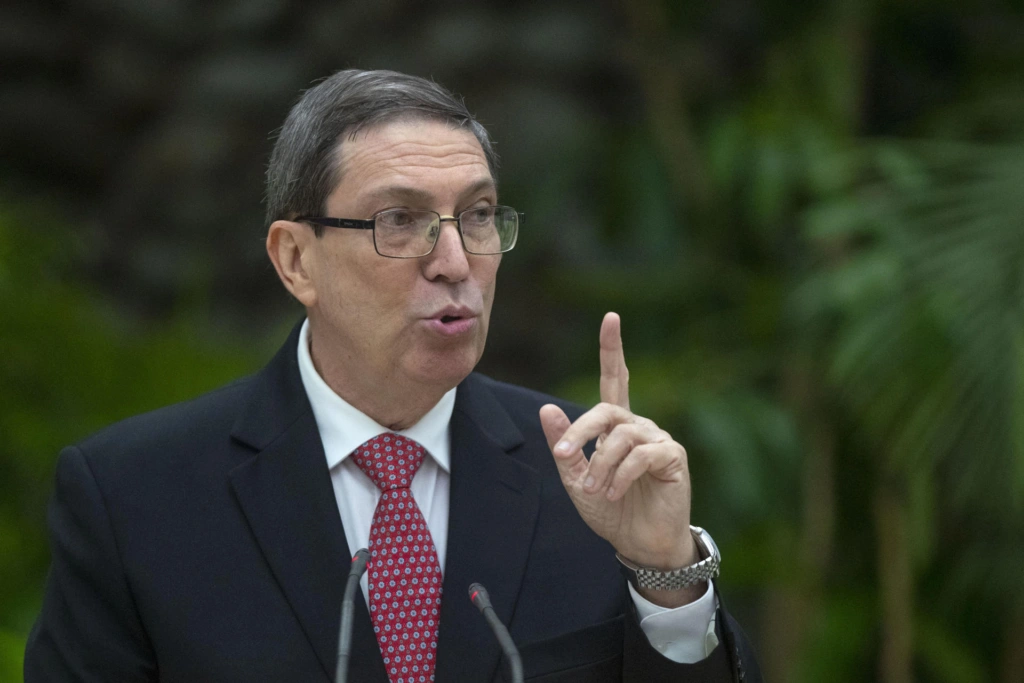
Cuba’s Foreign Minister Bruno Rodriguez accused United States on Monday of wielding military force and an imperialist doctrine to impose its will, denouncing a double standard on human rights and the use of economic coercion against weaker nations.
FM Bruno Rodriguez took to the social network X on Monday to condemn the world’s leading economic and military power, which he identified as United States.
Through lies and extortion, he wrote, Washington seeks to impose chaos, barbarism, interventionism, interference, and the use of force, alongside “the abuse of its economic power over the weakest and the application of unilateral coercive measures.”
RELATED: WHO Chief Visits Cuba to Assess Health Needs, Mobilize Support
The Cuban diplomat argued that these actions aim to undermine the sovereign equality of states and replace international law with an imperialist doctrine built on imposing peace through force.
He also warned that Washington applies a double standard on human rights. Economic coercion against weaker nations, he said, operates as a mechanism to force negotiations and supposed peaceful settlements of disputes.
La principal potencia económica y militar global intenta oficializar e imponer, por medio de la mentira y la extorsión, el caos, la barbarie, la injerencia, el intervencionismo, el uso de la fuerza militar, el abuso de su poderío económico sobre los más débiles y la aplicación de… pic.twitter.com/dEwXFZ9KHG
— Bruno Rodríguez P (@BrunoRguezP) November 23, 2026
Text reads: “The principal global economic and military power attempts to officialize and impose, through lies and extortion, chaos, barbarism, interference, interventionism, the use of military force, the abuse of its economic power over the weakest and the application of unilateral coercive measures.…”
Threats Escalate
The statement follows a November 12 telephone interview in which the U.S. President told Salem News Channel he intended to “finish Cuba” before leaving office, without ruling out military intervention. He confirmed that Secretary of State Marco Rubio is managing the effort to change the government on the island.
Donald Trump’s most recent threat of an operation against the Caribbean nation came during an October campaign rally in Florida. He described a scenario in which naval ships would pass Cuba on their return from Iran. “Those beautiful ships, we’ll pass by Cuba, we’ll have one of them stop about 50 yards from the coast,” he said in Fort Myers on October 23. “They’ll raise their hands and then we’ll send Marco Rubio to close the deal,” he added.
Cuban FM Rodriguez answered on X at the time. “We reject all threats related to the ambitions of the United States toward Cuba,” he wrote.
Threats have recurred throughout 2026. In September, at the United Nations, the U.S President declared that Cuba “is failing like never before, and it’s going to fall.”
The pattern hardened months earlier. On January 8, days after the attack against Venezuela that Cuban authorities describe as an illegal military intervention, the U.S. President told conservative commentator Hugh Hewitt that his administration had already exhausted every avenue of economic pressure and harm against Cuba, leaving only the military option.
Cuban President Miguel Díaz-Canel recently rejected any foreign interference in the nation’s future. He called it perverse that the White House evades responsibility for the collective punishment suffered by the island’s population.
For Havana, the sequence is unmistakable. A blockade sustained for decades, then explicit threats of direct military action, and now a stated goal of finishing Cuba before the term ends.
Rodríguez’s message carries that framing forward. By naming the mechanism, lies, extortion, coercion, he seeks to expose what he describes as the real engine behind Washington’s posture toward the region. The language has moved from economic pressure toward military possibility, and Havana is answering each escalation in the same public arena where the threats are made.
From teleSUR English via This RSS Feed.