

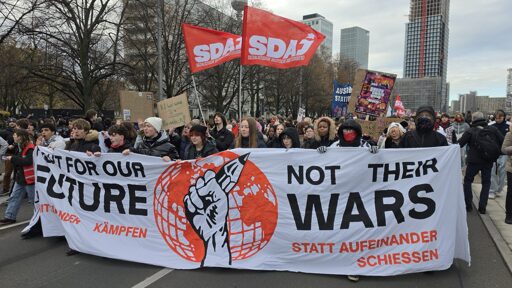

More than 50 student organizations in 27 European countries launched an international strike against war and militarization on Friday, November 20, drawing a million of young people onto the streets.
Students issued joint demands including an end to rearmament and all forms of conscription, investment in education and social services, and solidarity with oppressed peoples around the world. They also declared resistance to growing authoritarian trends in the region.
“We are protesting to claim our right to a better future, and we are aware that if we stand united, no one will be able to stop us from taking it,” said Alessandro Di Miceli from the Italian organization Rete della Conoscenza.

The international student strike drew a million students onto the streets of 27 European countries on November 20, 2026. Source: BreakThrough News
Actions took place in Norway, Sweden, Finland, Poland, Romania, Turkey, Greece, Croatia, Hungary, Slovakia, Austria, the Czech Republic, Germany, Denmark, the Netherlands, Belgium, Ireland, Italy, Britain, France, Switzerland, Spain, Portugal, Malta, and Slovenia, among others.
“From the right to education to the right to housing, from the struggle against the rising costs of living and the climate crisis to the fight against militarization and rearmament, specific demands may differ from country to country, but are all deeply connected between each other,” Di Miceli said.
Attacks on education funding
One concern shared by student groups across the region is the precarious state of public education. For almost two months, high school and university students in France have led massive protests and occupations against austerity measures imposed during Emmanuel Macron’s presidency.
Read more: 1.6 million join general strike in France against austerity
Similar policies took root elsewhere too. In Britain, Prime Minister Andy Burnham’s administration recently announced cuts to student welfare and support while planning to invest billions in the military.
“While the government says it doesn’t have the money to invest in education or opportunities for young people without cutting welfare and potentially pushing hundreds of thousands of young people into poverty, it is right now spending an extra £15 billion a year on the military,” Stop the War’s Shabbir Lakha wrote.
Teachers and parents protested side by side with youth organizations in many cities supporting their concerns. Still in England, the National Education Union (NEU) published a statement on planned school funding cuts on the day of the international youth strike. The union found that mainstream school funding in England will be slashed by £1.2 billion (USD 1.57 billion) in cash in 2027-28.
The cuts will affect approximately 11,000 schools in England, the NEU pointed out – many of them in the poorest parts of the country, including Hackney, Southwark and Tower Hamlets in London.
“Hackney and Tower Hamlets have the highest child poverty rates in the UK: half of their children live in poverty once housing costs are paid,” NEU general secretary Daniel Kebede warned.
Students refuse return of conscription
Another concern widely voiced among student groups is the return of military conscription. In Germany, more than 50,000 pupils and students organized their fifth school strike in a year. The German government plans to build Europe’s “strongest conventional army” in a matter of years, while slashing welfare and social security – with the youth insisting they will not be part of this scenario. Similarly, in Belgium – including in Ghent, Brussels, Leuven, Liège, and Antwerp – young people tore up letters issued by the Ministry of Defense regarding military service.
Read more: Gen Z protests in Germany met with racial profiling and police harassment
In Slovenia, the Rosa Collective described how thousands of students attended a recent arms fair as part of their “active citizenship” curriculum while structural needs remain unaddressed. “The military is targeting rural vocational and technical high schools,” the group wrote. “They aim to recruit young people from socially disadvantaged backgrounds, offering them money and adventure.”
Noting that Israeli arms companies Rafael and Israel Aerospace Industries appeared basically next door to the location visited by students, Rosa Collective warned that “young people are being recruited in secondary and primary (!) schools while some faculties and institutes are becoming incubators for the development of technologies for military use.”
Convergence with housing and cost-of-living campaigns
In Italy, Spain, and Portugal, the student strikes echoed mass mobilizations for housing and general strikes against the cost-of-living crisis. A national strike called by the mainstream trade union confederation CGIL was ongoing as students took to the streets in Italy, with progressive student collectives calling on the public to embrace a more ambitious agenda and support new mobilizations by grassroots unions on December 12.
In Spain, protesters cited the November 11 general strike as an inspiration. “We had an amazing strike last November 11, with more than 400,000 people marching only in Barcelona,” a spokesperson for Sindicat d’Estudiants told BreakThrough News. “And we said that day that this was not the ending of anything. We said that the demonstrations, that the strike had to keep going. And this is what we are doing today.”

Students rejected war, rearmament, and the far right. Source: BreakThrough News
“We are determined to continue organizing and mobilizing in the months ahead, until these demands become reality,” Shabbir Lakha emphasized in a statement by the Youth Strike Coalition. “The ruling classes of our countries should begin to worry, because this November 20 will only be the beginning. We will keep standing together as youth to fight for our future, not their wars.”
From BT News via This RSS Feed.