

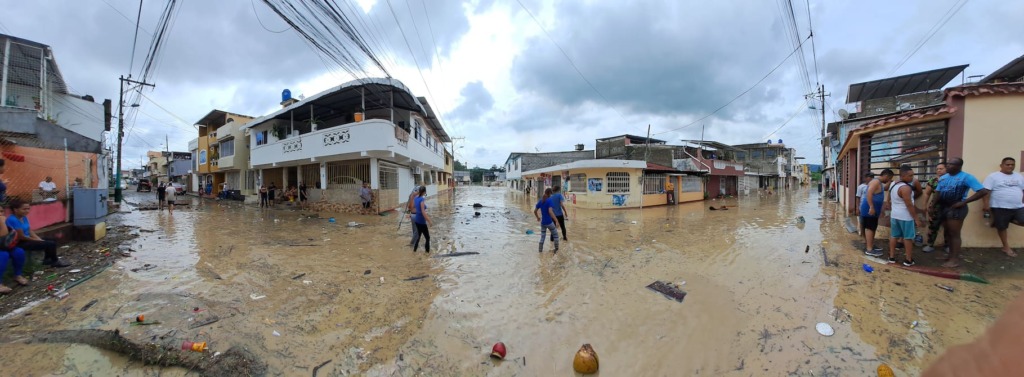
On Monday, Ecuador’s National Emergency Operations Committee (COE) reported 183 people are being cared for in three temporary shelters set up on Santa Cruz Island, in the Galápagos archipelago, following incidents caused by rains associated with the El Niño phenomenon.
RELATED:
Ecuador’s Flood Emergency Deepens as El Niño Claims 14 Lives
Meanwhile, heavy rains hit Quito early Monday, causing flooding in the northern part of the city and disrupting transportation.
This weather event is part of the conditions linked to the development of the El Niño phenomenon, as confirmed by the National Institute of Meteorology and Hydrology (Inamhi). According to technical monitoring, rainfall intensified starting at 12:50 a.m. and continued throughout the early morning hours across several parts of the country.
Inamhi’s forecast warns of heavy rainfall in 38 cantons along the coast and 11 in the highlands (Sierra). Significant rainfall—ranging from moderate to, in some spots, heavy—was also recorded in the southern part of Los Ríos province and the eastern part of Guayas province. In the Ecuadorian capital, water accumulation flooded the intersection of Mariscal Sucre Avenue and San Francisco de Rumihurco Street, in the northern part of the city.
🇪🇨🌧️ Milagro quedó bajo el agua y cientos de familias enfrentan una emergencia en #Ecuador. Las intensas precipitaciones provocaron el desbordamiento de ríos y esteros en esta localidad de la provincia de #Guayas, dejando calles y viviendas completamente anegadas.
Algunas… pic.twitter.com/gqV4iZpeLm
— GlobaLAT (@globaLATvideo) November 17, 2026
The text reads, “Milagro has been left underwater, and hundreds of families are facing an emergency in #Ecuador. Heavy rainfall caused rivers and streams to overflow in this town in #Guayas province, leaving streets and homes completely inundated.
Some people have had to swim to get food, while others remain trapped or are waiting for conditions to improve so they can leave their homes. Firefighters have been working for four days using boats and rescue equipment, and have already evacuated nearly 480 residents.”
At the same time, satellite reports released this morning showed moisture-laden clouds concentrated over the center of the country. This cloud mass covers parts of Esmeraldas, Manabí, Guayas, portions of Santa Elena, Cañar, and southern Napo; additional moisture-heavy cloud formations were also observed over Ecuador’s territorial waters.
Authorities are closely monitoring the progression of the storm system, given the damage that has accumulated over the past few days. In this context, the national press recently reported that the El Niño phenomenon has resulted in 20 deaths and affected 104,896 people across Ecuador, according to the National Secretariat for Risk Management (SNGR). Meteorological Warning No. 89 remains in effect from the afternoon of Saturday, November 21, through Tuesday, November 24, 2026.
Meanwhile, for the coastal region (Litoral), the National Institute of Meteorology and Hydrology (Inamhi) forecasts heavy and intense rainfall in Esmeraldas, Santo Domingo, Los Ríos, Guayas, Manabí, and Santa Elena. In the Andean highlands (Sierra), the heaviest precipitation is expected in Pichincha and Bolívar, as well as in the western areas of Cotopaxi, Chimborazo, Cañar, Azuay, and Loja.
#MonitoreoSatelital 🛰️| Lunes 23/11 (04h20): Persisten las lluvias moderadas y fuertes en #LosRíos, #SantoDomingo, #Bolívar y estribación de cordillera de #Cotopaxi. Se prevé que continúen durante las próximas horas de la madrugada. 🌧️#JuntosAnteElNiño #INAMHI pic.twitter.com/M4T3a04beA
— INAMHI Ecuador (@inamhi_ec) November 23, 2026
The text reads, “SatelliteMonitoring 🛰️| Monday 11/23 (04:20): Moderate to heavy rainfall persists in #LosRíos, #SantoDomingo, #Bolívar, and the foothills of the #Cotopaxi mountain range. It is expected to continue throughout the early morning hours. TogetherAgainstElNiño #INAMHI”
For the Amazon region, light to moderate rainfall is anticipated in the foothills of Sucumbíos, Napo, Pastaza, Morona Santiago, and Zamora Chinchipe, while the Galápagos Islands may experience moderate to heavy rainfall events.
The report warns of potential water accumulation in homes, businesses, and on roads, as well as travel disruptions caused by flooded roadways, dense fog, or fallen trees. There is also a continued risk of thunderstorms and strong wind gusts in vulnerable areas. Another danger highlighted by experts is the rising and overflowing of rivers in six coastal provinces and along the western mountain ranges of Bolívar, Cañar, Azuay, and Loja.
Key factors contributing to these conditions include a constant influx of moisture, wind circulation patterns, and high ocean surface temperatures. On November 20, the Navy’s Oceanographic and Antarctic Institute (Inocar) released a technical summary prepared by the National Committee for the Regional Study of the El Niño Phenomenon (CN-ERFEN).
The committee confirmed that the phenomenon continues to intensify and warned that its impacts could escalate as the rainy season progresses. In light of this projection, the CN-ERFEN and the SNGR recommended that institutions and local governments strengthen prevention efforts, monitor water flow, and clear out storm drains across the country.
#Ecuador | El Niño floods leave 14 dead and over 91,000 affected. Authorities warn that nearly 64% of priority flood prevention projects have yet to begin.#ElNino #FloodEmergency #ClimateCrisis #teleSUREnglish pic.twitter.com/rAPRoyWXGk
— teleSUR English (@telesurenglish) November 19, 2026
From teleSUR English via This RSS Feed.