

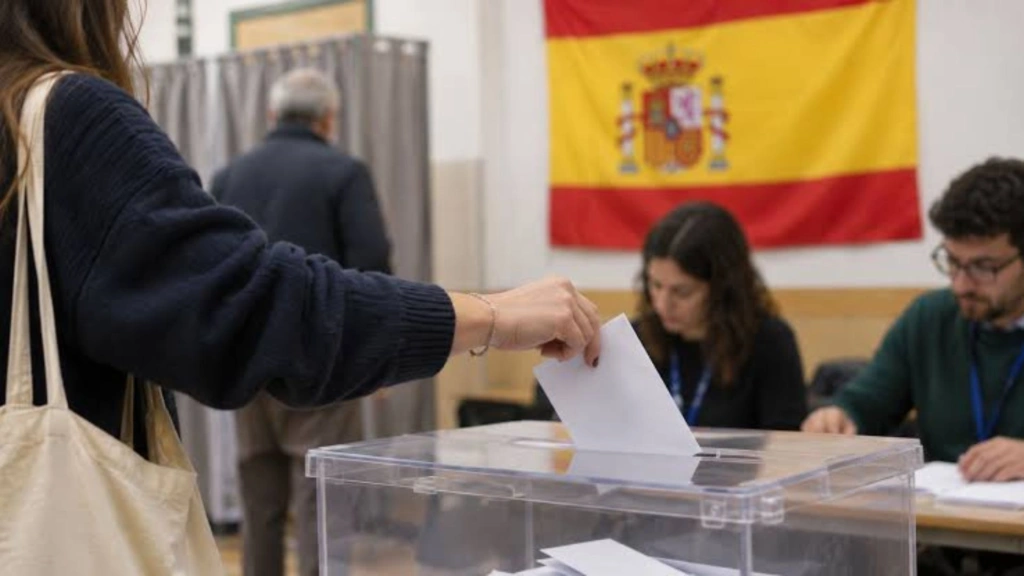
Monday, November 23, will be the final day for media outlets and polling firms to release voter intention surveys before Spain’s general elections. At midnight, a so-called “polling blackout”—a prohibition that will remain in effect until the polls close—will begin.
RELATED:
Spain General Election 2026: 16-Day Campaign for 350 Seats Begins
This restriction will span from November 24 to November 28, inclusive, in accordance with Article 69.7 of the Organic Law on the General Electoral Regime (LOREG). The regulation stipulates that, during this period, the publication, dissemination, or reproduction of electoral polls by any media outlet is prohibited.
Failure to comply with this measure may result in fines ranging from 3,000 to 30,000 euros, in addition to the mandatory removal of the disseminated content.
Election Polls
Most estimates from private firms place the People’s Party (PP) in the lead, projecting that it could secure an absolute majority in the Congress of Deputies through an agreement with Vox.
A daily poll conducted by 40dB for El País and Cadena SER, released last Friday, projected that the PP would win between 127 and 139 seats, while the Spanish Socialist Workers’ Party (PSOE) would secure between 115 and 123. Vox was projected to win between 56 and 62 seats.
The survey also projected between 8 and 11 seats for Frente Amplio, 10 for ERC, seven for EH Bildu, three each for Junts, the PNV, and Adelante Andalucía, two for the BNG, and one for Coalición Canaria. Podemos would be left without any representation.
Spain holds a snap general election Nov. 29. Four polls published Sunday all put @NunezFeijoo’s PP first, 0.5 to 6.4 points ahead of PM @sanchezcastejon’s PSOE. They project PP and Vox together at 190-210 seats, above the 176 needed for a majority in Congress. pic.twitter.com/rAMgYF57q9
— AmericanDailyPress (@USDailyPress) November 23, 2026
Meanwhile, a study by Sigma Dos for El Mundo, published after the debate between Pedro Sánchez and Alberto Núñez Feijóo, placed the PP at 31 percent of the vote—equivalent to between 125 and 131 seats. The PSOE would secure 27.1 percent and between 110 and 116 seats; Vox would register 19.4 percent and between 59 and 64 seats, while the *Frente Amplio* would reach 7.1 percent and between 11 and 14 seats.
Separately, ABC projected more than 190 seats for the combined total of the PP and Vox. In contrast, a poll by laSexta showed a narrower margin: 31.5 percent for the PP, 30.3 percent for the PSOE, and 18 percent for Vox.
Contrasting with these projections, the barometer from the Center for Sociological Research (CIS), published on November 12, presented a different scenario. It placed the PSOE in the lead with between 134 and 143 seats, compared to the 98–106 seats attributed to the PP. Vox would secure between 57 and 65 seats—a total that would prevent the PP and Vox from reaching an absolute majority.
The ban is intended to ensure a period of reflection for the electorate, free from the influence of last-minute polls that cannot be verified. The measure originated in a law passed unanimously in 1980, proposed by Manuel Fraga, and was subsequently incorporated into the LOREG (Organic Law on the General Electoral Regime) in 1985.
The prohibition does not prevent political parties from conducting private, internal polls. Furthermore, since Spanish legislation only applies within national territory, foreign media outlets are free to publish polls regarding Spanish elections from countries such as Andorra or Australia.
Spain’s political tensions take center stage as Prime Minister Pedro Sánchez and opposition leader Alberto Núñez Feijóo face off in a heated election debate. The two leaders clash over key issues shaping the country’s political future, exposing deep divisions ahead of the polls.… pic.twitter.com/agAjsYZ8DS
— teleSUR English (@telesurenglish) November 20, 2026
From teleSUR English via This RSS Feed.