

This story was originally published in the Daily Yonder. For more rural reporting and small-town stories visit dailyyonder.com.
Taneum Fotheringill
The Daily Yonder
Editor’s Note: This interview first appeared in Path Finders, an email newsletter from the Daily Yonder. Each week, Path Finders features a Q&A with a rural thinker, creator, or doer. Like what you see here? Join the mailing list and receive more conversations like this in your inbox.
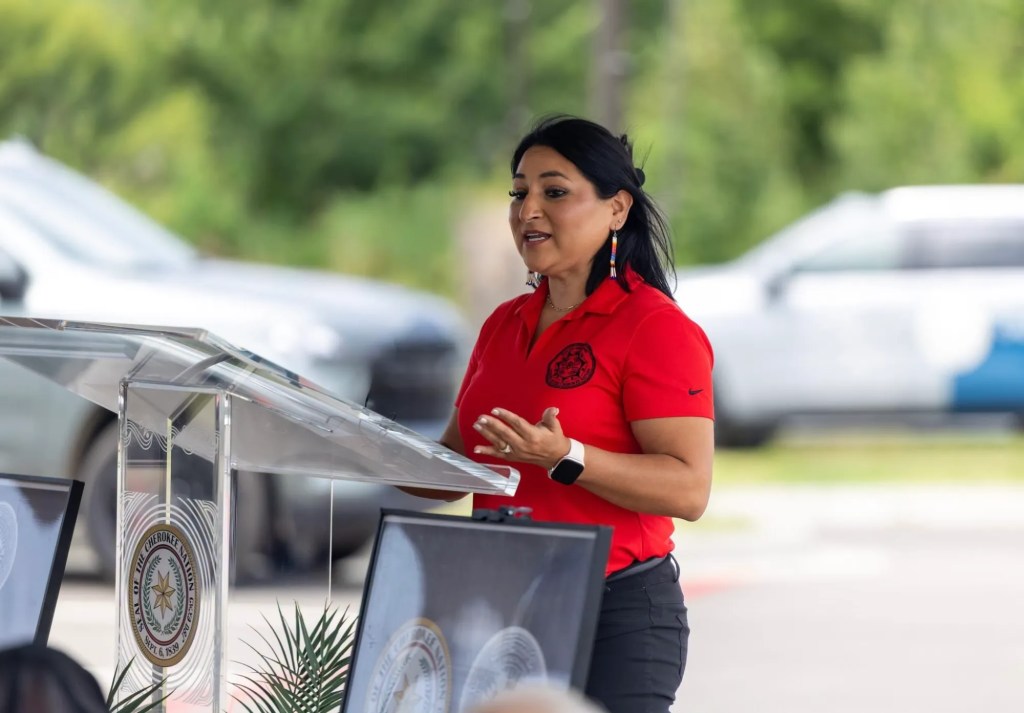
Recently, I talked with Sasha Blackfox-Qualls, a former registered nurse and current Cherokee Nation Tribal Councilor. Blackfox-Qualls participated in the 2025-26 Obama Foundation Leaders USA cohort, an eight-month leadership program for 24 to 45-year-old changemakers across the public, civil, and private sectors. Guided by a sense of service to her fellow community members, Blackfox-Qualls has contributed to improving maternal and infant outcomes during her time working with the Oklahoma Perinatal Quality Improvement Collaborative on implementing the industry-standard TeamBirth process which seeks to address preventable failures in communication resulting in a more dignified and safe childbirth experience.
This conversation has been edited for length and clarity.
The Daily Yonder: You’re currently serving on the Tribal Council of the Cherokee Nation as a representative, but I learned about you from your work with TeamBirth, where you brought your experience as a registered nurse to bear to improve maternal outcomes in your community.
SBQ: Yes, I work and reside within the Cherokee Nation Reservation here in Northeast Oklahoma. Prior to me being on the council, I served as a registered nurse, and I was the inpatient nurse supervisor for the inpatient obstetrics department. What we’ve seen is that Native Americans face higher health disparities, higher rates of maternal and neonatal morbidity, and mortality rates. We started looking at some of the initiatives that we could do to minimize those risks to our citizens. Working closely with the Oklahoma Perinatal Quality Improvement Initiative, there is an initiative called TeamBirth which incorporates what they call ‘huddles.’ We started working with the team in Oklahoma City to bring that effort to the Cherokee Nation.
We were seeing the national primary C-section rates increasing. TeamBirth initiatives start out as a shared decision making model with the patient and their families, and it incorporates them into overall patient care. Whenever we see someone come into the hospital, we generally don’t see them on their best days. We often tend to think of having a baby as a celebration, and it is, but oftentimes that’s not the case as well. We see a different side of delivering a baby, and it’s very unfortunate for some of those families. We want to be there for the patient and for their family.
We take in the whole family as one that we care for. Whenever a patient presents to our department, their care team, whether that be the nurse, a midwife, the physician, we have a huddle within a certain amount of time of their admission and we talk about their plan of care in the room, at the bedside with the patient, and anyone that they choose to be a part of their support system [can be there]. We discuss the plan of care amongst everyone, that way there’s close communication. Anytime that there’s a change in patient status, then we have another huddle. That helps decrease the need for primary C-sections, adverse patient outcomes, and improves overall patient satisfaction.
DY: It’s so important for patients to feel like they have a role in the process, right? In implementing the huddles you were successful in reducing maternal mortality rates and achieving a below national average C-section rate. With that improvement – and of course, there’s more to go and maintain – is there another area of care that you’re focusing on for rural and tribal areas?
SBQ: I did have to resign from my position as a registered nurse since serving on the Tribal Council to avoid a conflict of interest. I miss patient care tremendously, I do, but serving on the council, I am able to help a wide range of citizens throughout the entire district that I serve, and not just in OB care, but all aspects of life whether that be education, roads and transportation, housing, childcare, education, or public health initiatives. My day-to-day work varies as does the impact that I’m able to make now.
DY: It must have been hard to make that change, resigning as a registered nurse for the time being.
SBQ: Yes, it was very tough. I had to really think about and pray about it and talk it over with my family. There was just such a need for improvement here in rural Oklahoma. My heart was in it and my willingness to serve the community too. My overall goal is to make a positive impact and be a role model for our youth. I want them to have eyes where what they can see is what they can be – and hope that they too grow up and want to make a difference in this crazy world.
DY: You participated in the Obama Foundation Leaders USA program last year. I’m curious how you thought about participating in a cohort that’s national, and even global, and how you make sense of the place-based work that you are doing at the same time?

“My overall goal is to make a positive impact and be a role model for our youth. I want them to have eyes where what they can see is what they can be – and hope that they too grow up and want to make a difference in this crazy world.” (Photo courtesy of Sasha Blackfox-Qualls)
SBQ: To be transparent, I did not even know about the Obama Foundation leadership program. I was nominated through my work at TeamBirth. I got an email saying “congratulations, you have been nominated. Here’s the application link” and I was kind of blown away – I was a little bit starstruck. I went through the application process and it was a bit daunting knowing how many applicants there were and how many they were selecting. I felt like a small fish in a big pond. I got selected to serve and it was a bit overwhelming thinking, “what is it that I have done to deserve to be a part of these amazing leaders, these change makers?”
During the program, they break you up into groups – I’m not sure how they do this, but it’s just like magic – and you feel like you have known your cohort your entire life, and that you too belong within this group of change-makers. It’s such an honor to have been selected to be a part of that cohort.
DY: I can definitely understand that internal feeling of “should I go for this?” or “does it make sense for me to be here?: I’m so happy to hear that it’s a place that you found belonging and collaborators. Has it changed how you think about the work you’re doing locally?
SBQ: Definitely. I now have a group chat with 100 change-makers across the nation. Whatever I may encounter, for instance, one of my schools may be looking for grants for recreation activities – if they’re needing a new playground set or lights for a ball field, or public safety initiatives – I’m able to bounce ideas among that network and to have those friends. It has been life changing because I’m able to incorporate all of their knowledge and bring that here to rural Oklahoma, whereas I didn’t have that before.
DY: I imagine that the people in the cohort are all types of folks who are working on specific issues, or in place-based ways where everyone is really connected to what they’re doing and have a lot of experience to offer and suggestions to make.
SBQ: Absolutely, everything from climate change to AI to public health. We have legal representatives, those that were in the House and Senate in their respective states, philanthropy, arts and culture, different religious backgrounds… It’s just a wide variety of knowledge. It’s been amazing to make these connections and friendships and to have that resource to bring back here.
DY: What advice would you give to other folks who may think to themselves, “well, I don’t know if they, whether it is this program or something else, would ever accept me”?
SBQ: I would say go for it. To not be afraid to take that leap of faith and to believe in yourself. You’re worthy of this.
Note: The Obama Foundation Leaders USA application will be live from early November through early December. They are looking for Leaders between the ages of 24 and 45 who have at least three years of demonstrated impact in their field. Applicants do not need to be nominated to apply.
This article first appeared on The Daily Yonder and is republished here under a Creative Commons Attribution-NoDerivatives 4.0 International License. 
The post Q&A: Sasha Blackfox-Qualls appeared first on ICT.
From ICT via This RSS Feed.