

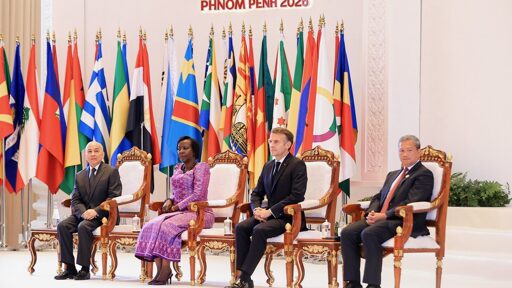

The 20th Francophonie Summit – the highest meeting of the International Organization of La Francophonie (OIF) – took place on November 14**–**16 in Phnom Penh, Cambodia, without three West African countries that have increasingly distanced themselves from France and its political influence in the region.
The three-day summit, hosted for the first time by Cambodia, brought together leaders and representatives of French-speaking countries under the theme “Reinvesting in Peace for Shared Prosperity and Lasting Stability.” Among those attending was French President Emmanuel Macron, Rwandan President Paul Kagame, Democratic Republic of Congo President Félix Tshisekedi, Canadian Prime Minister Mark Carney, Vietnamese President To Lam, and Togolese President Faure Gnassingbé.
However, the absence of the three Sahelian countries, alongside a bitter diplomatic dispute between Rwanda and the Democratic Republic of Congo (DRC), continue to make the headlines.
The Sahel’s departure from the Francophonie
Mali, Burkina Faso, and Niger were suspended from the OIF following military coups in 2020, 2022, and 2023, respectively. Their governments subsequently moved to end longstanding military and diplomatic arrangements with France, including the expulsion of French troops from their territories.
In March 2025, the three countries announced their withdrawal from the International Francophonie Organization (OIF). Niger and Burkina Faso communicated their decisions on March 17, followed by Mali on March 18, shortly before International Francophonie Day on March 20.
In a joint communiqué, the foreign ministers of the three countries recalled their historical involvement in the organization, noting that they had participated as founding members in the 1970 Niamey Summit, which established the Agency for Cultural and Technical Cooperation (ACCT), the institution that eventually became the OIF.
However, they accused the organization of abandoning its founding principles of cooperation, solidarity, and respect for cultural diversity following the military transitions in the three countries. Instead of supporting their populations’ aspirations, the OIF had distinguished itself through the “selective application of sanctions on the basis of geopolitical considerations and contempt for their sovereignty.”
The ministers further accused the organization of becoming a “remotely controlled political instrument,” arguing that its actions contradicted its stated objectives of promoting peace, cooperation, and solidarity among member states.
The communiqué stated that the three heads of state, Burkina Faso’s Captain Ibrahim Traoré, Mali’s General Assimi Goïta, and Niger’s Brigadier General Abdourahamane Tiani, had decided to withdraw their countries “in full sovereignty,” adding that the decision reflected their commitment to “defend their legitimate interests.”
The departure carried a particular historical note. Mali and Niger were among the organization’s founding members, and the agreement establishing the ACCT was signed in Niamey on March 20, 1970. Their withdrawal, alongside Burkina Faso’s, was a major break with an institution that has historically connected France with countries across Africa and other parts of the world.
Often described as the French-speaking equivalent of the Commonwealth, the OIF brings together 90 states and governments, comprising 53 full members, five associate members, and 32 observers.
Leadership dispute exposes divisions between Rwanda and DR Congo
The summit’s other major challenge was the failure to elect a secretary-general for the 2027–2030 term, following a diplomatic confrontation between Rwanda and the Democratic Republic of Congo.
Rwanda’s Louise Mushikiwabo was seeking a third term, but her candidacy faced opposition from Congo, which accused Rwanda of supporting the M23 armed group operating in eastern DRC. The Congolese government had initially presented Juliana Lumumba as its candidate but subsequently withdrew her candidacy and backed Romania’s Dacian Cioloș. Mauritania’s Coumba Ba was also in the running.
The dispute escalated when the DRC threatened to walk away. Rwanda, meanwhile, denounced France for interfering in the election after reports emerged that Macron had asked Kagame to withdraw Mushikiwabo’s candidacy, a request Rwanda rejected.
Following closed-door negotiations, member states failed to reach a consensus. Instead, they agreed to extend Mushikiwabo’s mandate by 12 months and postpone the election until further notice.
Despite the leadership impasse, the summit adopted three documents: the Phnom Penh Declaration, a resolution on crises and peacebuilding, and the Phnom Penh Appeal on protecting cultural heritage.
France searches for new partnerships beyond the Sahel
The summit took place amid France’s declining influence in parts of West and Central Africa, particularly following the withdrawal of its military presence from Mali, Burkina Faso, and Niger.
Macron’s attendance also came as he faces domestic political challenges, including protests over the cost of living, wages, inequality, and public services. The demonstrations have added pressure on the French government as the country approaches its next presidential election.
Beyond the Sahel, France has increasingly sought to reposition its diplomatic and economic relations with other African countries.
In May 2026, Macron co-hosted the Africa Forward Summit in Nairobi with Kenyan President William Ruto, the first in an English-speaking country. Progressives in Kenya argued that the Nairobi summit was an attempt by France to reposition itself, with East Africa emerging as a new strategic frontier.
Read more: After setbacks in West Africa, France courts Anglophone Africa
Francophonie as a political camp has challenges. Its members share a language, but not interests. Three founding members have walked out, the largest African member threatened to follow, and the leadership is deadlocked. The revival of France’s place in Africa and in a shifting world order is facing difficulties.
From BT News via This RSS Feed.