

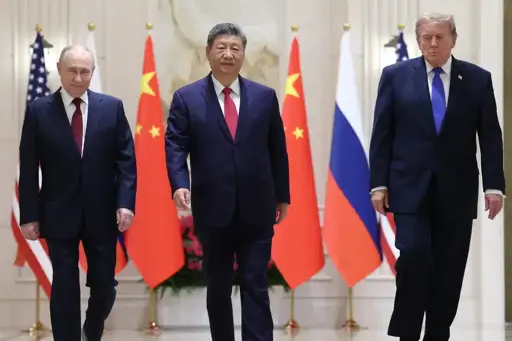
All eyes were on the futuristic Chinese city of Shenzhen for the latest summit of the Asia-Pacific Economic Cooperation (APEC) in China. Donald Trump, Xi Jinping and Vladimir Putin appeared together on the same stage, amid tensions with no real prospect of a resolution. The APEC summit took place following the Association of Southeast Asian Nations (ASEAN) conference in the Philippines, which also included a symbolic security meeting of the “Quad” (comprising the United States, India, Japan and Australia) in Manila.
A New Yalta?
The APEC summit hosted the first-ever trilateral meeting between the leaders of the United States, China and Russia. The wars in Ukraine and Iran, nuclear weapons and the technological race were supposed to be on the agenda, but were unlikely to go beyond announcements reflecting each participant’s own priorities. And that is precisely what happened: the meeting, which lasted an hour and a half, concluded with the publication of a four-point “peace declaration” covering “UN reform,” “energy security,” “immunity for their officials” and “dialogue on nuclear risks.”
Despite the absence of European powers from the negotiations, Europe featured prominently in the discussions, particularly regarding plans to reshape the UN to suit the interests of the major powers represented at the summit and the question of the war in Ukraine. Discussions between the United States, China and Russia remain focused on the strategic debate surrounding the decline of the unipolar world that emerged after the fall of the Berlin Wall—a decline whose effects are being felt mostly by the European imperialist powers.
Other issues discussed included the economic crisis and the rising cost of living linked to the wars in Iran and Ukraine, as well as challenges to institutions such as the International Criminal Court. However, this meeting between Putin, Trump and Xi Jinping was far from being a “new Yalta,” as some bourgeois media outlets have described it.
Unlike the conference held during World War II, when the world was divided into blocs led by US imperialism and the Soviet bureaucracy, the former workers’ states, bureaucratically deformed or degenerated, are no longer on the agenda. While the Yalta Conference sought to organize the postwar international order and contain the inevitable upsurges in class struggle that awaited Europe and the world after 1945, the Shenzhen meeting appears primarily to confirm the accelerating decline of the United States as the power that had dominated the international order unchallenged for several decades.
The United States, the dominant imperialist power since the collapse of the Soviet Union, stood alongside China, the rising capitalist superpower, and Russia, whose declining economy has become increasingly dependent on Beijing
However, the Yalta settlement helped maintain an international order built on containing class struggle worldwide, thanks to Stalinism’s active collaboration with imperialism. Whereas the APEC summit took place against the backdrop of an explosion of class struggle that has been unfolding in recent weeks, particularly in Europe. Indeed, the meeting coincided with a wave of class struggle stretching from Bangladesh to Indonesia and from Spain to the youth rebellion in France, which also reflects a significant international shift to the left.
Europe at the Heart of the Global Imperialist Crisis
Putin hoped to show Europe that Russia was not isolated, but the most eagerly anticipated meeting did not include European leaders. Nevertheless, he emerged as the event’s biggest winner: the summit provided him with a major platform to demonstrate that Moscow, rather than its European adversaries, remains a key bridge for both Washington and Beijing. Putin even contemptuously dismissed European powers’ initiatives to undermine Russia.
Europe and its major imperialist powers were, in fact, the biggest losers. They were completely sidelined even as they accelerated their headlong rush into an arms race and militarism. Tellingly, the war in Ukraine was not even mentioned in the final document signed by the three leaders.
Faced with the impact of the Shenzhen photo-op, the leading European figures in the so-called “Coalition of the willing” were forced to organize emergency meetings in Berlin that same day with Ukrainian representatives, in an attempt to counter this political spectacle and reaffirm their own geopolitical positions.
A Weakened US Hegemony Faces the Rise of China
Trump and Xi Jinping held their third meeting in 2026, amidst a radical shift in the balance of power between states, noticeably different from the situation in 2018, when the technological and trade war began.
Although Trump had previously held the upper hand, the balance of power is now tilting in China’s favor. Xi Jinping, who played host to the meeting, made a point of staging the decline of US hegemony from Shenzhen while reaffirming that Washington is no longer the sole mediator of world affairs. He made it clear that the United States must come to terms with the fact that they need to negotiate with the Chinese industrial giant, which controls a large share of global supply chains and strategic minerals.
The threat of trade sanctions and retaliatory tariffs, once an effective weapon against an economy as dependent on exports as China’s, now carries far less weight as China establishes itself as a global power in technology, industry and mining. Beijing has gone on the offensive, using its capitalist dominance in manufacturing and critical supply chains to coerce Washington.
Meanwhile, the US military defeat in Iran, followed by the international humiliation suffered in the Strait of Hormuz, had already signaled a shift in Washington’s power dynamic. The global superpower stood helplessly as China supported the Iranian theocratic regime. Trump’s crushing political defeat in the midterm elections, which turned him into a “lame duck” after his party lost both chambers of Congress, further strengthened China’s confidence.
“You are a great leader. I tell everyone, you are a great leader,” Trump had declared at the Beijing summit in May. In response to these flattering remarks, Xi issued subtle threats. The United States should stay out of the Taiwan affair, rein in trade provocations and put an end to its military adventures in the Middle East.
“Can China and the United States overcome the Thucydides Trap and create a new paradigm for relations between major powers?” Xi asked. 1He was referring to the tendency toward war that arises when a rising power confronts a declining one, which in this case would mean the United States. – Trans.
In September, Donald Trump personally welcomed Xi Jinping at Joint Base Andrews, greeting him on the runway with a lavish 30-meter red carpet laid out at the door of the Air China aircraft. Only John F. Kennedy had previously done something comparable, in 1962, and never before in the presence of a geopolitical adversary.
Indeed, the United States appears to be pursuing a dual strategy: on the one hand, accepting an ongoing and widespread decline in its hegemony, while on the other seeking to preserve its position as the foremost military and financial imperialist power.
The current administration illustrates this dilemma in its own way. Trump has cultivated a political relationship with China aimed at reducing open tensions and encouraging conciliation. The era of insults and provocations that characterized his first term is now over.
At the same time, within the deeper structures of the US imperialist state, the convergence of forces opposed to China has grown exponentially. Bipartisan agreements aimed at containing China cover every area, from trade in advanced technologies to restrictions on diplomatic partners’ bilateral relations with Beijing.
This is part of the latest wave of restrictive measures. Shortly before Trump’s arrival in Asia, his administration took steps to restrict China’s access to advanced AI chips through data centers located outside its borders, proposing new regulations designed to close a legal loophole and further exacerbate tensions.
On Tuesday, November 17, China denounced the proposed regulations as a “classic case of economic coercion and extraterritorial jurisdiction” that “disrupts the stability of global industrial and supply chains.”
This was the latest in a series of measures adopted by both sides to declare new sectors of their economies off-limits to their rival, under the pretext of national security. Beijing has designated more technologies as strategically vital, imposing tighter export controls. Washington has proposed banning US investment in Chinese biotechnology, hypersonic weapons and artificial intelligence.
Tensions are escalating as China’s presence expands massively into areas considered sensitive by the United States, particularly in Latin America.
In Brazil, Beijing has managed to establish a strong foothold for its cloud computing and artificial intelligence companies, offering storage rates 40% to 60% lower than those of US tech giants, alongside open-source licenses and agreements with the federal government and state administrations.
Faced with the rising costs of US computing infrastructure, dominated by AWS and Microsoft, the Brazilian government is pursuing a pragmatic strategy of “dual dependency,” taking advantage of China’s presence. This has attracted billions of dollars in investment in digital infrastructure and data centers not only from the United States but also from the Asian giant, including companies such as ByteDance, Tencent and Huawei.
China’s growing influence in key Latin American economies is difficult to contain and creates contradictions in US plans to aggressively reassert control over the “Western Hemisphere” through the “Donroe Doctrine.”
Trump and the United States Face Mounting Domestic Crises
The timing of the meeting between Trump and Xi could hardly have been worse for the United States. Militarily defeated in the Middle East and politically weakened at home, Trump arrived in Shenzhen as a diminished president.
On top of his collapsing approval ratings came the failure of the military intervention in Iran, a ballooning deficit and unprecedented public debt of $40 trillion. Amid this accumulation of setbacks, all Trump came away with was a photo-op in Shenzhen.
The US administration itself is divided over how to approach the China question. These internal divisions have deepened following revelations that Nvidia CEO Jensen Huang was having an extramarital affair with Alice Huang, director of Megaspeed, a data center company based in Singapore. US intelligence agencies identify her as a Chinese spy, alleging that she smuggled Nvidia chips into China.
It is widely known that Secretary of State Marco Rubio himself orchestrated the downfall of Jensen Huang, one of Donald Trump’s leading economic allies.
The affair also exposed tensions between Treasury Secretary Scott Bessent and Commerce Secretary Howard Lutnick. The latter has been criticized for slowing down measures aimed at restricting the supply of Nvidia chips to overseas data centers serving Chinese customers. Bessent, by contrast, has adopted a harder line toward China, with Rubio’s backing.
After months of internal debate, the Commerce Department published a comprehensive regulation targeting Chinese companies that had remotely accessed advanced AI chips through data centers in Southeast Asia.
The press release stated that the new trade regulation had been “drafted by and under the direction of the Treasury Department and the National Security Council,” first.
In response, Beijing has strengthened its arsenal of countermeasures against restrictions imposed on Chinese companies. It has established new legal mechanisms to circumvent foreign sanctions, and Chinese companies have filed lawsuits in domestic courts against international firms such as JPMorgan Chase and Citibank for complying with US restrictions.
It has also established a national foreign investment security review system, which it has used to block Meta’s $2 billion acquisition of Manus and SoftBank’s $5.4 billion takeover of ABB Robotics.
In China, the Specter of Social Explosion Haunts the CCP
None of these countries’ structural problems could be resolved through two days of symbolic meetings. Rather, the summit sought to conceal the internal weaknesses of all three regimes: Trump’s political deadlock, Putin’s costly military hemorrhage and China’s deep economic crisis.
And while there is no denying that Trump’s position in the United States is clearly deteriorating, there is little to suggest that more peaceful times lie ahead for Xi Jinping.
China’s economic difficulties reflect a deep structural crisis that directly affects its model of accumulation. The real estate sector, historically one of the country’s main engines of growth, is mired in a severe crisis. This is eroding household purchasing power, bringing construction to a standstill and causing investment in the sector to plunge by nearly 22%.
This contraction is worsening the weakness of domestic consumption and exposing a structural imbalance: household consumption accounts for just 56% of GDP, the lowest share among the world’s major economies.
Although the high-tech and electric vehicle sectors are experiencing strong growth, most of the workforce faces stagnant wages, widespread job insecurity and youth unemployment hovering around 19%.
Rather than redirecting resources toward strengthening the purchasing power of the working class, Beijing has chosen to inject enormous public subsidies into factories and high-tech industries. This policy is generating overcapacity and dumping on the global market, fueling a record trade surplus that is triggering a new wave of geopolitical tensions, tariff barriers and protectionist measures led by the United States and the European Union.
At the same time, the Chinese economy faces the threat of deflation and total non-financial debt exceeding 300% of GDP. This burden is compounded by local government financing mechanisms and loss-making “zombie” companies, drastically reducing the state’s room for maneuver in implementing effective countercyclical fiscal stimulus.
This economic suffocation has not emerged out of nowhere. It is accompanied by intensifying social tensions and class struggle across the country.
In response to unpaid wages, mass layoffs, sudden factory closures and rising youth unemployment, China’s working class and youth are reacting with a significant increase in wildcat strikes, work stoppages and spontaneous protests in factories and urban centers.
As grievances in traditional industries, hit by cost-cutting and corporate spending restructuring, converge with the exploitation of workers in the digital platform economy, the prospect of more intense social struggles exposes the internal fractures of China’s capitalist order at a time of recession and crisis in global hegemony.
The Specter of Class Struggle
The Shenzhen conference above all served to confirm the profound signs of weakness in US imperialism and the crisis of multilateralism that had placed the Western powers at the center of global relations.
US imperialism must now acknowledge the growing role of other powers, which are equally reactionary and bear deep structural weaknesses.
It is within these fault lines between the major powers that class struggle is emerging as a more decisive factor than geopolitics. This is demonstrated by the youth rebellion in France against the Macron government and the November 11 general strike in Spain to defend access to housing and fight precarious work. These mobilizations, like those in Italy, also oppose the military spending of the major powers.
A week before the summit, thousands of textile workers in Bangladesh went on strike to demand a 140% wage increase. This massive mobilization was quickly met with state repression.
These developments, which went unmentioned at the APEC summit, are of fundamental strategic importance. They point toward an increasingly turbulent evolution of state politics in the period ahead, regardless of any temporary agreements reached between Washington, Moscow and Beijing.
For while Trump, Xi and Putin posed for photographers in Shenzhen and signed their “peace declaration,” the accelerating trend toward militarism and the arms race, alongside cuts to social spending in areas such as education and healthcare—with Europe providing the clearest example—is fueling a powerful resurgence of class struggle, extending to the Gen Z uprisings in different parts of the world against an increasingly decadent and warmongering capitalism.
Originally published on November 20 in CRP Asia.
Notes[+]
Notes
| ↑1 | He was referring to the tendency toward war that arises when a rising power confronts a declining one, which in this case would mean the United States. – Trans. |
The post Shenzhen Summit: The Stakes of the Meeting Between Xi, Putin, and Trump Amid the Return of Class Struggle appeared first on Left Voice.
From Left Voice via This RSS Feed.