

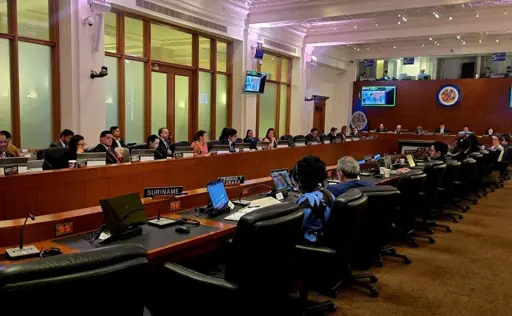
Mexico expressed its “deep concern” and rejection at the Organization of American States (OAS) over the convening of the Inter-American Treaty of Reciprocal Assistance (TIAR) consultation body to address transnational organized crime. Mexico warned that resorting to a Cold War collective defense instrument “could create a scenario of greater violence in which we would all lose.”
During a special session of the OAS Permanent Council on Friday, November 20, Mexico’s permanent representative to the organization, Alejandro Encinas, urged TIAR member states not to establish “an automatic link” between organized crime and terrorism, noting that they are distinct phenomena covered by different legal frameworks.
The resolution, backed by 14 of the 18 TIAR member states that participated in the vote, calls for examining measures “that do not involve the use of armed force” against drug cartels. Brazil and Uruguay voted against the initiative, while Mexico did not take part in the vote after having formally withdrawn from the treaty in 2002.
Encinas categorically rejected the concept of narcoterrorism, saying that there was no consensus on it in international law. He stressed that the unilateral designation of a criminal organization as a terrorist group “does not change international rules on the use of force or authorize military operations on the territory of other states,” a matter that falls exclusively under the authority of the United Nations Security Council.
Historical precedents and call for shared responsibility
In his remarks, the Mexican diplomat reviewed previous instances in which the TIAR was invoked to question its relevance. He pointed out that its first invocation targeted the “democratic and legitimately elected government of Guatemala,” leading to the US intervention that overthrew President Jacobo Árbenz in 1954. He further said that the 1982 Malvinas War exposed the TIAR’s operational limitations, and its 2019 activation regarding Venezuela (which withdrew from OAS that year) illustrated the risk of treating internal matters of countries as regional security problems.
“Security priorities cannot be subordinated to political considerations and the strategies of third countries. This proposal brings us closer to a point of no return where the OAS puts its mission and its future at risk,” Encinas warned. He noted that the approved resolution did not reflect the unanimous will of the organization’s members.
Encinas added that “drug trafficking does not originate south of the United States,” instead it is a network sustained by demand for drugs in the US, illicit arms trafficking, and global financial networks. He urged the OAS to address drug consumer markets and sources of arms supplies.
Finally, he pointed out that the OAS has specialized channels such as the Secretariat for Multidimensional Security and the Inter-American Drug Abuse Control Commission (CICAD) to approach these issues. He reiterated Mexico’s willingness to deepen police, judicial, and intelligence cooperation with full respect for national sovereignty.
(Telesur)
Translation: Orinoco Tribune
OT/JRE/SC
From Orinoco Tribune via This RSS Feed.