

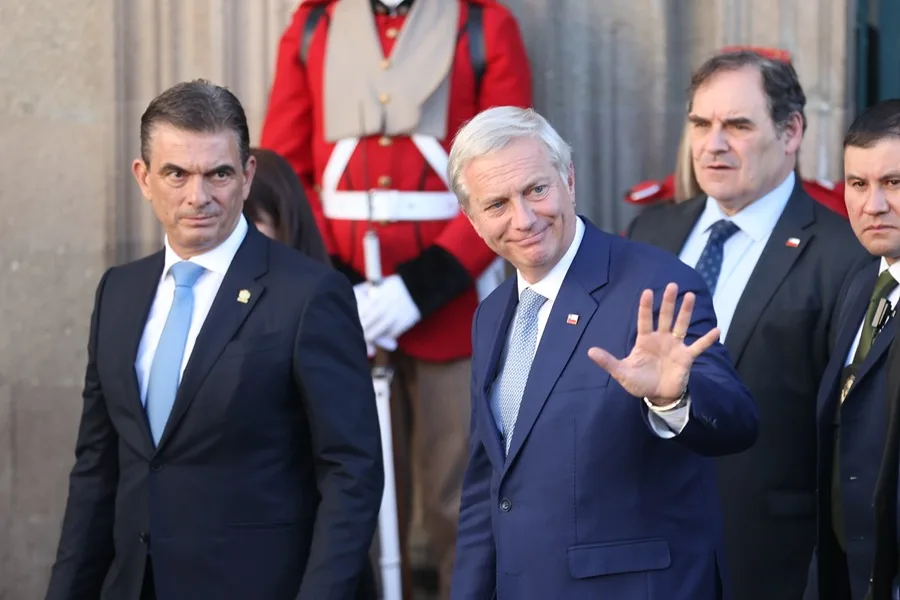
Both governments pledged to work toward restoring diplomatic ties, with discussions covering trade, infrastructure and security.
Bolivia and Chile have resumed high-level political consultations after 16 years, with both governments pledging to work toward normalizing diplomatic relations despite longstanding differences, Bolivia’s Foreign Ministry said Saturday.
RELATED: Thousands March in Chile Against Kast’s Budget Cuts
The 23rd Meeting of the Political Consultations Mechanism was held in Santiago, bringing together Bolivian Deputy Foreign Minister Carlos Paz and Chilean Deputy Foreign Minister Patricio Torres. The mechanism had not convened since 2010, according to the Bolivian government.
The meeting followed an agreement between Bolivian President Rodrigo Paz and Chilean President José Antonio Kast, who met in La Paz in mid-October and called for renewed engagement between the two countries.
🇧🇴🇨🇱 Tras 16 años, Bolivia y Chile retoman el diálogo político.
En Santiago se realiza la XXIII Reunión del Mecanismo de Consultas Políticas, con una delegación encabezada por el vicecanciller Carlos Paz y el viceministro de comercio exterior Rodrigo Arce. pic.twitter.com/yahjL7Gl5B— Cancillería de Bolivia 🇧🇴 (@MRE_Bolivia) November 20, 2026
Text Reads: After 16 years, Bolivia and Chile resume political dialogue.
The XXIII Meeting of the Political Consultation Mechanism is being held in Santiago, with a delegation led by Deputy Foreign Minister Carlos Paz and Deputy Minister of Foreign Trade Rodrigo Arce.
Both delegations acknowledged their historical differences and agreed to address them through constructive dialogue, pragmatism and a gradual approach, while maintaining a forward-looking perspective, Bolivia’s Foreign Ministry said.
The talks covered physical integration and connectivity, including the transit of Bolivian goods through Chile, the reversal of the Sica Sica-Arica oil pipeline and Bolivia’s access to fiber-optic infrastructure.
Economic issues also featured prominently, with officials discussing the modernization of Economic Complementation Agreement No. 22 and cooperation in investment, trade, mining and tourism.
The delegations also addressed cross-border security, efforts to combat human trafficking and transnational organized crime, consular and migration cooperation, and disaster risk management.
The renewed dialogue takes place against the backdrop of a longstanding dispute over Bolivia’s access to the Pacific Ocean. The two countries have had no diplomatic relations at ambassadorial level since 1962, except for a brief restoration between 1975 and 1978. Both, however, maintain general consulates in La Paz and Santiago.
The dispute escalated in 2013, when Bolivia brought its maritime claim before the International Court of Justice in The Hague. In 2018, the court ruled that Chile had no legal obligation to negotiate an agreement granting Bolivia sovereign access to the sea.
The two governments are scheduled to continue discussions on energy and security at the 14th Meeting of the Working Group on Free Transit, set for Dec. 11 in La Paz.
Since Rodrigo Paz took office in November 2025, officials from both countries have held several meetings to discuss economic cooperation, consular affairs and security, signaling renewed efforts to strengthen bilateral relations.
From teleSUR English via This RSS Feed.