

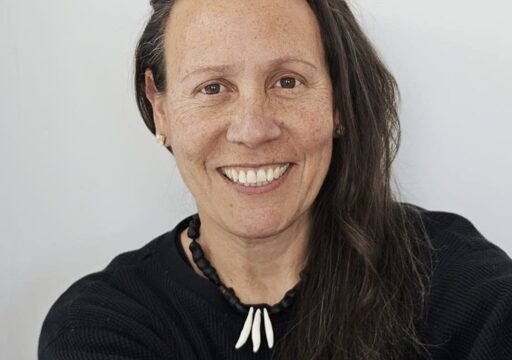

Julia Mage’au received the Senior Pacific Artist Award at this year’s Arts Pasifika Awards.
Last month, Julia Mage‘au Gray received the Senior Pacific Artist Award at the 2026 Arts Pasifika Awards in Auckland. Born in Mekeo, Papua New Guinea, where she’s the first person in 80 years to tattoo traditional designs, her work also includes dance, photography and filmmaking. Here she is talking to Dale.
Tēnā koe, Julia. I’ve got a very soft spot for Papua New Guinea. I was lucky to travel there when I was a young fulla.
Oh wow!
It was the first time I’d been anywhere outside New Zealand or Australia. So I fell in love with the place. We’re a league family as well, and I know PNG is a rugby league mad country.
But can we start by celebrating your people and your villages, please, Julia? Would you be kind enough to tell us about your whakapapa?
I am Mekeo. That’s where my family’s from. It’s in Central Province, and it’s a three-hour drive west of Port Moresby. My village is Oaisaka — the government name is Inawi.
My mother was born there, and my father is Australian. But yes, I was born and raised in Papua New Guinea in my early years. I’ve lived both in Papua New Guinea and Australia, and I married into Aotearoa. My partner Aniheta Crombie is from Levin. He’s Ngāti Tūwharetoa and Muaūpoko.
Beautiful. I was there because I used to sing with our family in a cabaret group, and we did a tour up there when the South Pacific Festival of the Arts was on. It was the early ‘80s.
That would have been amazing.
It was amazing. The event was in Port Moresby and we entertained in Rabaul, Lae, and up at the Panguna mine when it was open. It was quite a trip. What was your old man doing up there?
My grandfather worked there. He was a lithographic printer for the Department for Information and Extension Services from 1963 till 1974, and so my father, Rick Gray, was raised there. He was there from when he was about 12, and then he moved back to Australia when he was 19.
But he met my mum, Mali, in Sydney. She was one of the first Papua New Guineans to get a scholarship for high school in Sydney, so that’s where they met. He proposed under the Sydney Harbour Bridge.
As you do.
As you do, yeah. So, we’ve been back and forth between Papua New Guinea and Australia for quite some time, and I’ve spent most of my later adult years here in New Zealand.

Mali and Rick Gray, Julia’s parents. (Photo supplied)
Tēnā koe. So your mum went to high school in Sydney?
Yes, she’s pretty intelligent. Basically, her aunty took her to a boarding school, and she did some tests and was awarded a scholarship. She would’ve been 10 or 11 when she first went to Australia. And she froze — she was so cold. She still speaks her language, but now with an Australian accent. She ended up studying politics, so I suppose education’s in the family now.
You mentioned in one of your pieces that there are 800 languages in Papua New Guinea. So how does language retention and revitalisation differ from what we’ve witnessed here in New Zealand?
Papua New Guinea is incredibly diverse, and there more than 800 living languages — most of these languages haven’t died. So that’s a really massive difference when you’re in places like New Zealand and Australia, where Indigenous peoples are trying to bring back language.
I think that’s where Papua New Guinea has been very fortunate, but unfortunately, colonisation and Christianity don’t sleep, and our languages are slowly starting to feel the impact of that. They’re on the brink of full change. I mean, languages always change, but it’s a different landscape, so to speak.
But the importance of language and the impact of accepting many different languages in the same space is huge. Papua New Guineans are masters at code-switching and being able to read between the lines and pick up languages. So, for example, my mum speaks five languages, and that’s kind of average for Papua New Guineans.
And, of course, you have this overarching Pidgin, or Tok Pisin, which is awesome.
That’s right. Meanwhile, I struggle with one language.

Julia, aged 4 (right), with Bubu Isoaimo (great-grandfather) and Aunty Minia, in Oaisaka, Mekeo, Papua New Guinea, 1977. (Photo: Rick Gray)
Papua New Guinea is such a huge landmass. There are so many different people, and population numbers are largely guesstimates. You know, here we want a census to determine how many people are here and how old they are, and that’s pretty difficult in Papua New Guinea. What would you say of the way that the people of the land have been just that — they’re the people of the land, and sometimes we can’t catalogue or pigeon-hole them in the way that western society might want?
That’s so true. Living outside of Papua New Guinea, I really struggle with how academics and researchers speak about us.
Part of the work that I’ve been doing through my cultural practice, specifically skin marking, is authoring our own stories. Our stories and the way that we view the world are really hard to describe if you’re someone from the outside who’s never walked in our steps, so to speak.
So that’s at the forefront of our work: to author our own stories. And I suppose also to really bring light to the fact that, as Pasifika across the region — and this includes Austronesian-speaking peoples all the way to Taiwan — we are collective in the way that we do things. And when you grow up in a culture that focuses on the individual and what they want — me, me, I, I — how can you understand cultures like ours when you don’t know what it is to be accountable to everybody?
Papua New Guinea is really lucky in the way that we’re still connected to the land and to our ancestors, but as I said, colonisation and Christianity don’t sleep.
So we go home once a year, and we do our skin marking in our village and try to bring that back. But there are still missionaries bringing in new belief systems, along with colonisation and globalisation. It just doesn’t sleep, and so it’s a constant struggle.

Julia and daughter Vasa, marking the young women in their family in Gopoauga, Mekeo, Papua New Guinea. (Photo: Aisa Pokarop)

The young women of the family sitting with Madelyn Efi Eko, in Gopoauga, Mekeo, Papua New Guinea. (Photo: Julia Mage’au Gray)
Obviously the colonisation process is still underway, and it’s not just the western world, is it? You’ve got the encroachment of Indonesia in West Papua.
Yeah, it’s horrid.
I mean, hey, somebody decided to cut off half the damn land and take it for themselves.
I know. They divide us with these lines. Even the terms Polynesia, Micronesia, and Melanesia — our ancestors didn’t have those lines. Our lines were our family lines. They were lines that showed how we were connected, and now we have these political lines that divide us. And unfortunately, we hold to those lines. “I’m Melanesian,” or “I’m Polynesian”. We adhere to them. But it’s sad. We should be holding to the lines that connect us, not the lines that divide us.
And when I think of West Papua and Papua New Guinea, I think about how we have 800 living languages in Papua New Guinea, but in West Papua at the moment, there are only 200 or so. I mean, if one half of the island is over 800 and the other is 200, that speaks for itself. How much has been lost, and will we ever gain that knowledge back?
Tēnā koe. I was intrigued when I read a piece where you said that you’re a very keen observer of body language, and that the body doesn’t lie. What do you mean by that?
I think what we all forget is that our first language isn’t verbal — it’s physical. As mothers looking at their children, and as babies, we learn to read each other’s bodies. You can feel the energy that’s being projected from someone. You can see in their bodies whether they’re open to you, or whether they’re closed to you. In Papua New Guinea, absolutely everybody can read the room, so to speak.
When you’re surrounded by different cultures and different languages, you rely on the body. Because the body never lies. It will always speak its truth. And I mean, this is a massive topic, but once you learn to read what the body’s saying and the energy that’s coming from other bodies, or from your own, you gain quite a lot.
And it’s not just the body. That visual language also includes what you wear and how you wear it. As a people, what you choose to wear says a lot about what your culture holds important. What do you speak about with what you wear? For example, we wear our dogs’ teeth when we’re dancing, and without dogs’ teeth, it’s a bit empty. It’s like, this is our wealth — this shows our connections.
Basically, it’s language without the words. I really believe that it’s not the words that hold the culture. It’s your bodies and your practice and how you think that holds the culture, and then the words come from that.
And it’s through our practice and our bodies that we connect to our ancestors. If you’re not doing the practice and you’re only using the words, there will be a disconnect between the way our old people thought and how we think today.
If you look across our region, there are so many similarities in the way we express ourselves and the way that we connect to our ancestors. We have far more in common with one another than we realise.
I mean, gosh, you can go to Rapa Nui, and they wear boars’ tusks, and you go to Papua New Guinea, and they have boars’ tusks. When you go to Sāmoa, they have centipede tattoos. You go to the Philippines, and they have centipede tattoos. The whole region is connected, and that’s the beauty of it.

Dressing Magaiva, in Port Moresby, Papua New Guinea. (Photo Julia Mage’au Gray)

The cousins being dressed to gefa. Port Moresby, Papua New Guinea. (Photo Julia Mage’au Gray)
Let’s talk about dance for a moment. I’m very interested in your skin marking kaupapa, but dance is also part of your work. Did you see this from your nana or your aunties in the village? Where did you get the moves and the choreography in your mahi?
The dancing comes into it because that’s our family’s role. We are a dancing clan, so I’ve always been around it. I think what is difficult for a lot of people to understand is that dance and music and our visual language are all connected. They’re not separate or divided.
If you look at it as Mekeo, you wouldn’t use the word “dance” as the umbrella term for our cultural practices. So when I think of dance, it’s not just movement — it’s also expressing something about my family.
So the skin markings, what we wear, how we wear it, and when we wear it are really important. And so is the dancing for us.
I mean, when I got the award, I was asked to siva up to receive the award, which made me laugh because, one, I’m not Sāmoan. And two, if I was to actually dance up in the Mekeo way, it would take me a good three days because we don’t dance for nothing. It’s long. Just getting dressed takes a long time.
I think dance has always been a massive thing for me because, when you move around quite a lot between countries, language is not the thing that you fall into — it’s the body. And so, reading the body and moving became normal. That was what I was comfortable with.
I sat with my grandparents, my grandfather in particular, and I watched him make all the adornments that we wear. And then I would watch them dance, and the dance would last for at least three days when I was young. Now it’s not so much. But they would dance all night, all day. They wouldn’t rest. They would fast for this.
That’s where that love of dance began for me. My body moved that way, and when words are not your friend, that’s what ends up happening, I reckon.
I reckon. I’m picking that these three-day dance festivals help you get closer to our maker, and I just wonder if you’ve experienced a spiritual jolt or trance-like state when you’re deep in your village dance?
Oh gosh, yes, it’s very trance-like. It really does pull you in. But I think that when you’re listening to your body, you can move into that space all the time. A lot of our work is reading the body, and so when we’re doing our skin marking, when we’re doing a movement practice, when we’re making our skirts, our necklaces, those are all moments that connect you spiritually.
It’s being able to sit in the silence and to listen and be present, but it’s also being able to laugh and cry and be angry. So, for us, to be connected to our ancestors is to be in the moment, to be in the practice. And to be able to listen to what your body says when you’re working, when you’re doing the mahi. That’s when they come through, and when the stories come through. So, I suppose it’s less about a jolt moment and more about it being a daily practice.

Julia and daughter Vasa marking Ade Revareva on Ranu James in Beerwah, Queensland, Australia. (Photo: Kat Sonter)

Vasa and Julia marking.
Tēnā koe. That brings us to skin marking. Here, too, there’s been a revitalisation of tā moko. I think that’s occurring around the wider Pacific. Did you have any hesitancy as a wahine bringing back wahine skin markings?
I follow my gut and do what needs to be done, and then I think about the consequences later. So, I think that’s kind of the approach that I took with picking up the tools.
I couldn’t have picked up the tools anywhere else but Aotearoa. I say that because this place allows for that kind of growth. In Australia, we couldn’t do this work mainly because we’re still justifying who we are on a daily basis. But we could come to Aotearoa and pick up the tools and be accepted. We were so welcome.
I resisted picking up the tools at first*,* but I could see that no one else was going to do it. And then, as I continued on the journey, I realised that without my knowledge of dance and the way that we dress, I wouldn’t have been able to revive the practice anyway. Because you need that knowledge — the way you wear, the way you move, how things are worn, what designs go where, you know? You need to understand how a design fits on the body, and how it works with the energy of a particular individual.
It’s been 12 years of developing a practice. And I’m realising that reviving and continuing a practice, keeping it living, isn’t just about picking up the tools, it’s actually about listening. Listening to what’s around you. Changing our colonised-shaped thinking.
Being in Aotearoa has been incredibly important for our practice to continue. Being able to be in conversations with other cultures, like the Fijian community that’s based here, as well as working with the Veiqia project. The work is so big that I actually don’t know how to talk about it, which is probably why I’ve started my PhD, because I feel I need to articulate it.
I’ve been working with my daughter and my cousin, placing our grandmother’s, our bubu’s, marks back onto their skin. What was normal for my grandmother is now normal for my daughter, but it’s something that we’ve had to work really hard to make normal again.

Julia’s daughter Salevasa (Vasa) in Mekeo attire.
Were there any reservations about wahine and tā moko from the old guys back in Mekeo?
No, no, it’s a women’s practice. They don’t have that issue in Papua New Guinea. But I have felt resistance here, because it’s a male-dominated industry.
That said, we’ve been making some noise, and there are other women artists out there starting their journeys. We were just in Taiwan for the Tattoo Waves Festival, which connects Austronesian-speaking peoples, and we were really excited because in the last two years it’s only been my daughter and me, and the rest have been male practitioners from Hawai‘i, Borneo, the Philippines, Aotearoa. But this year we had two other women practitioners who were from the Philippines and Sāmoa.
So, it’s definitely changing, and women are starting to really speak up.
Well, with your filmmaking, your choreography, and your skin art, you’re not just reviving these practices, but also playing a part in their ongoing protection.
Yes, definitely. And we’re also educating those who are coming through on what they can and can’t do, so they’re not just working in the dark.
It’s all for the same thing. It’s authoring our stories and wanting our voices to be heard and our old people’s thinking to come back through. And it’s using whatever tool is available to us, whether it’s theatre, film, or photography. Whatever we can do to bring people together and put our stories out there. I always say “we” because it’s not just me. I get the idea, and then I pull everybody in. We work together.

Julia with son Keama, daughter Vasa, partner Heta, and dog Tsiilo. (Photo supplied)
You know, you touched earlier in our kōrero on how lines on maps are used to divide us, but as Pasifika peoples, we’re all interconnected through our DNA and whakapapa and linguistically. What would you say about the interconnectedness we share as Indigenous peoples? How vital is it for us to collaborate in cultural preservation?
Oh my gosh, it’s so important. What some of us have lost, others have kept. So when we connect and tok stori, when we talk together, we are reminded. It helps us to remember what we’ve lost when we see what our brothers and sisters are doing across the seas.
It’s so important, especially when we recognise that a lot of us are connected because of the Austronesian voyages. We have similar languages. There are words that are the same. There are practices that are the same. Our worldviews are so similar because we’re related.
We’re so connected, it’s not funny. So I think it’s really important to have these conversations and to keep connecting with each other because that’s how we got here.
(This interview has been edited for clarity and length.)
The post Julia Mage‘au Gray: A language without words appeared first on E-Tangata.
From E-Tangata via This RSS Feed.
You must log in or register to comment.