

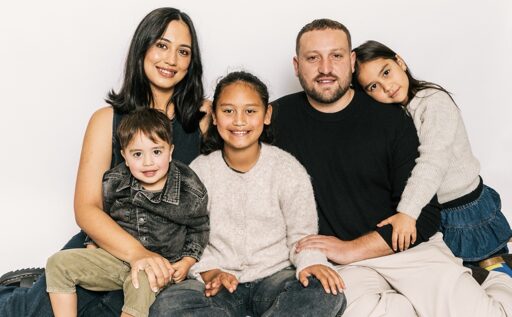

Christian Curtis and partner Sainima Morris, with their children. From left: Ezra Curtis (2), Amani Brown (10) and Aliya Brown (6). (Photo supplied)
Christian Curtis’s experience with his daughter’s schooling reflects what Māori educators have long known — that when hauora, or wellbeing, is the foundation, learning has somewhere strong to stand.
I can clearly remember my first parent-teacher interview for one of my daughters. I sat across from her teacher, who was doing his absolute best, while he explained that she was behind in maths, writing, reading, spelling and comprehension. Yet when I asked: “What about her? Her wellbeing? What is she great at? Does she interact well with her friends? How is she in the classroom?” I was met with a blank face.
Thinking back to that first meeting, I was saddened — for both my daughter and her teacher. But the system was doing exactly what it was designed to do: a teacher feeding back what he was required to prioritise, measure and report, and a parent left unsure about how his child’s wellbeing was being looked after while she was at school.
Four years later, my daughter is now in bilingual education at a new kura, where hauora is at the forefront, fostering resilient, capable tamariki who are grounded in their identity and culture. And guess what? She’s up to speed in all areas (and excelling in some). Her kaiako (teachers) know who she is and how she ticks, and they encourage her light to shine. As any parent knows, it’s a truly beautiful thing to see.
A year ago this month, the law changed to make educational achievement the “paramount objective” for every school board. Making sure a school is a physically and emotionally safe place became a “supporting objective”. And, as Jessie Moss wrote on E-Tangata recently, the curriculum itself is also under pressure.
For years, we’ve asked how schools can support the wellbeing of tamariki, but maybe we need to turn the question around. Why do we still treat wellbeing as something education provides alongside learning, rather than the foundation from which learning begins? What would education in Aotearoa look like if we designed it from hauora outward, rather than treating literacy and numeracy as the whole job?
Many of the answers already exist in kura kaupapa Māori, rumaki reo and bilingual education.
I’m not Māori, but I’m a father of two daughters who whakapapa Māori, Tokelau, Filipino and Scottish, and I pay close attention to the spaces where they spend their days. Every morning, they walk into a place where they don’t have to leave their culture or language at the door. They’re part of a whānau where tuakana look after teina, and where they’re supported to reach their fullest potential.
I’m also a systems innovator in the Healthy Families Waitākere team at Tuia Waitākere. My mahi asks me to think about the systems and environments that shape our health and wellbeing, long before we need a GP or hospital visit. That includes Whāia te Oranga, which places specialist hauora practitioners alongside kaiako in bilingual units in West Auckland.
As a pāpā and in my mahi, I keep arriving at the same conclusion: hauora and learning grow together.
The evidence reflects what many whānau already know — language, culture, belonging and learning are deeply connected.
Aotearoa research shows culturally sustaining learning environments can strengthen Māori students’ engagement, sense of belonging, and educational outcomes. Research in te reo Māori–English bilingual classrooms has found that strengthening te reo Māori doesn’t come at the expense of English — growth in each language can reinforce the other.
And Māori education researchers have long pointed to identity, relationships, culture and hauora as essential alongside academic achievement. When education strengthens who a child is rather than asking them to separate their identity from their learning, hauora and learning reinforce each other.
Bilingual education has all the answers. Over the last five years, I’ve seen how complex these settings are, the unbalanced expectations placed on kaiako, and the disparity in how classes are funded. Kaiako teach multiple year levels in one class. The kaiako in the bilingual units are the only ones tutoring kapa haka, the only ones leading karakia, mihi whakatau and karakia mō te kai, and the only ones in the school who can speak te reo Māori.
I also see the care they take to teach to the highest standard in two languages, and to nurture every tamaiti to reach their fullest potential. Imagine what would be possible if these spaces were resourced equitably.
In our whānau, hauora is what made that progress possible. Once my daughter’s wellbeing came first, her reading, writing and maths followed.
Our mokopuna will grow up in a world none of us can picture yet. They’ll need resilience, connection, a strong sense of who they are and where they come from, and the confidence to navigate whatever comes next. These are foundations for life.
What would it take?
Equity in how bilingual settings are resourced, so the load kaiako carry is rebalanced across a wider circle of support.
Hauora practitioners, kaumātua and community experts working alongside kaiako as part of everyday school life, with tamariki learning from people who share their language, culture and values.
Long-term investment, so that support stays with tamariki as they grow.
And a system willing to learn from what kura kaupapa Māori, rumaki reo and bilingual settings already know — that when hauora is the foundation, learning has somewhere strong to stand.
These days, I look forward to parent-teacher interviews. We talk about who my daughter is, what lights her up, how she’s growing as a friend and a learner — and then her reading, writing and maths.
Christian Curtis (tangata Tiriti) is a pāpā to tamariki of Māori, Tokelauan, Filipino and Scottish descent. He is a systems innovator with Healthy Families Waitākere at Tuia Waitākere and has spent nearly a decade working with Māori and Pasifika communities in West Auckland.
Further reading:
Mana Ūkaipō: Māori Student Connection, Belonging and Engagement at School. New Zealand Journal of Educational Studies.
A better start to literacy for bilingual children in New Zealand: findings from an exploratory case study in te reo Māori and English. International Journal of Bilingual Education and Bilingualism.
The post Without wellbeing, there is no learning appeared first on E-Tangata.
From E-Tangata via This RSS Feed.
You must log in or register to comment.