

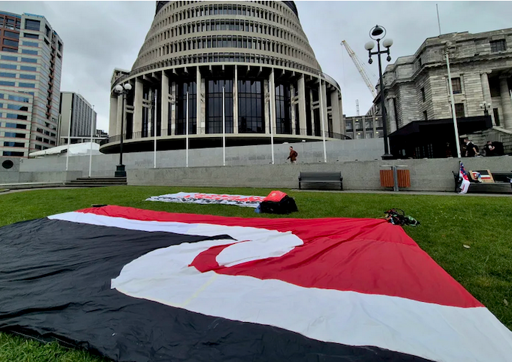

“If we’re serious about changing our form of democracy, we have a place to start, from He Whakaputanga and Te Tiriti to Matike Mai,” writes Catherine Delahunty. (Photo: RNZ)
Tweaking MMP doesn’t go far enough, writes Catherine Delahunty. We need constitutional transformation and a reimagining of the way we do politics in this country.
As we wait for the final election results, many commentators are looking critically at our electoral process. MMP has come under heavy fire, with much of the debate focusing on overhang strategies and the influence of big money.
Alongside that is a strand of disillusionment, not only with the failure of this election to deliver a clear result, but also with the failure of successive governments to deliver economic and social justice.
Some people think the 1950s were better times, some think that we should all just pull ourselves up by our own bootstraps, while others believe big tech solutions will save the climate and the economy.
But the real question has always been: “Better times for whom?” Another round of fast-track environmental attacks and racism, with no alleviation of poverty, feels especially bleak.
For many of us, the current debate doesn’t go far enough. Tweaking MMP won’t fix an electoral system that still fails the vast majority of us.
Instead, we should focus on constitutional transformation that benefits all of us, and the land itself. (For legal clarity, I recommend Claire Charters’ new book Sovereignty: The Case for Constitutional Transformation, where she describes the Crown as “unjust, illegitimate, illegal”. It’s an excellent starting point for a country that has yet to accept its history.)
In community gatherings around the country, many of us are already talking about how we might reimagine political decision-making in this country. The starting point is Matike Mai, the report on constitutional transformation.
These conversations are happening in large and small groups and are for everyone, because everyone is affected by the way our laws are made and implemented.
However, as we’ve found here in Hauraki, people need to understand He Whakaputanga and Te Tiriti o Waitangi before they can understand the basis for the constitutional changes being proposed. The fact that so many people haven’t had access to this knowledge inhibits our ability to reimagine a healthy political future.
In our Hauraki online reading group, which is reading Matike Mai chapter by chapter, people are considering the proposition that small tweaks to the Westminster system may not deliver the values or decision-making processes that benefit everyone.
This isn’t a radical conclusion, considering that the Westminster form of democracy was designed in a colonising and class-based society on the other side of the planet, reflecting a war-like vision of majority control over minorities, and prone to the elite manipulating that majority.
I recently learned the expression “the domination code”, which has deep roots in western political practice. Steve Newcomb, the Shawnee-Lenape scholar, activist and author, spoke about this at “Dismantling the Doctrine of Discovery”, an Indigenous gathering of inspirational thinkers and practitioners hosted by Tina Ngata and her team.
I was privileged to be there to listen to the dark history of colonialism in all its brutal detail and consequences, and to see Indigenous regeneration, which could literally save a fragile, broken world.
Can we non-Indigenous people also imagine something better in response to the challenge of Matike Mai? Because it’s clear that not everyone is flourishing in politics as we know it.
In my nine years as an MP, I met many people who believed all politicians were greedy liars who broke their promises daily. This deep cynicism wasn’t just among tangata whenua, who had every reason to distrust the Crown — it came from many other citizens, too. They saw us all as the same, which I think meant that they could see the system’s failures, but attributed them to bad characters motivated by self-interest and a love of power.
In my experience, most people who go to parliament aren’t bad people, but the system is based on values that don’t work for people outside that bubble.
It’s too easy to claim the system would work if only politicians were honest and well-intentioned, which is what the Opportunity Party is pitching. But if the system doesn’t change, nothing will. The Greens fought hard for a code of conduct in the House, but the two major parties rejected it. Not because they’re evil individuals, but because they’re comfortable with what Westminster stands for.
It’s a values-based system, but those values don’t build peace or justice, let alone housing and jobs. It rewards winners who have the numbers. It acts like Te Tiriti o Waitangi happened to facilitate Westminster domination.
In our reading group, we’ve reached the “Values” chapter of Matike Mai. It’s the heart of the kaupapa, and the values are easy to understand and relate to. Dr Moana Jackson, who was one of the leaders of this work, was known for putting care into every word of the Matike text, so that everyone could engage with it.
These values are all about upholding tikanga — doing what is right — and the need for belonging, conflict resolution, and community, which is defined as fair representation, good relationships, and mutual respect between communities.
Everyone who works in communities knows it’s not easy, but the collaboration and mutual respect that these values express are far more workable than competition and domination.
Pākehā grappling with these ideas can feel the depth of humanity in the Matike Mai values. They’re saying these values give them a sense of hope that was completely absent from the recent election, and they offer a sense of community that feels like a balm after this year’s depressing adversarial shenanigans. But we must go further and let go of the idea we were raised to believe — that Westminster democracy is as good as it gets in a colonised country.
If we’re serious about changing our form of democracy, we have a place to start, from He Whakaputanga and Te Tiriti to Matike Mai. There is room, too, for other ideas and models based on the values of where we are and who we want to be.
It’s our imagination, courage and our relationships that can rebalance power and redesign the political systems, not our votes in isolation.
Now is a great time to talk about domination-based democracy as a failed political system and what could work better. Of course, the vested interests of 21st-century capitalism don’t want these changes, but the rest of us have everything to gain.
Catherine Delahunty is a Pākehā activist in environmental, social justice, and Te Tiriti o Waitangi issues. She is a writer and a tutor on social change issues, and a grandmother. Catherine was a Green MP for nine years and lives in Hauraki.
The post The system is broken, not just MMP appeared first on E-Tangata.
From E-Tangata via This RSS Feed.