

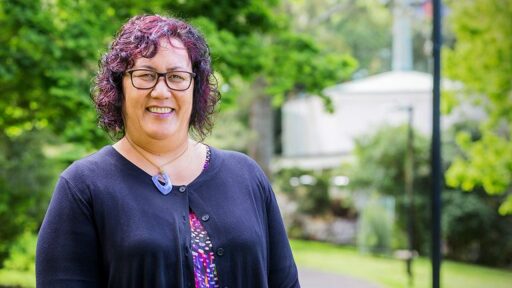

Dr Aroha Harris, associate professor of history at Waipapa Taumata Rau, University of Auckland. (Photo: Waipapa Taumata Rau University of Auckland)
Historian Dr Aroha Harris (Te Rarawa, Ngāpuhi) has spent more than two decades in research with iwi and hapū. In this excerpt from her new essay collection, We Are What We Write, she shares what she’s learned from studies that didn’t go to plan.
Despite more than 20 years’ practice and a genuine dedication to researching right, I have rarely paused to reflect on the times my research — no matter how informed and well-intended — has gone wrong. Today, I’m going to do exactly that: ponder the moments in my research life when best practice has gone bad.
Mistakes will be my focus: mistakes and misdemeanours arising from the lack of preparedness and naïve expectations of my clumsy younger self; bust-ups and breakdowns of an older, more qualified, but not-always-wiser me.
I have a seemingly large stock of examples to choose from:
Younger me was told by a project manager to pull my head in when I was about to argue over division of responsibility with a team member.
I once accommodated a research participant who wanted to contribute to a project I was co-leading but didn’t want to talk to me. To be fair, their reasons were not about me personally.
I’ve turned up to an interview and been told to leave my recorder aside. “What’s wrong with your ears?” I was asked.
I’ve been caught out more than once by research team members unexpectedly leaving mid-project.
But my main focus will be a small selection of examples harvested from an abiding commitment to iwi research, particularly in the North, as well as a range of non-iwi and non-academic research experiences.
These have often been entangled, long-running, loyal yet challenging experiences. Though I’ll make light of them, some were incredibly stressful at the time. Research has delivered many joys, but it has also been the source of many tears.
*
The more I think about the errors of my research ways, the more I have to think about. But there’s no need for sackcloth and ashes, because as I unravel these difficult moments, I want to be mindful of research as human interaction. I want to note the potential, therefore, for error, even in the face of best efforts.
And I want to nod to the view that sometimes when people participate in our research, they indulge us, usually from a position of aroha.

Aroha Harris’s new book was launched at the National Library Te Puna Mātauranga and included an on-stage kōrero with Charlotte Macdonald, left, professor of history at Te Herenga Waka Victoria University of Wellington. (Photo: BWB)
I was very young when I first experienced the genuine human response that research can generate. When I was at intermediate school, our local newspaper published an essay I wrote about Elizabeth Yates, mayor of Onehunga in 1894 and the first woman mayor in the entire so-called British Empire.
That story led an elderly descendant of Elizabeth to my door to thank me for the essay that honoured her grandmother. It was a touching moment between two people who might never have otherwise met — let alone have reason to.
In this instance, I could have just as easily been confronted by an angry descendant demanding to know who I was to write about their ancestor.
Fortunately — I think — my earliest errors were made among my own, particularly with my nana, my dad’s mother, Violet Ōtene Harris. The first time I sought Nana’s help with a research project, I was naïvely affronted that I had to do some work at the marae. I travelled from Auckland to Mangamuka for two working bees before we even spoke about my project.
Even after Nana and I got into a rhythm of working with my research interests, she still had waiata for me to learn, Māori Land Court cases for me to help with, hui to attend and, well, we all know how that goes.
Despite many missteps (or lessons, as I like to call them), I hope I haven’t wasted the privilege of being able to get it wrong in the privacy of a nana–moko relationship, to be mentored at the same time I was reprimanded.
In 1995, I interviewed a kaumātua, a retired career public servant. I thought I had it in the bag. We knew each other, and I already had three or four interviews in the series under my belt. So I kicked off with my usual two-part question about his name and where he was born.
In all the previous interviews, I had received an open-ended response about how people were named and why, often accompanied by explanations of parents, grandparents, significant aunts, uncles and siblings, which transitioned easily into conversations about childhoods and upbringings.
But with this interview, what I got was his name, the place he was born, and a birth date in the 1920s. Full stop. It wasn’t the answer I had prepared for, and if you listen to the recording, you can tell.
I was caught out unwrapping a cassette, barely paying attention at all. Generously, the kaumātua didn’t growl; he just gave me a look and time to recover. There is a silence in the recording which I still experience as embarrassed awkwardness — mine, of course, not his.
Sometimes, to console myself, I contemplate the possibility that if we don’t experience embarrassment and awkwardness at least once, we’re not doing it right, or at least not putting ourselves — our research selves — out there.
*
I’ve twice blundered into communities with unresolved prior research conflicts. I’ve been to hui where the teams I was a part of were confronted with demands like: “What do you researchers want?”
“We’re sick of researchers,” one hui said. “You come in, you do your research, and we never see you again. Why should we help you?”
I have to admit the first time this happened, I thought to myself, “But you knew we were coming with a research agenda — we set it up with you. Why did you wait till we got here to turn us away?”
Well, my private question was clearly answered as the group we were visiting talked.
They had never seen the results from an earlier project they had contributed to; in fact, they never saw those researchers again. I guess if you never see the researchers again, you lose the opportunity to express dissatisfaction — or satisfaction, for that matter.
So our team copped it. We didn’t get the interviews we thought we had arranged. But we did leave the group with the same koha we left with everyone who contributed, and we included their criticisms in our final report.
And I believe our handling of the situation at least partly contributed to that group opting to join a later research project.
 I recall being caught unexpectedly in two research hui bust-ups, both, unsurprisingly, related to Treaty claims. These have a great capacity to both reach boiling point and get so cold as to freeze people out.
At a hui to discuss a draft report I had prepared for a particular group, one of the whānau was so upset about the use of interviews undertaken 10 years earlier that, in their anger, they dredged up old internal politics that I did not need to know about.
The person wasn’t addressing me, but I felt incredibly uncomfortable and a bit anxious, so I decided to step outside and let the locals have their debate.
What I didn’t expect was that the protagonist would follow me. Fortunately, they calmed down, shifting from outburst to pleading with me to understand that their own family members, now deceased, were among those who’d contributed those 10-year-old interviews.
I already knew that, just as I knew the family members had agreed to be interviewed in support of the research. But my view wasn’t a priority in the heat of that particular exchange, so I left it alone.
In this case, time healed. The next time I saw that person, they were very complimentary about the report, and without necessarily apologising, muttered something about reading the report before judging it.
*
In another exchange, I was nowhere near as cool. One of my relations, who was angry about many things, accused research team members of doing what they wanted instead of what they were told.
After a summer of whānau working voluntarily because of issues with our funder, I was furious and joined the fray. But the moment I raised my voice, I knew I had crossed a line.
Before the end of the hui, I stood up to apologise, not just to my relation but to everyone. It was very clear to me that regardless of everyone’s roles in the heated debate, I had a particular responsibility as the lead researcher.
Most people were forgiving and understanding, but it was frosty for a while with that particular relative. Ultimately, producing a report that people were happy with helped relations to thaw.
And I do think that good outputs can help mend research injuries, just as they can affirm positive collaborations.
I have lost my cool on projects within research teams I’ve been a part of, rather than with our many and wonderful research contributors. I don’t need to expose the details to make the point that what I’ve learned is that teams develop their own dynamics.
Some teams work well, powered by trust, communication, reliability, and shared goals. Other teams struggle. They wrestle with debates they can’t resolve, develop tensions when team members over-promise and under-deliver, or buckle under the pressure of workloads and personality clashes.
But even teams that struggle can produce good results if they have solid leadership to lean on. I’ve benefited from such leadership myself, having had someone step in before an internal team debate got out of hand.
In that case, we agreed to finish the job first and then have the argument that was brewing. And it was a good strategy; a facilitated frank discussion that allowed everyone involved to work together again.

Dr Aroha Harris: “Sometimes, to console myself, I contemplate the possibility that if we don’t experience embarrassment and awkwardness at least once, we’re not doing it right, or at least not putting ourselves — our research selves — out there.”
I had planned at this point to comb back over the cases I’ve presented to pan for the gold in the lessons they’ve taught me. But then I realised I was at risk of patronising an already enlightened audience.
There’s no need for me to rehash those omnipresent guidelines about communication and responsibility and integrity; whanaungatanga. I will give this one tip for free, though: keep good friends. They will always come to the rescue when you need help to decompress.
Mulling over this final point, it occurred to me that underpinning everything I’ve learned is a certain touchstone, an anchor, a personal mission statement if you like: taku pūtake, my driving philosophy. Or maybe it’s not so sophisticated. Maybe it’s simply a reminder that I want my research to be a contribution to whānau and hapū lives.
History — the narratives of Māori lifeways shaped into histories alive with the power, wisdom, joys and tribulations of our pasts — is front and centre of my practice.
I am responsible for holding my bottom lines, including making repairs when I stumble or fall across them.
And I want to be fulfilled by the work I do.
In anchoring myself this way, in allowing myself to be appropriately guided, in aspiring to research right, I hope at least to minimise, if not eliminate, error and harm. And I hope all my mistakes are lessons.
We Are What We Write, by Dr Aroha Harris (BWB, $39.99) is available now.
Dr Aroha Harris (Te Rarawa, Ngāpuhi) MNZM is an associate professor in history at Waipapa Taumata Rau, University of Auckland. She is a founding member of Māori history collective Te Pouhere Kōrero, and has also served as president of the Native American and Indigenous Studies Association, the New Zealand Historical Association, and as a member of the Waitangi Tribunal.
The post When best practice goes bad appeared first on E-Tangata.
From E-Tangata via This RSS Feed.