

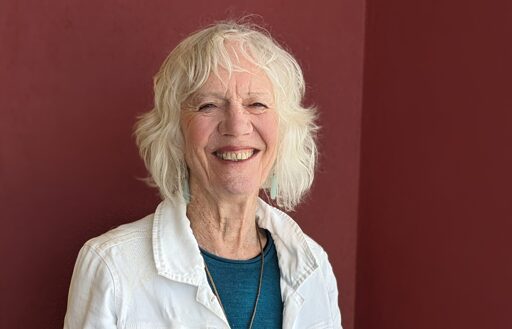

Recalling our country’s role in a mass boycott of the 1976 Montreal Olympics are Bob Burgess, who was an All Black in the early 1970s, podcast host Mary Ellen O’Connor, and activists David Wickham and Pauline McKay. (Picture: Josephine O’Connor)
Fifty years ago, at the 1976 Montreal Olympics, New Zealand caused the first major boycott of the Olympic Games when 26 countries walked out because of our sporting contact with apartheid South Africa.
Ask older New Zealanders what they remember about the 1976 Montreal Olympics, and many will likely say that it was John Walker winning the gold medal in the 1500 metres.
But not everyone. This year marks 50 years since Aotearoa caused the first major boycott of the Olympic Games, when nearly 30 countries walked out of the Montreal Olympics to protest against our ongoing sporting contact with apartheid South Africa.
Now, activists from HART (Halt All Racist Tours) are telling the story of their role in the boycott for the first time in a new podcast, Walkout ‘76: Rugby, Racism and Revolt. This four-episode podcast is a privately funded project, driven by members of HART who want Aotearoa’s role in this history-making walkout captured for future generations.
HART was formed in 1969 to oppose the New Zealand Rugby Football Union’s (NZRFU) acceptance of the South African Rugby Board’s proposal that Māori and Pasifika All Blacks be allowed to tour South Africa in 1970 as “honorary whites”. Previously, players of colour had been banned altogether.
As South African anti-apartheid campaigner Sam Ramsamy has said, rugby held a hugely important place in apartheid South Africa.
“The South African Rugby Board was more than a sporting body because it encompassed all the weird and illegal components of apartheid. Rugby was the bible, the universal bible for South Africa.”
And New Zealand, desperate to play rugby with its greatest rival, was happy to accept these rulings. In response, Syd Jackson, the president of the Federation of Māori Students, fired the opening salvo.
“No Māori should go to South Africa,” he said. “How can we, when seeking equality in New Zealand, go to a country which actively denies another coloured people the rights we either enjoy, want extended, or are striving to extend for ourselves?
“If Māoris go, they will be going for the entertainment and ego satisfaction of a white minority. The tour should be opposed whether Māori are allowed into South Africa or not.”
He then challenged the wider student body to take action.
That challenge landed on the desk of Auckland University’s international affairs committee, chaired by Trevor Richards. He called a meeting, and proposed creating an organisation to fight the All Blacks’ 1970 tour of South Africa.
Trevor remembers thinking: “If New Zealand couldn’t get it right on this, we couldn’t get it right on anything. We had to act.”
Tom Poata of the Māori Organisation on Human Rights attended that meeting and suggested the name Halt All Racist Tours, or HART, which stuck. Trevor Richards became the chair.
The idea of “honorary whites” served as a perfect target for the campaigners, who identified sport as the key axis between Aotearoa and South Africa in the anti-apartheid push of the 1970s.
Despite the protests, the 1970 tour went ahead. But after a Labour government was elected in 1972, New Zealand barred all sports teams not selected on merit, including the Springboks’ tour of 1973. HART felt that real progress was being made.
In 1974, the Commonwealth Games was held in Ōtautahi Christchurch. In what’s been called the greatest middle-distance race of all time, the little-known 20-year-old Filbert Bayi of Tanzania led from the front and beat the favoured John Walker into second place. Ben Jipcho of Kenya was third. The spotlight was squarely on African athletes.
But at the end of 1975, an extraordinary U-turn occurred. Robert Muldoon was elected prime minister, partly on his promise to “play sport with everyone”. White South African sports teams were now warmly welcomed back to Aotearoa New Zealand. The invitation for the All Blacks to tour South Africa in 1976 — with Māori and Pacific players again classified as “honorary whites” — was accepted with the blessing of the government. Black Africa was horrified.
This All Blacks tour was due to take place at the same time as the Montreal Olympics, in July 1976. The spectre of protest action against Aotearoa in the context of the Olympics now became a real possibility. South Africa had already been expelled from the Olympic Games in 1964 because of apartheid.
The Supreme Council for Sport in Africa, based in Nigeria and headed by Abraham Ordia, was key in what happened next. HART had been busy making connections in African countries, and in late 1975, HART activist Dave Wickham was having dinner with Ordia and Brigadier Olufemi Olutoye, Nigeria’s minister of sport.
Olutoye announced that should Aotearoa be allowed to take part in the games, the African nations would boycott. Wickham said: “I nearly fell off my chair. I hadn’t realised how far their planning had advanced.”
HART went into overdrive, campaigning against the All Blacks’ tour. As the departure date loomed, they saw a big spike in support.
Activist Pauline McKay recalls: “There was real momentum, and it came from a broad cross-section of the community, rather than the student-led movement it had originally been. The mainstream churches and the trade unions were the core of the HART base by then.”
Then, two weeks before the All Blacks were due to arrive in South Africa, there was a massacre in Soweto, a black township on the outskirts of Johannesburg. African schoolchildren, protesting against the use of Afrikaans as the medium of instruction, were mown down. The official death toll was 176, although some put it as high as 700.
“People witnessed schoolchildren being shot on their TVs,” says Trevor Richards. “I have never seen such a spontaneous and immediate outpouring of opposition to a rugby tour. People were coming onto the street, saying: ‘Where is a petition I can sign?’”
The tone-deaf NZRFU wanted to know what dead children had to do with a rugby tour, Richards said. “Oh, and by the way,” it said, “would there be any danger to the All Blacks?”
The NZRFU was not even slightly rattled, and the All Blacks duly departed for South Africa two weeks later with the government’s blessing. But Soweto had added an extra layer of disgust with South Africa to the already charged atmosphere.
Meanwhile, Montreal was preparing for the Olympics. Lance Cross, the New Zealand representative on the International Olympic Committee (IOC), was informing his fellow members of New Zealand’s “reasonable attitude to apartheid” and its resentment at being singled out by Black African nations for a possible boycott. He also suggested the threat was just a bluff.
HART had posted David Wickham to Montreal to monitor events and to stress that New Zealand was speaking with a forked tongue, using the “reasonable approach to apartheid” line for the international community and “we’ll play sport with anyone” for the home crowd.
Wickham also pointed out that while other countries played sport with South Africa, none did so with the blessing of their government. He recalls his encounters with Kiwi sports journalists in Montreal. “They didn’t have much of a clue about Africa, and swallowed Lance Cross’s line that the Africans were bluffing about the boycott.”
Dennis Brutus, the founder of SANROC, had now arrived from Chicago. He and Abraham Ordia worked hard behind the scenes to create a unified African response, anticipating that the IOC wouldn’t ban New Zealand.
They were right. Despite a last-minute plea from 16 African nations, the IOC didn’t ban New Zealand from the Games. Olufemi Olutoye, Nigerian chef de mission and sports minister, immediately called a press conference.
Everyone knew that at this point, a day before the Olympic Games opening ceremony, Nigeria’s decision would be critical. Olutoye wasted no time. He told the media: “What we object to is the principle of maintaining sporting relationships with racist South Africa, regardless of the type of sport involved. The Nigerian team will not be competing in the Olympic Games.”
Almost all African and Arab nations walked out behind them. Back in Aotearoa, with no idea what had happened, Trevor Richards stumbled out of bed in the middle of the night to watch the opening ceremony, the first live telecast beamed to the world.
“As Greece led the athletes into the stadium, I began to list the African nations that were not appearing, right until the last two, Zaire and Zambia, did not enter the stadium. Africa had closed ranks. It was an amazing moment.”

Trevor Richards. (Photo: University of Auckland)
All up, 26 nations who had registered to take part in the Olympic Games decided not to because of the New Zealand government’s open support for its All Blacks tour of South Africa.
This was a huge sacrifice for the African athletes, most of whom were already in Montreal.
Filbert Bayi lamented: “It was painful for us because we trained for four years. I missed that Olympic Games in 1976, and that was my peak. Even if I went to the Olympic Games four years later, I would not be the same Filbert Bayi.”
The sudden departure of the African teams profoundly altered the competitive dynamics in races such as the 1500 metres, 5000 metres, and 3000-metre steeplechase. The late withdrawal also caused widespread administrative confusion, not to mention massive financial losses.
But the historical impact was huge. This remarkable show of solidarity by the African nations forced international sporting bodies to confront apartheid on the global stage. It laid the foundation for the Gleneagles Agreement of 1977, in which Commonwealth nations, including New Zealand, committed to severing sporting contacts with South Africa.
On the domestic front, anti-apartheid sentiment had also reached a tipping point. By 1981, when the Springboks toured New Zealand — in direct contravention of the Gleneagles agreement — the massive groundswell of protest sparked a new era for the anti-racism movement in Aotearoa.
Now the movement was also being challenged by Māori to confront racism in our own backyard, which, although different in some respects, could look very similar to that of South Africa.
This story is important now because the ugly racism of the ’70s never really disappeared. It might have gone underground for a while, but cynical political actors can easily re-ignite it, as we’re seeing now.
In the Walkout ’76 podcast, HART activists are joined by special guests, including African running legend Filbert Bayi, New Zealand rugby great Bob Burgess, South African anti-apartheid campaigner Sam Ramsamy, and MP Willie Jackson, whose uncle, Syd Jackson, was instrumental in Aotearoa’s revolt against apartheid.

Mary Ellen O’Connor, a former teacher, hosts the podcast Walkout ‘76: Rugby, Racism and Revolt*.*
Walkout ’76 is available on Spotify, iHeartRadio, and Apple Podcasts.
See also ‘Neither Forgotten or Forgiven’, by Trevor Richards, which recounts the history of Māori protest against South Africa’s racist sports practices from the end of World War One.
The post Walkout ’76: Rugby, racism and revolt appeared first on E-Tangata.
From E-Tangata via This RSS Feed.
You must log in or register to comment.