

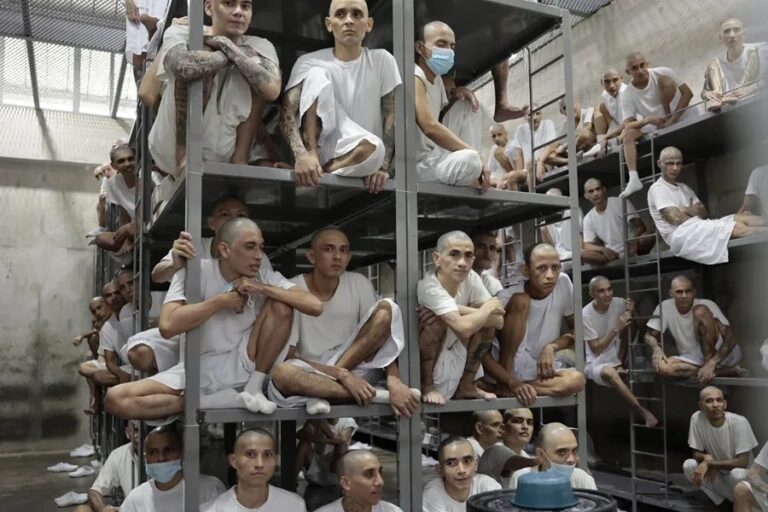
Bukele megaprisons Latin America spread as 16 projects emerge, raising concerns over human rights, due process, and organized crime.
Related: Bukele Registers Bid for Third Consecutive Term in Office
Bukele Megaprisons Latin America: 16 Projects Raise Rights Concerns
The Bukele megaprisons Latin America model is spreading across the region, with at least 16 megaprison projects announced or underway since 2023. The trend reflects the growing appeal of El Salvador’s hard-line security strategy, even as human rights groups warn of serious risks.[telesurtv]
According to InSight Crime’s “Map of Latin America’s Megaprisons,” countries including Honduras, Costa Rica, Peru, Ecuador, Panama, Colombia, and Guatemala have announced or launched large-scale prison projects. The report notes that many of these initiatives remain in the design or execution phase and operate more as political gestures than structural policy changes.[telesurtv]
The appeal of the model lies in its promise of immediate results. Bukele offers a dramatic drop in violence in a short time, but critics say the strategy comes at the cost of basic rights and due process.[telesurtv]
A Model Built on Propaganda and Control
The Bukele megaprisons Latin America strategy is being marketed as a solution to crime. But human rights authorities argue that the model’s success is built on a powerful propaganda machine that dehumanizes detainees and hides abuses.[telesurtv]
The report notes that the model attracts countries whose criminal problems are very different from El Salvador’s. In El Salvador, the government was fighting local gangs with limited resources in a small territory. In countries like Ecuador, Honduras, and Colombia, the challenge is transnational mafias linked to drug trafficking, port control, and institutional corruption.[telesurtv]
The difference in scale and complexity raises questions about whether the model can be replicated. Critics argue that what works in El Salvador may not work in larger, more diverse countries.[telesurtv]
A Wave of New Prisons Across the Region
The Bukele megaprisons Latin America trend is already producing concrete results. Costa Rica recently inaugurated the Center for High Containment Against Organized Crime (Cacco), inspired by El Salvador’s Center for the Confinement of Terrorism (Cecot), with a capacity for 5,100 inmates.[telesurtv]
In Ecuador, the Cárcel del Encuentro began operating in November 2025, while President Daniel Noboa’s government is planning another facility for 15,000 inmates. The existing prison has already faced allegations of torture, denial of medical care, and deaths of inmates in state custody.[telesurtv]
Other projects include the Minga Guazú Social Reintegration Center in Paraguay for high-risk inmates and the construction of Argentina’s Center for High-Profile Inmates (Ceriap), known as “El Infierno.”[telesurtv]
Inter-American Commission on Human Rights
Diplomatic Visits to Cecot
The influence of El Salvador’s system is also reflected in official visits to Cecot. Chilean President José Antonio Kast visited the prison days before taking office, and Peruvian President Keiko Fujimori visited in October as part of a “study” to apply the model in her country.[telesurtv]
These visits underscore the growing appeal of the Bukele model across the region. They also highlight the political dimension of the strategy, which is as much about image as it is about security.[telesurtv]
The visits have drawn criticism from human rights groups, who argue that exporting a model based on mass detention and limited due process is dangerous. They warn that the model could deepen authoritarianism rather than solve the underlying causes of violence.[telesurtv]
A Risk of Strengthening Mafias
Despite the rhetoric, specialists warn that building large prisons does not guarantee the dismantling of criminal structures. InSight Crime notes that organizations like Brazil’s First Capital Command (PCC) and Ecuador’s Los Choneros emerged or strengthened inside prisons, using them as command and recruitment centers.[telesurtv]
In Latin America, prisons have often been the origin and command center of organized crime, not its end. The report warns that mass incarceration could end up expanding the recruitment base of these groups.[telesurtv]
The operational limitations of the model are also a concern. While El Salvador was fighting local gangs with limited resources in a small territory, countries like Ecuador, Honduras, and Colombia face transnational mafias linked to drug trafficking, port control, and institutional corruption.[telesurtv]
Human Rights Abuses in El Salvador
The Bukele megaprisons Latin America model is also being questioned because of human rights abuses in El Salvador. Under the state of exception in place since March 2022, more than 90,000 people have been detained, with multiple reports of arbitrary arrests, torture, and mistreatment.[telesurtv]
The scale of the arrests led the Salvadoran government to acknowledge the release of about 8,000 innocent people and to consider granting parole to nearly half of those processed in October.[telesurtv]
Critics argue that what is being exported is not just a prison, but the idea that rights are an obstacle to security. They warn that once it is accepted that people can be detained without evidence and convicted without trial, no one is safe.[telesurtv]
United Nations Human Rights Council
Geopolitical Context
The Bukele megaprisons Latin America trend takes place at a time when security is becoming a central political issue across the region. Governments are under pressure to deliver results, and the Bukele model offers a seemingly quick fix.
The trend also reflects a broader shift toward authoritarianism in the Americas. By prioritizing security over rights, governments are testing the limits of democratic governance.[telesurtv]
The broader geopolitical meaning is that the model is not just about crime. It is also about the balance of power between the state and its citizens, and the future of democracy in the region.[telesurtv]
What Comes Next
The immediate next step is to see whether the megaprison projects can deliver on their promises. That will require addressing the root causes of crime and ensuring that human rights are respected.[telesurtv]
The outcome will depend on whether governments can build a more comprehensive security strategy that goes beyond mass incarceration. The Bukele model offers a quick fix, but it may not be a lasting solution.[telesurtv]
For now, the Bukele megaprisons Latin America trend represents a significant shift in the region’s security policy. The next phase will determine whether the model can deliver lasting results or whether it will deepen the problems it claims to solve.[telesurtv]
From teleSUR English via This RSS Feed.