

By Misión Verdad – Nov 20, 2026
Venezuela recently issued a statement expressing “its full willingness to carry out all necessary coordination with Colombian authorities in matters of security.” To that end, it offered all relevant institutional resources.
“Venezuela reaffirms its commitment to border and regional security, the fight against transnational organized crime, and the strengthening of bilateral cooperation, based on mutual respect, national sovereignty, and shared responsibility in preserving peace and stability in the region,” read the statement published on November 12.
To comply with the Venezuelan government’s decision, the Strategic Operational Command of the Bolivarian National Armed Force (FANB) activated the Integral Defense Operational Zone No. 31 Apure, deploying its forces and means through the Sovereignty and Peace Operation. The operation aims to dismantle logistical camps and clandestine airstrips used by transnational criminal groups for extortion, drug trafficking, and illegal mining.
The deployment took place after the Colombian armed group National Liberation Army (ELN) kidnapped a Colombian army sub-lieutenant, María Camila Pantoja, in the department of Arauca. The Colombian Army’s Eighteenth Brigade reported that she was intercepted by two armed men while she was transiting the urban area of the Saravena municipality, in Arauca. The ELN’s Eastern War Front confirmed on November 5 that it has the officer in its custody.
Arauca is one of the territories most affected by the Colombian armed conflict due to the historical presence of the ELN and its strategic location for the transit of armed groups. The war has intensified in recent years, fueled by violence from the Colombian state, although former President Gustavo Petro had predicted in 2023 that the decades-long war between the ELN and the Colombian state would definitively end in 2025.
In response to the sub-lieutenant’s kidnapping, Colombian Defense Minister Jorge Eduardo Mora requested that the United States mediate with the Venezuelan government to collaborate in the search operation. “We are in a process of intelligence search, obviously asking for the support of the United States, asking them also to mediate with Venezuela, so that the Venezuelan side also makes an effort to contribute to the work that we are expecting,” said Mora.
The latest cycle of large-scale violence on the Colombia-Venezuela border intensified in early October when there was a confrontation in Venezuela between the Bolivarian National Guard (GNB) and ELN members, resulting in one death and leaving at least five people injured.
The confrontation occurred in the town of Junín, near the border with Colombia, and was the first between Venezuelan forces and the guerrilla organization since the start of Abelardo de la Espriella’s presidency. Let us recall that during his electoral campaign, he promised to fight against “organized crime” with the support of the United States.
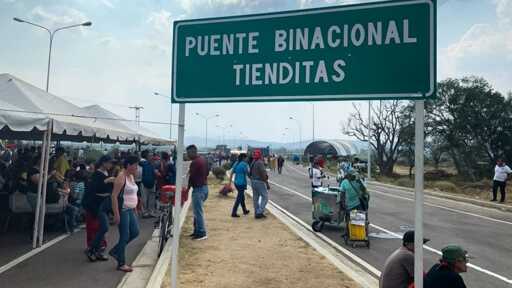
Venezuela’s Táchira state governor, Freddy Bernal, has requested the state’s residents to avoid traveling to Colombia’s Norte de Santander department. Given the recent clashes, he asked people to refrain from crossing the border unless it is strictly necessary.
In this regard, he said that security forces have reinforced controls on the border to prevent the violence from spreading to Venezuela, expressing his support for the merchants and business owners in the area. He also expressed solidarity with Norte de Santander Governor William Villamizar and Cúcuta Mayor Jorge Acevedo as the region faces widespread violence.
“We cannot rule out that a criminal might try to enter through a rural area,” Bernal said in a broadcast from the border. “What I do reaffirm is our determination to act against those who cross with the intention of committing crimes. The response must be through the justice system, before the competent courts.”
The porosity of the Colombia-Venezuela border, in addition to its extension, has historically been exploited by criminal groups and guerrilla contingents to carry out various activities, not only related to firepower but also to the illicit economic dynamics that have affected the states of Táchira, Zulia, and Apure, as well as the neighboring Colombian departments, for decades. The ELN is just one of the factors in contention. The Colombian army has also had a significant share of responsibility in the ongoing conflict, along with organized crime, which has permeated the stability of the border on the Venezuelan side.
Therefore, decision-making in the governorships of Táchira and Apure, and in Miraflores in general, is relevant insofar as it addresses the negative variables that develop due to this dynamic of official-guerrilla violence and the commercial flow of illicit economies.
However, this stage of violence has a more distant precedent. It began on January 16, 2025, with the outbreak of an armed offensive in the Catatumbo region of Norte de Santander, on the border with Zulia state, in which the following events occurred.
The fight between the armed groups ELN and Front 33 for control of the Catatumbo region has left civilians missing and thousands displaced. The Catatumbo region is a strategic location for drug production and trafficking, the reason why these groups have shared control of large parts of Catatumbo since 2018 under an armed coexistence agreement.
On the morning of January 16, the ELN committed a series of murders simultaneously in districts of five municipalities in Catatumbo: Teorama, Convención, Hacarí, Tibú, and El Tarra. According to reports, among the victims were social leaders, members of the Association for the Peasant Unity of Catatumbo (ASUNCAT), and former FARC combatants who had signed the Peace Accords and demobilized in 2016.
The trigger was that ELN broke the non-aggression pact that was in effect in the area in order to reclaim spaces dedicated to illicit trade, and launched a simultaneous offensive against Front 33 (dissidents of the FARC) and against ex-combatants who had signed the 2016 Peace Agreement. The dispute is over territorial control of strategic corridors for drug trafficking and cross-border illicit economies.
This outbreak of violence is part of a border dynamic that has been reconfiguring since 2017, when FARC demobilized and various armed groups began to dispute the power vacuums, cocaine routes, smuggling, and illegal mining along the more than 2,200 kilometers of binational border that includes the Catatumbo-Zulia, Arauca-Apure, and Vichada-Amazonas axes.
Since August 2026, the Colombian government has carried out bombing attacks in Norte de Santander and Arauca, and has deployed over 8,000 troops. During the early hours of October 11, a camp of Front 33 was attacked in an area between Tibú and El Tarra. Four people died, including a 16-year-old girl.
El Tiempo reports that there are over 8,500 members of armed groups at the border, which helps us to gage the war scenario. In addition, there is the struggle for control of illegal economies which, apart from the production and commercialization of cocaine, has seen a new category added: illegal gold mining.
Venezuela Offers Security Coordination With Colombia as FANB Deploys in Apure
A source told the newspaper that a kilogram of gold can reach 500 million pesos in Catatumbo, while a kilogram of coca is traded for around 5 million pesos. This margin undoubtedly makes illegal mining a source of income for armed groups seeking to control the mining areas, transport routes, and crossings that connect with Venezuela.
It is an undeniable reality that there has been a deterioration in border security since Iván Duque’s government. His administration marked a dark period because the crisis between Colombia and Venezuela intensified, leaving economic and security factors at the border between the two countries adrift. He adopted a confrontational discourse and allowed Colombian territory to become a center of operations for attacks on Venezuela.
Reports indicate that after Duque’s government ended, the country became embroiled in “the largest humanitarian crisis since the Peace Agreement” signed by the Colombian state with the Revolutionary Armed Forces of Colombia (FARC) in November 2016. Instead of combating criminal groups, there was a symbiosis between the Colombian state and paramilitary groups, something that became evident through Plan Guaidó and Operation Gideon against Venezuela.
Colombia’s suspension of relations with Venezuela facilitated the creation of trails that became a breeding ground for smuggling and extortion of both nations’ border populations. Therefore, Venezuela’s armed deployment on the border has been urgent, leading to collaboration with the Colombian state within the framework of a bilateral relationship in continuous tension since the new government in Bogotá took the reins of Colombia. This web, where several factors converge in a context of war that has already lasted for over half a century in Colombia, makes the situation more chaotic and reveals that the binational border is, at this moment, a critical issue that Venezuela must not ignore.
Translation: Orinoco Tribune
OT/SC/SF
From Orinoco Tribune via This RSS Feed.