

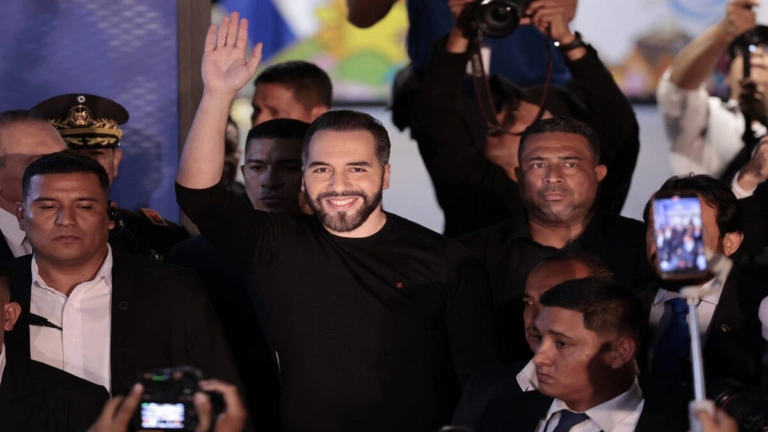
El Salvador’s president seeks another six-year term under a constitutional reform that abolished presidential term limits.
El Salvador’s President Nayib Bukele has formally registered his candidacy for a third consecutive term, setting the stage for a February 2027 election under constitutional changes that allow indefinite presidential reelection.
RELATED: Salvadoran Military is Teaching Haiti’s Gangs A Lesson: Bukele
Bukele filed his candidacy with the Supreme Electoral Tribunal (TSE) shortly before midnight Thursday, the deadline for registering candidates for the presidency, Legislative Assembly and municipal offices. He was accompanied by Vice President Félix Ulloa, who will again run as his running mate under the ruling Nuevas Ideas party.
Around 3,000 supporters gathered outside the electoral authority as Bukele, 45, arrived under heavy security. Addressing the crowd, which chanted “Six more years,” he declared: “We will make history again. El Salvador will not return to the past.”
The president defended the electoral process, claiming that democracy now prevails in the country and that all political parties are free to participate. He also stressed the need to maintain and build on the achievements of his administration.
Bukele first took office in 2019 and began a second term on June 1, 2024, despite constitutional provisions then prohibiting consecutive reelection. His latest bid follows a constitutional amendment approved by the Legislative Assembly in July 2025, which removed presidential term limits and extended terms from five to six years.
The reform also eliminated the presidential runoff and brought forward the next presidential election from 2029 to 2027, aligning it with legislative and municipal elections.
With the registration period closed, the TSE will review the submitted documents, request any necessary corrections and decide whether to approve or reject the candidacies.
Bukele enters the race as the clear frontrunner, with an approval rating of around 80 percent. His popularity has been bolstered by a sharp decline in violence under his security policies and the state of emergency imposed to combat criminal gangs.
His bid for another term has nevertheless renewed criticism from opposition groups, independent media and international organizations, which have raised concerns about the growing concentration of power in the country.
The Inter-American Commission on Human Rights (IACHR) described the 2025 constitutional reform as a “serious setback for democracy and the rule of law.” A group of United Nations experts has also warned that abuses committed during the government’s crackdown on gangs constitute crimes against humanity.
From teleSUR English via This RSS Feed.