

This article by Arturo Sánchez Jiménez originally appeared in the November 20, 2026 edition of La Jornada, Mexico’s premier left wing daily newspaper.
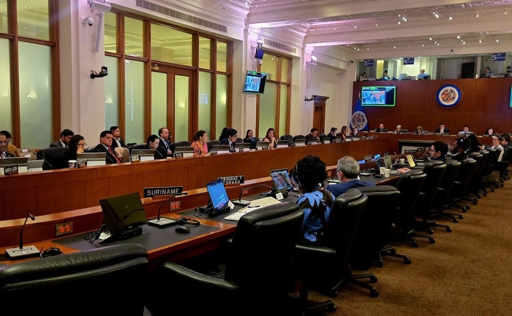
Mexico rejected this Friday at the Organization of American States (OAS), “with deep concern,” the convening of the consultative body of the Inter-American Treaty of Reciprocal Assistance (TIAR) to confront transnational organized crime. It warned that prioritizing a collective defense mechanism that emerged from the Cold War “could create a scenario of greater violence in which we all lose.”
At an extraordinary session of the OAS Permanent Council, Mexico’s permanent representative, Alejandro Encinas, urged against establishing “an automatic link” between organized crime and terrorism, because they are distinct phenomena with their own legal frameworks.
The resolution, backed by 14 of the 18 TIAR member states that voted, proposes examining actions “that do not involve the use of armed force” against cartels. Brazil and Uruguay voted against it; Mexico, which gave notice of withdrawal from the treaty in 2002, could not vote.
Encinas “categorically” rejected the term narcoterrorism because it lacks an agreed definition. He said that the unilateral designation of a criminal group as terrorist “does not change international rules on the use of force or authorize military operations in the territory of other states,” and that only the United Nations Security Council can make that determination.
He recalled that the first time TIAR was invoked was against Guatemala’s “democratic and legitimately elected” government, “using the same argument being advanced today,” an episode that ended with the US intervention that overthrew Jacobo Árbenz. He added that the Malvinas War in 1982 exposed the treaty’s inability to act, and that its most recent invocation, in 2019 amid the Venezuelan crisis, showed the risk of treating an internal conflict as a matter of regional security.
“Security priorities cannot be subordinated to political considerations and the strategies of third countries,” he maintained. He placed on record that the decision “does not reflect the will of all members of the organization” and warned that the proposal “brings us closer to a point of no return where the OAS puts its mission and its future at risk.”
“Drug trafficking does not originate south of the United States,” he emphasized. He described it as a threat sustained by drug demand, arms trafficking and a financial chain with global reach, and called for addressing consumer markets, sources of weapons supplies and the financial systems that sustain the cartels.
He recalled that the OAS already has bodies for cooperation, such as the Secretariat for Multidimensional Security and the Inter-American Drug Abuse Control Commission (CICAD), and reiterated Mexico’s willingness to strengthen intelligence sharing and police and judicial cooperation, with respect for each state’s sovereignty.
-
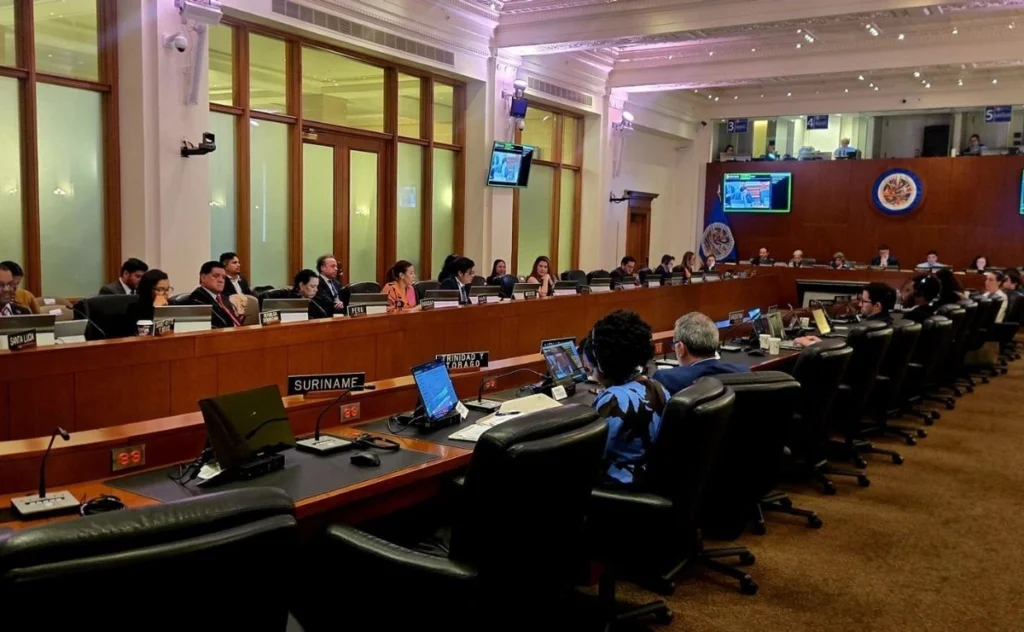
Mexico at the OAS: “Categorically” Rejects the Term Narcoterrorism for Lacking an Agreed Definition
November 20, 2026
A terrorist label does not authorize military operations abroad, Mexico says, warning against invoking a Cold War defense pact against cartels.
-

Mexico Has Built 4,000 Kilometers of Roads by Hand Since 2018, National Indigenous Peoples Institute Says
November 20, 2026
Launched under López Obrador in Indigenous communities, the program now reaches 18 states, with 32 billion pesos planned for this term.
-

Analysis | Let’s Talk About Migration
Gaza: The Fragile Anatomy of a Human and International Crisis
November 20, 2026November 11, 2026
An overview of the Gaza crisis: casualties, mass displacement, famine, destroyed infrastructure and the international legal cases against Israel.
The post Mexico at the OAS: “Categorically” Rejects the Term Narcoterrorism for Lacking an Agreed Definition appeared first on Mexico Solidarity Media.
From Mexico Solidarity Media via This RSS Feed.