

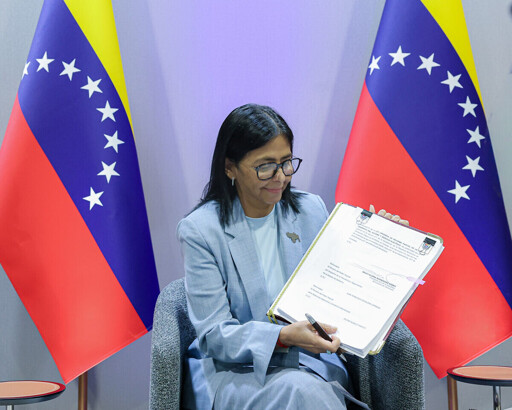
Caracas (OrinocoTribune.com)—On Thursday, November 19, Venezuela’s Acting President Delcy Rodríguez promulgated the partial reform of the Organic Law of the Electrical System and Service, opening the electricity sector to national and foreign private capital. The reform also requires oil companies to secure their own electricity supply to avoid adding pressure to the already strained national grid.
Rodríguez signed the law during a videoconference inaugurating Expo Venezuela Energética Oriente 2026 in Anzoátegui state.
Oil agreements and economic recoveryDuring the activity, the acting president announced that state-owned Petróleos de Venezuela, SA (PDVSA) had signed 84 oil and gas agreements. The figure was confirmed by Venezuela’s Ministry of Communication and Information.
Rodríguez highlighted Article 19 of the reformed Organic Hydrocarbons Law, which requires international investors to incorporate national businesses into their operations.
Rodríguez reported that oil production had reached 1.269 million barrels per day, of which 730,000 came from the Hugo Chávez Frías Orinoco Oil Belt. She advocated using oil revenue to diversify the economy rather than perpetuating Venezuela’s dependence on oil income, stressing that production growth must translate into higher wages, pensions, improved public services, and better living conditions for workers and their families.
The oil agreements follow the January 29 reform of the Organic Hydrocarbons Law, approved less than a month after the January 3 US military attack and the kidnapping of President Nicolás Maduro and First Lady Cilia Flores. The reform offered greater benefits to private oil corporations. Among the sector’s latest developments was the November 9 memorandum of understanding between ExxonMobil and PDVSA, which opened negotiations for the US corporation’s possible return to Venezuela.
As Orinoco Tribune recently reported, Venezuela’s economy grew 7.42% in the third quarter of 2026, its 22nd consecutive quarter of growth. However, the sustained recovery has yet to restore even half the size of the economy in 2012, before its collapse due to illegal US imperialist sanctions.
Electricity reform and the oil industry’s self-generation requirementThe reform, unanimously approved by the National Assembly on November 10, authorizes private participation in electricity generation, transmission, distribution, and commercialization, with concessions of up to 25 years. It also provides temporary tax exemptions to encourage investment and creates the National Superintendency of the Electrical System, attached to the electricity ministry, to regulate and inspect public and private operators, Alba Ciudad reported.
The acting president explained that the reform incorporates into law the self-generation requirement already included in contracts signed with domestic and foreign investors in the hydrocarbons sector. Oil companies must ensure their own electricity supply rather than increase demand on the national electrical system. Surplus electricity generated by these companies could be incorporated into the national grid.
The provision is particularly relevant given the expected increases in oil production. Venezuela’s electricity infrastructure has deteriorated after years of illegal US sanctions restricting access to financing, equipment, and spare parts, compounded by disinvestment and inadequate maintenance. Rising electricity demand amid economic recovery, the June 24 earthquakes, and the effects of El Niño have added further pressure to the system.
As Orinoco Tribune reported in September, Venezuelan analysts warned that the reactivation of mature oil fields around Lake Maracaibo without additional electricity generation capacity could overwhelm the grid. Washington continues to retain control over transactions in the sector through its selective sanctions waivers.
Privatization and concerns over electricity tariffsNational Assembly President Jorge Rodríguez has insisted that the reform does not constitute the privatization of the national electrical system and that the state will retain responsibility for guaranteeing service to the population. The legislation nevertheless allows private companies to profit from several activities previously reserved for the public sector. Tariffs will be indexed to the highest-valued foreign currency, while a subsidy mechanism is envisaged for residential users unable to afford full rates.
Since the reform’s approval in the first discussion in June, criticism within Chavismo and the Venezuelan left has focused on the risks of this de facto opening to privatization. Even among those who recognize the severity of the electricity emergency and the need for unconventional solutions, concerns remain regarding the potential impact of profit-oriented operators and foreign currency-indexed tariffs on the bills of workers and their families, whose wages have yet to recover from the economic blockade and inflation.
Writing in Aporrea, José Antonio García warned that partial privatization could transfer a significant share of household income to private electricity operators. More recently, Luis José González Castillo questioned whether public subsidies and tax exemptions would end up guaranteeing private profitability while the Venezuelan state and electricity users assumed much of the financial risk.
The debate recalls President Hugo Chávez’s administration’s decision to consolidate public ownership of the electricity sector. While the emergency demands increased generation capacity, the challenge is to ensure that expanded investment does not come at the expense of affordable access to electricity, labor rights, and public control over a strategic service.
Later on Thursday, Acting President Rodríguez met with Venezuela’s political and military high command to review the agreements reached during her recent international diplomatic agenda, including those related to energy and technical-military cooperation. The meeting, attended by Jorge Rodríguez, Diosdado Cabello, Defense Chief Gustavo González López, and the military high command, took place one day after Venezuela signed an agreement to resume military cooperation with the US during US Secretary of War Pete Hegseth’s unannounced visit to Caracas. The official report did not disclose further details of the meeting outcome.
Entrepreneurship and the blockade on artificial intelligenceOn Friday, November 20, Acting President Rodríguez held the fifth anniversary celebration of the Motor Emprendedor and Emprender Juntos (Entrepreneurship Together) programs at the Teresa Carreño Theater in Caracas. She reported that Venezuela’s entrepreneurship rate had reached 26%, with nearly seven million entrepreneurs nationwide.
The acting president highlighted the participation of young people and women, citing figures of 70% and 64%, respectively, La Iguana TV reported. She also reported that approximately 2.4 million entrepreneurs had registered with Emprender Juntos and that nearly 90% of those registered had received financing, primarily through public banks and the National Entrepreneurship Fund.
During the same event, Rodríguez instructed Foreign Minister Oliver Blanco to work toward the complete lifting of restrictions on access to artificial intelligence (AI) platforms in Venezuela. She stressed that access to these tools should allow Venezuelan youth to develop their own technological capacities and innovations.
Years of illegal US sanctions and corporate overcompliance have extended the economic blockade’s impact into the digital sphere. Major US AI companies, including OpenAI (ChatGPT) and Anthropic (Claude), exclude Venezuela from their supported markets. Google’s Gemini remains a notable exception among major US AI services.
Chinese AI platforms, particularly DeepSeek and Alibaba’s Qwen, have helped fill the gap left by the restrictions imposed by Western technology corporations. For Venezuela, access to these technologies is also a matter of technological sovereignty. However, developing domestic capabilities rather than deepening dependence on foreign corporations capable of unilaterally denying access to their services, could be counterproductive, according to analysts.
Special for Orinoco Tribune by staff
OT/JRE/SF
From Orinoco Tribune via This RSS Feed.