

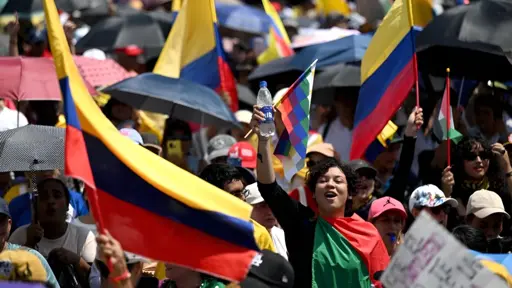
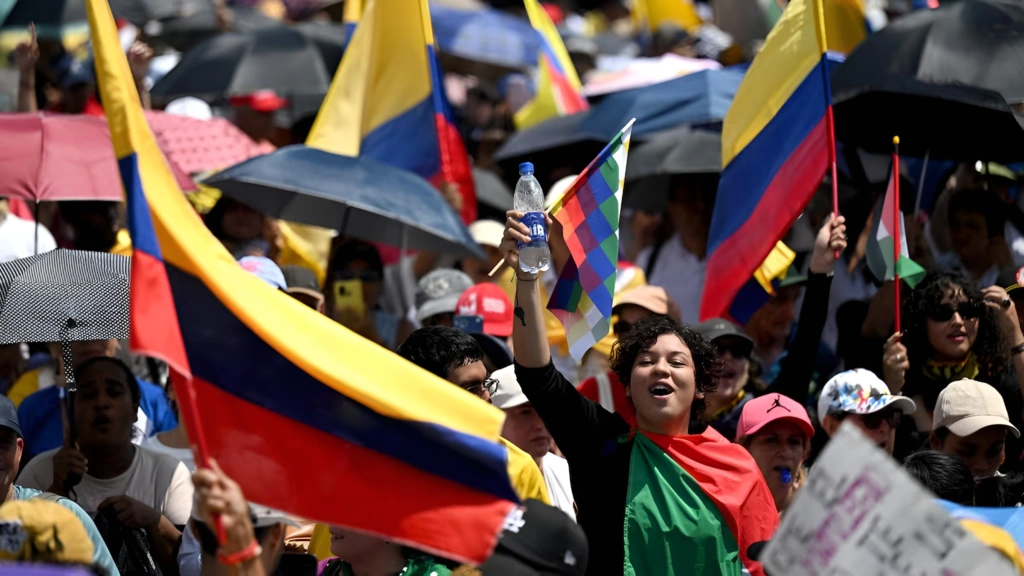
Thousands march in Bogotá, Cali, and Medellín as unions reject personal tax hikes, health contribution increases, and strict new protest decrees.
On Thursday, November 19, thousands of citizens have been called to gather in major Colombian cities as part of a national strike against the economic and social adjustment policies of far-right President Abelardo de la Espriella.
Organized primarily by the Central Union of Workers (CUT) and the Colombian Federation of Educators (FECODE), the demonstrations aim to reject the Colombian administration’s economic rescue bill (Bill 477 of 2026) and to oppose recent changes to regulations of public order.
RELATED: De la Espriella’s Navigates Turbulence During First 100 Days
Labor unions, opposition politicians, and social organizations said that the legislation places the financial burden of fiscal adjustment on salaried workers and middle-income households.
#Colombia | Labor unions and students staged a national strike against the tax reform proposed by the Abelardo de la Espriella administration and its aggressive policies targeting the middle and working classes.https://t.co/P2gbwbwOUX
— teleSUR English (@telesurenglish) November 20, 2026
Tightening Rules Before the Storm
The November 19 national strike occurred three months after President Abelardo de la Espriella took office in August 2026, following a narrow electoral victory over the Historic Pact coalition. The mobilization marked the second major street demonstration against the administration, following initial opposition marches held on October 14.
In its first 100 days, the De la Espriella government shifted economic and institutional policy, reversing several labor and social reforms enacted during Gustavo Petro presidency, suspending a previous decree on minimum wage adjustments, and requesting financial assistance from the International Monetary Fund (IMF).
A central element of the political context preceding the strike was the modification of legal rules governing public demonstrations. On October 13, President De la Espriella signed Decree 1525/ 2026, accompanied by legislative initiatives that critics called the Social Protest Law.
Decree 1525 updated police intervention protocols by eliminating mandatory stages of facilitation, dialogue, and mediation in situations where authorities determine that violence is the primary factor.
The new framework expanded the official classification of violent acts to include road and transit blockades, allowing Unified Command Posts (PMUs) to document the economic impact of demonstrations on local businesses and employment.
Human rights organizations, such as the “Temblores” NGO, and opposition lawmakers from the Historic Pact coalition filed legal challenges against Decree 1525 before the Council of State.
Congress members, including Senate Second Vice-president Alejandro Ocampo, argued that restricting the constitutional right to protest by executive decree rather than a statutory law passed by Congress violates Article 37 of the 1991 Colombian Constitution.
Labor leaders also compared the current fiscal debate and the April 2021 tax reform proposal under former President Iván Duque, which preceded months of nationwide strikes.
Unions and Opposition Unite on Demands
The November 19 strike was led by the Central Unit of Workers (CUT), Colombia’s largest labor confederation, under the direction of union leader Fabio Arias.
The CUT coordinated the mobilization alongside the Colombian Federation of Education Workers (FECODE), public healthcare worker unions, judicial branch employees, university student organizations, and rural peasant associations.
Political support for the strike came from the Historic Pact coalition and former President Gustavo Petro. On November 18, Petro used his social media platforms to urge citizens to gather in public squares across the country, stating that the government’s economic proposals threatened household income and employment.
Senator Iván Cepeda also endorsed the demonstrations, saying the administration’s tax reform attempted to resolve a fiscal deficit by increasing costs for citizens.
During the mobilization, participating unions and social sectors presented a unified set of demands to the national government and Congress.
First, organizers demanded the immediate withdrawal of Bill 477 of 2026, formally titled the Economic Rescue Bill, from legislative debate.
Although Finance Minister Miguel Gómez Martínez announced on November 16 that the government would remove a proposed Value-Added Tax (VAT) increase from 5 percent to 19 percent on basic food items, agricultural inputs, and prepaid healthcare plans, the CUT maintained the strike call.
Union officials noted that the project law still contained increases in worker health contributions, raising rates from 4 percent to 8 percent for salaried employees and from 12.5 percent to 15.5 percent for independent contractors, as well as lower income tax thresholds.
Second, unions called for the protection of state-owned enterprises and public patrimony. Labor organizations warned that provisions within the Economic Rescue Bill authorizing state restructuring and asset monetization could lead to the privatization of strategic public companies, including the state oil company Ecopetrol, its midstream subsidiary Cenit, and the state financial holding Bicentennial Group.
Third, participating sectors demanded guarantees for public funding in education, healthcare, and the judicial system. Judicial workers in Bogotá protested against proposed budget cuts to the justice sector, while teachers and healthcare workers demanded the preservation of existing labor protections.
Rural peasant organizations additionally demanded the suspension of the so-called “Barranquilla Agreements,” arguing that these accords facilitate foreign corporate access to strategic mineral resources without adequate guarantees for rural land reform.
Finally, demonstrators demanded the repeal of Decree 1525 of 2026 and the rejection of extraordinary legislative powers requested by the Executive branch, calling for adherence to constitutional protections for peaceful assembly and the 2016 Peace Agreement.
Pasto pic.twitter.com/O0bVoXqHOz
— Gustavo Petro (@petrogustavo) November 19, 2026
Who Pays for the Economic Rescue?
Submitted to Congress on October 29, by the Ministry of Finance and Public Credit, Bill 477 of 2026, officially titled the Economic Rescue Bill, constitutes the centerpiece of President Abelardo de la Espriella’s fiscal policy.
According to the government’s memorandum, Colombia’s primary fiscal deficit would remain near 4.4 percent of Gross Domestic Product (GDP) without legislative intervention. The administration designed the bill to reduce that deficit to 3.3 percent in 2026, 2.1 percent in 2027, and 0.3 percent in 2028, projecting a primary fiscal surplus starting in 2029.
To achieve these targets, the legislation combines state expenditure cuts with structural modifications to the Colombian Tax Statute. The bill mandates a 15 percent reduction in overall public expenditure compared to current levels, including a 50 percent cut in government service contracts and a 20 percent reduction in public personnel costs.
It also modifies territorial debt rules by raising the debt sustainability indicator for municipalities and departments from 100 percent to 140 percent of current revenues, opening approximately 15.1 trillion pesos in additional local borrowing capacity.
In its original text, the bill proposed substantial changes to corporate and personal taxation. For businesses, Article 57 initially sought to lower the general corporate income tax rate from 35 percent to 33 percent in 2027 and 31 percent by 2028, while restricting the 15 percent domestic minimum tax exclusively to multinational groups with global revenues exceeding 750 million euros.
However, following intense public opposition and negotiations with congressional rapporteurs ahead of the November 19 strike, the Ministry of Finance announced on November 18 that it would abandon the gradual corporate rate cut and maintain the general business income tax at 35 percent.
Similarly, on November 17, the Ministry confirmed the removal of a controversial proposal to raise the Value-Added Tax (VAT) on basic family basket goods from 5 percent to 19 percent. Additionally, the bill eliminates the VAT exemption on international e-commerce purchases under 200 U.S. dollars and raises the VAT on hybrid and electric vehicles from 5 percent to 19 percent.
Despite those last-minute revisions, labor unions, tax analysts, and progressive lawmakers maintained that the remaining text of Bill 477 disproportionately affects middle- and low-income citizens.
According to fiscal calculations published by the Central Unit of Workers (CUT), the Economic Rescue Bill aims for a cumulative fiscal adjustment equivalent to 4.7 percent of GDP by 2030, with 75.32 percent of that effort financed through increased taxes and citizen contributions, and only 24.68 percent derived from state operating reductions.
Union economists also criticized the bill’s provisions altering payroll contribution exemptions and increasing worker health insurance deductions, arguing that reducing household disposable income will contract domestic consumption rather than stimulate economic growth.
Gridlock, Tear Gas, and Mass Marches
The November 19 national strike unfolded across major urban centers and regional transport corridors throughout Colombia. To monitor the demonstrations, the national government installed a Unified Command Post (PMU) at the Palacio de Nariño in Bogotá.
In Bogotá, up to eight distinct columns of marchers, comprising teachers, judicial workers, university students, and union members, converged from points including the National Park, the National University, and southern districts toward the historic Bolívar Square.
In southwestern Colombia, Cali served as a focal point, with crowds gathering at Plazoleta Jairo Varela and Retreta Park. Near Popayán, in the municipality of Cajibío (Cauca department), indigenous, peasant, and student organizations blocked the Pan-American Highway at the El Cairo sector early in the morning, leading to clashes with riot police.
Further north in Bucaramanga, protesters marched from the Industrial University of Santander (UIS) and engaged in skirmishes with police units.
In the Caribbean region, demonstrators in Barranquilla marched from the National Institute of Secondary Education “José Félix de Restrepo” (INEM) in Soledad along Calle 30 to Carrera Octava, where participants organized a sit-in and communal soup kitchens.
Riot police dispersed the gathering using tear gas. Henry Gordon, President of the Central Unit of Workers (CUT) branch in the Atlántico department, publicly denounced the police operation, stating that the march had been formally notified to local authorities to conclude at midday and was proceeding peacefully when officers intervened.
Additional marches took place in Medellín, where teachers from the Antioquia Teachers Association (ADIDA) rallied across five meeting points amid localized disturbances near the University of Antioquia, as well as in Cartagena, Santa Marta, Riohacha, Valledupar, and Cúcuta.
#Colombia | Workers and Catatumbo farmers protest in Cúcuta against proposed fiscal reforms, austerity measures, and worsening insecurity in Norte de Santander.#NationalStrike #Catatumbo #SocialJustice #teleSUREnglish pic.twitter.com/tgNZE6gFYT
— teleSUR English (@telesurenglish) November 20, 2026
Hardline Warnings Meet Calls to Persist
President Abelardo de la Espriella issued multiple public statements establishing a strict distinction between permitted marches and roadway obstructions.
During a morning inspection tour in Bogotá, De la Espriella said that peaceful assembly is protected under the Colombian Constitution, while warning that security forces would not tolerate road blockades or acts of urban violence. Later, De la Espriella traveled to Cali, where he oversaw security operations to clear transit corridors and described opposition leaders as sectors attempting to generate institutional instability.
On November 20, President De la Espriella presented an official public order assessment characterizing the state response as effective and declaring that while protests are permitted, his administration would not allow a coup d’état.
Simultaneously, strike organizers and opposition leaders announced plans to maintain political and social pressure beyond the single-day walkout.
Union leadership also outlined institutional and grassroots follow-up measures. Central Unit of Workers (CUT) President Fabio Arias and regional union boards announced that labor confederations will monitor congressional committee debates on Bill 477 of 2026 to oppose the remaining personal income tax modifications, worker health contribution increases, and state restructuring clauses.
The Battle Moves to Congress
The November 19 national strike demonstrated the deepening polarization surrounding fiscal adjustment and public order governance in Colombia.
Although the Ministry of Finance withdrew two of the most contested proposals from the Economic Rescue Bill shortly before the mobilization, labor unions and opposition coalitions maintained their opposition to higher personal income taxes, increased worker health contributions, and public spending cuts.
As Bill 477 advances through legislative debates in Congress and labor organizations prepare ongoing assemblies, the interaction between congressional negotiations, judicial reviews of protest regulations, and street mobilizations will shape the trajectory of President Abelardo de la Espriella’s economic program.
Sources: RTVC – Radio Nacional Colombia – La Silla Vacía – Vorágine – RUMS – Rutas del Conflicto – Volcánicas – El Tiempo – El Espectador – Insight Crime – Centro de Memoria Histórica – France 24 – El Orden Mundial
From teleSUR English via This RSS Feed.