

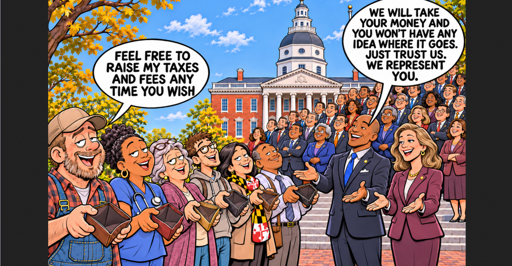
Portugal’s António (Under Pressure, 3/2/26): “We never know who controls whom, and now with artificial intelligence, it’s going to get worse.”
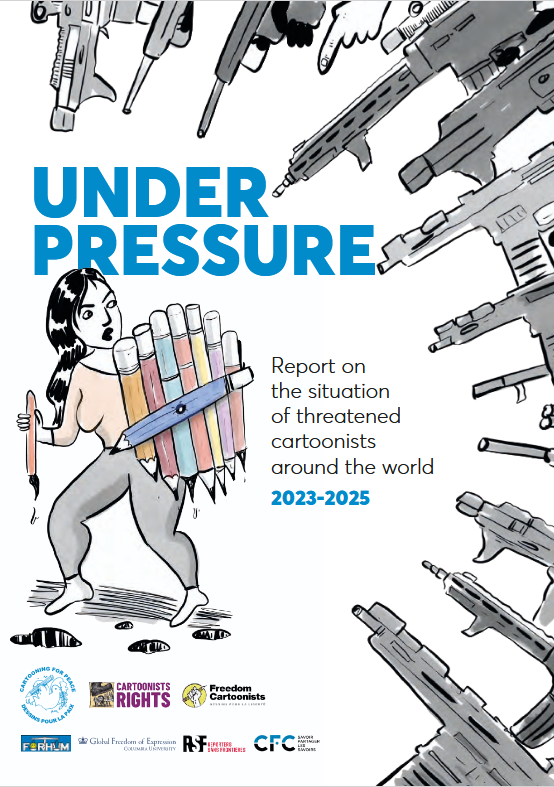
Whether one chooses to call it artificial intelligence or President Trump’s preferred terminology, “super intelligence,” AI represents a growing threat to the livelihood of cartoonists around the world. As explained in Under Pressure: Report on the Situation of Threatened Cartoonists Around the World, 2023–2025, published by Cartooning for Peace and a coalition of freedom of expression advocacy groups:
New technologies pose ethical and legal challenges, most especially artificial intelligence. The livelihood of cartoonists has not been spared from the emergence of these new tools, which require a defined and protective legislative framework.
One of the most direct ways AI threatens political cartoonists is by taking their jobs: In Under Pressure, journalist and editorial cartoonist Omar Zevallos cited the 2025 example of the Nicaragua-focused online newspaper Artículo 66 replacing cartoons with AI-generated images.
Just a few months later, the phenomenon came to the US, when Baltimore Sun fired their cartoonist, Kevin “KAL” Kallaugher (Baltimore Brew, 7/1/25). The two-time Pulitzer finalist and Herblock Prize winner was not fired for any lack of talent on his part. Rather, it was because he was an “ultra-liberal” who refused to toe the right-wing line of new owner David Smith, chair of the Sinclair Broadcasting Group (FAIR.org, 9/30/25).
For a while, the Sun replaced KAL with syndicated material by other cartoonists more to their ideological liking. Now even that has changed. Since August, the Sun has begun using AI-generated images instead of paying a cartoonist.
‘Transparency? Not our problem!’
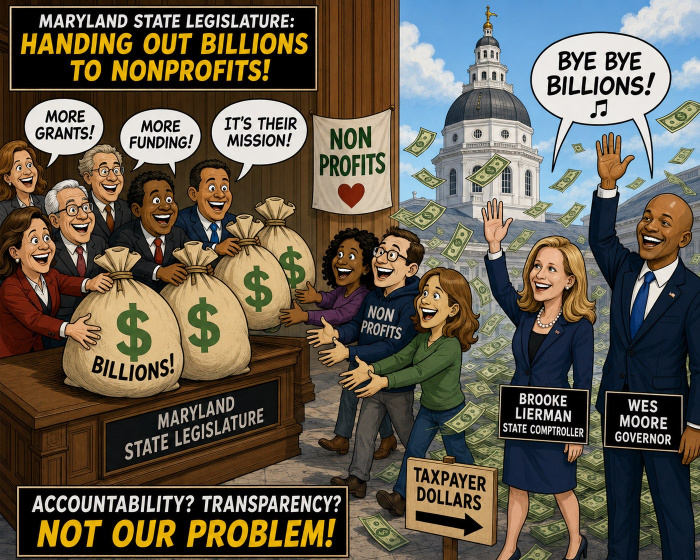
This AI-generated Baltimore Sun cartoon (8/25/26) offers the penetrating insight that some nonprofits receive money from the Maryland state government.
A representative example (Baltimore Sun, 8/25/26) offered scorn for the Maryland state government. There was no attempt made to pass the image off as a legitimate cartoon, as a text caption admits it was “produced using artificial intelligence tools by the Baltimore Sun editorial staff.”
The image showed the “Maryland State Legislature” exclaiming “More grants!” and “More funding!” as they hand bags of money labeled “Billions!” to people labeled “Non Profits.” (In reality, these include hospitals, clinics, homeless shelters, food banks and the like, though there’s no hint of what Maryland’s nonprofits actually do in the image.) State officials, helpfully tagged “Wes Moore Governor” and “Brooke Lierman State Comptroller,” look on and wave. There’s a sign that says “Taxpayer Dollars” with an arrow, though it’s unclear whether this is supposed to indicate the direction these dollars are going (away?) or simply to identify what the piles of cash in the background of the image are meant to signify.
A caption spells out the purported message of the cartoon: “Accountability? Transparency? Not Our Problem!”
Like the Sun‘s other AI-created images, the nonprofit attack does not work on any level as a political cartoon. The best political cartoons are punchy, to the point, and, most importantly, funny. Calling the above image a cartoon is not only an insult to the hard work that goes into the best of satire and caricature, it would also imply that there is any observable humor to the image.
Instead, it belabors its points with an overabundance of text. There’s no clever imagery or wordplay at hand. Generic figures with the same plastic expressions gloat about the alleged malfeasance of local nonprofits. Virtually everyone in the image displays a flat, identically rendered hand, as if showing off the image generator’s ability to produce hands with the correct number of fingers.
With an image like this, readers are cheated out of seeing a human artist’s take on current events, local and national. Cartoons by Herblock, Bill Mauldin and Art Young once shaped the politics of the United States. It’s difficult to imagine anyone being so similarly affected by one of the Sun’s shoddy imitations.
‘Certain irrelevance and then demise’
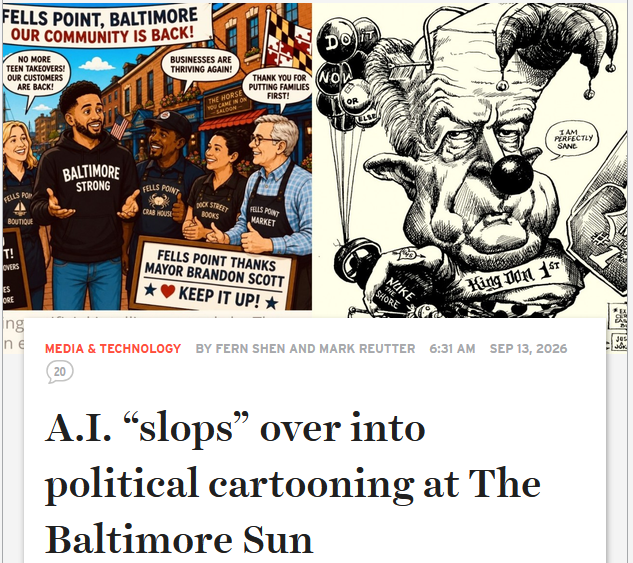
The Baltimore Brew (9/13/26) contrasts an image from the Baltimore Sun‘s AI “cartoonist” (9/4/26) with the work of fired Sun artist Kevin “KAL” Kallaugher.
Cartoonists have been horrified and disgusted by the Sun’s embrace of AI images as substitutes for cartoons. KAL derided it as an “embarrassment from a once reputable publication” (Baltimore Brew, 9/13/26).
An open letter from the Association of American Editorial Cartoonists predicted the “slop published by the Sun might as well be a signpost, pointing the way for publications like the Sun to certain irrelevance and then demise.” Another open letter from the Herb Block Foundation deemed the image “insipid” and its publication “highly offensive and borderline immoral.”
The Sun is easily the most prominent example of this trend. KAL (Baltimore Fishbowl, 9/22/26) wrote that it is “the first case in American journalism where AI cartoons have basically become part of a publication’s repertoire.”
Unfortunately, the Sun is not alone. Cartoonist Tim Campbell (Substack, 9/26/26) was appalled when he saw an AI-generated image accompanying an editorial in the Hamilton County Reporter in Indiana. Fortunately, after he contacted the publisher, they agreed to no longer publish AI images on the editorial page.
AI slop has also begun camouflaging itself as work by talented—that is to say, human—cartoonists. For instance, Open AI’s ChatGPT has been adding the signatures of real cartoonists, including New Yorker contributor Brendan Loper, to generated images. “I’m not a territorial person,” Loper said (Neiman Lab, 10/5/26), “but my name is my name. It felt very much like a violation of my personhood.” Fellow New Yorker cartoonist Jason Adam Katzenstein stated that ChatGPT is “attaching my name to work that I do not endorse or like. It’s slop, and unlike the other slop that I’ve encountered, this is slop that’s pretending to be me.”
‘Fact of modern life’

McClatchy, then known as Knight Ridder, was one of the few corporate news outlets the questioned the WMD hoax used to sell the Iraq War (Extra!, 3-4/06). Don’t count on McClatchy‘s large language models (Nieman Lab, 11/18/26) to show the same skepticism.
The use of AI-generated images instead of human drawings is part of an unfortunate trend of AI replacing human labor in journalism. A Wall Street Journal op-ed (8/24/26) by billionaire investor Stanley Druckenmiller betrayed all the hallmarks of AI writing, including clunkers like “This wasn’t liquidity management, it was price management” and “If the 30-year must trade at 5.5% to clear, that isn’t a crisis. It is an invoice.” Both Druckenmiller (Washington Sun, 8/25/26) and the Journal (8/25/26) defended the use of AI, with the editor of the latter calling it a “fact of modern life.”
An August column in Britain’s Financial Times (8/13/26; Poynter, 8/17/26) also used AI to condense a longer piece of writing, without the editor’s knowledge. The paper (8/17/26) printed a disclaimer and added an apology to the top of the piece that reiterated, “The FT editorial code of conduct specifically prohibits the use of AI in the writing process.” A study by Semafor (8/26/26) using an AI detector—itself a controversial tool—suggested that out of 310 guest columns published by the New York Times, Washington Post and Wall Street Journal, 10 appeared to be at least 80% AI-generated and an additional 40 to be partially AI-generated.
This is not just an issue on the editorial pages. Futurism (9/17/26) discovered “an AI Slop Empire” operated by Brown Brothers Media, who bought up legitimate news websites before morphing them into content farms of AI-generated material. Newspaper chain McClatchy Media, owner of newspapers such as the Charlotte Observer, the Kansas City Star and the Miami Herald, laid off dozens of reporters in favor of articles generated by AI chatbots (Nieman Lab, 11/18/26).
‘Outsourcing thinking and creativity’

This unsigned image from Editor & Publisher (9/25/26) appears to have been AI-generated.
The Baltimore Sun, in addition to its AI slop “cartoons,” has also used AI to replace coverage by local journalists. In February, the paper published two AI generated political analyses (2/12/26, 2/12/26), one of which twice referred to incumbent President Donald Trump as the “former president.” The union representing Sun workers (Objective, 2/25/26) blasted the AI-generated articles as insulting to “our talented human reporters and their work.”
Cartoonist and journalist Rob Tornoe (Editor & Publisher, 10/2/26) explained:
When editors let writers turn to chatbots to do their writing, they’re also outsourcing the thinking and creativity they sought in the first place. It also comes down to trust, and right now readers trust human beings over robot-written slop with a tendency to make up facts and pump out annoyingly obtuse copy.
Tornoe called for greater transparency from publications and content syndicates on whether material is generated using AI. He also argued for a universal, public-facing code of content on the use of AI. Tornoe’s piece was welcome, although it would have been even better if Editor & Publisher (9/25/26) has not itself been credibly accused of using AI images rather than paying a human cartoonist. (E&P, which didn’t respond to a request for comment, says on its website that it is “experimenting with generative AI for images not available from sources or our photo licensing services.”)
In his 1938 exposé Lords of the Press, pioneering media critic George Seldes explained that “one of the fundamental facts about American journalism today” is that “the servants of the press lords are slaves very much as they have always been, and that any attempt at revolt is immediately punished with the economic weapon.” Now being replaced by an unthinking, unfeeling machine that cannot talk back is one possible punishment.
Featured Image: An AI-generated Baltimore Sun cartoon (11/8/26).
From FAIR via This RSS Feed.