

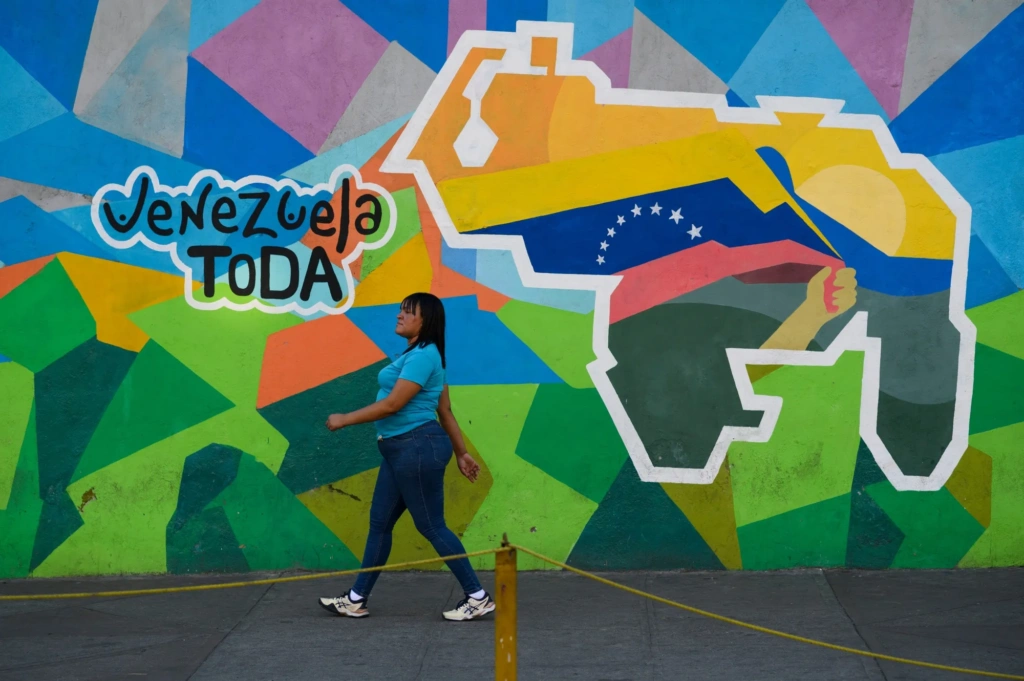
Venezuela’s Acting President, Delcy Rodriguez, on Friday reaffirmed her country’s rejection of the 1899 arbitral award that placed the disputed Esequibo region and reiterated that Caracas does not recognize the International Court of Justice (ICJ) as a body to settle the territorial controversy or any ruling it may issue.
Venezuelan Acting President Delcy Rodriguez made the statement on November 20, in a communiqué in which she urged the Cooperative Republic of Guyana to comply with the commitments set out in the 1966 Geneva Agreement.
Venezuela defends that accord as the path to reaching mutually satisfactory understandings. She also said no state can evade its international obligations by relying on third parties or outside bodies that are incompatible with earlier commitments, and concluded: “The sun of Venezuela rises in the Esequibo.”
RELATED: Venezuela Urges to Resolve Esequibo Dispute Through Dialogue
Guyana, led by President Irfaan Ali, holds the opposite position. It argues that the border dispute, covering roughly 160,000 square kilometers west of the Esequibo River and more than two-thirds of the territory Georgetown currently administers, must be resolved through an ICJ ruling.
Mensaje de la presidenta encargada, Delcy Rodríguez #20Nov
"Venezuela reaffirms its historic stance of rejecting the fraudulent 1899 arbitral award, as well as the non-recognition of the International Court of Justice to settle the territorial dispute over Guayana Esequiba, or… pic.twitter.com/PkfEiv3q0j
— Mi Mapa de Venezuela incluye nuestro Esequibo (@AntroCanal) November 20, 2026
Guyana and Washington Respond
Ali told reporters on Thursday that United States supports resolving the dispute through the court. He said Washington respects Guyana’s territorial integrity and that everyone will have to accept the ICJ’s decision. He also dismissed the idea that U.S. President Donald Trump is pressing for a bilateral solution, saying U.S. officials have consistently backed Guyana’s sovereignty in official meetings.
His remarks followed a report that in September a then-State Department policy planning official, Jeremy Lewin, suggested to Guyanese Foreign Secretary Robert Persaud that Guyana consider ceding control of part of the Esequibo to Venezuela, and offered to mediate.
On Thursday, the State Department affirmed its position on the land boundary has not changed and that it continues to support the 1899 award, which it said should be respected unless a competent legal body or the consent of both parties defines a new boundary. The U.S. Embassy in Guyana repeated its support for the award while mentioning the option of a negotiated agreement. Guyana’s foreign ministry said Washington backs the ICJ process and that it received assurances nothing has changed.
Background of the Dispute
The Paris Arbitral Award, issued on October 3, 1899, granted the United Kingdom rights over about 159,542 square kilometers of territory in the Esequibo that Venezuela claims. Caracas calls the ruling null and void, arguing it was reached behind Venezuela’s back, under coercion and amid threats of force by the British Crown, and citing alleged doctored maps and documents. Guyana and the ICJ process treat the matter differently, and the court has not ruled on the merits in the material available.
In May, Acting President Rodriguez appeared before the ICJ in The Hague during oral hearings held May 4 to 11. She affirmed that Venezuela maintains its historic position of not submitting existential matters, such as independence and territorial integrity, to judicial mechanisms. Following this, she also said Caracas upholds the Geneva Agreement and will defend the Esequibo by all peaceful means consistent with international law.
From teleSUR English via This RSS Feed.