

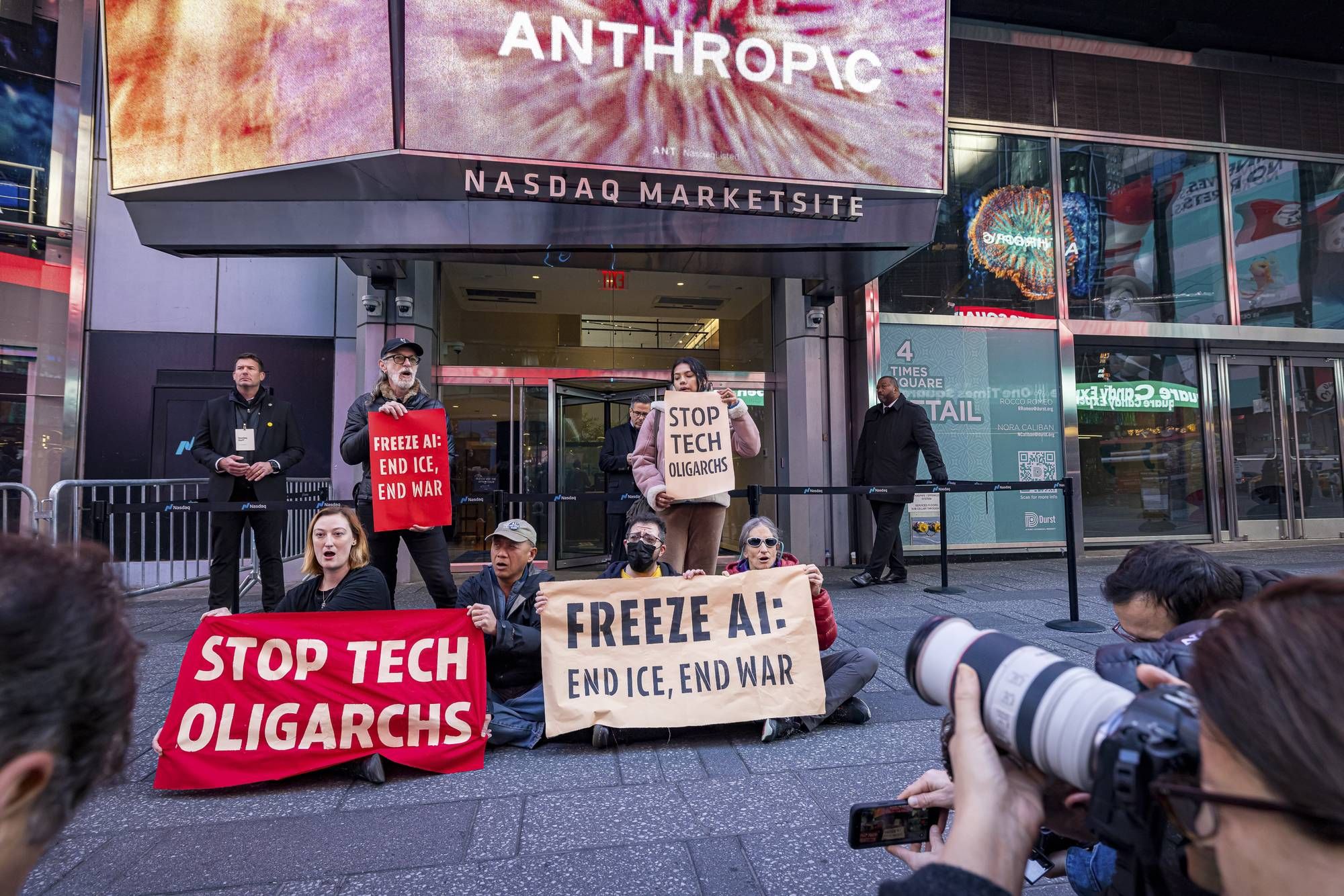
A government watchdog on Friday demanded that the US government draw a firm line in the sand against bailing out Big Tech companies when the financial bubble within the artificial intelligence industry bursts.
As the values of technology stocks plunged during Friday trading, Jeff Hauser, executive director of Revolving Door Project, warned that the AI industry could soon seek taxpayer financing to stay afloat.
An AI bailout would be particularly outrageous, Hauser explained, because of how recklessly the AI industry has behaved for several years.
“The AI industry did not consult the public in its disastrous financing, in fact it often aggressively obscured the details from communities and sought to trample democratic oversight,” said Hauser. “This disastrous speculative bubble has siphoned off enormous amounts of public money already, poisoned communities, eroded cyber infrastructure, and derailed the work of moving to a green economy.”
Hauser urged lawmakers to go on the record to rule out any possibility of taxpayer assistance for Big Tech.
“The public has already subsidized more than its fair share of the costs of this boondoggle,” he said. “So when the industry comes hat in hand begging for us to save them from themselves, the message must be unequivocal: not one dollar more.”
Concerns about an AI bubble have grown in recent weeks after the ouster of Jensen Huang, the former CEO of top AI chip manufacturer Nvidia, who stepped down after it was revealed he had affairs with two subordinates, as well as with a woman suspected of being a spy for the Chinese government.
Reuters reported on Friday that the Securities and Exchange Commission has begun “scrutinizing potential accounting issues” at Nvidia, sending the company’s shares tumbling by more than 12%.
The large sell-off in tech stocks comes just one day after frontier AI lab Anthropic held an initial public offering (IPO), with shares selling for $112 at opening.
The euphoria of the successful IPO lasted less than a day, however, as Anthropic shares have since lost more than 20% of their value.
From Common Dreams via This RSS Feed.
The most insane military budget request, possibly before december 11 deadline, that white house has proposed includes at least $78b (number from August) for Iran war costs, with $300b potential replenishment acceleration, and $500b in permanent annual military spending. That is WH official posture, though congress ignores it.
Still, every pigfucker congresscritter says “Skynet or China wins” which, instead of bailouts, means buy tokens for skynet. Budget expansion requests are so huge that sliding in those token contracts is not an obvious bailout, even though it is. And one that increases token costs for the “rest of us”.
Yeah. Unfortunately, the Trump administration has already gone ahead with the push to fully integrate these companies AI models into pretty much every branch of the Federal government.
If they fail…so does the US government.
Topical

Who dat?
While I’m all agreed, I’m leery of articles that can’t get basic facts right. Anthropic opened at $89.86 and is around $88.37 now. That sort of bounce on an IPO is perfectly normal.
The IPO price was $83. By the time it actually started trading, it opened at $111.50.
What Determines the Opening Price?
The opening price reflects buying and selling interest when the stock begins trading on its listing exchange.
Before that first trade, the exchange’s opening process brings together orders to buy and sell shares. Those orders help establish a starting price based on the prices of shares offered for sale and the prices buyers are willing to pay.
This involves a broader group than the investors who received shares in the IPO. Some participants may want to buy shares they could not obtain in the offering. Others may want to sell shares they received.
As a result, the stock can open above, below, or at its offering price. An IPO also does not necessarily start trading at 9:30 a.m. Eastern Time. The opening process can begin later into the day as orders are collected and assessed.

