

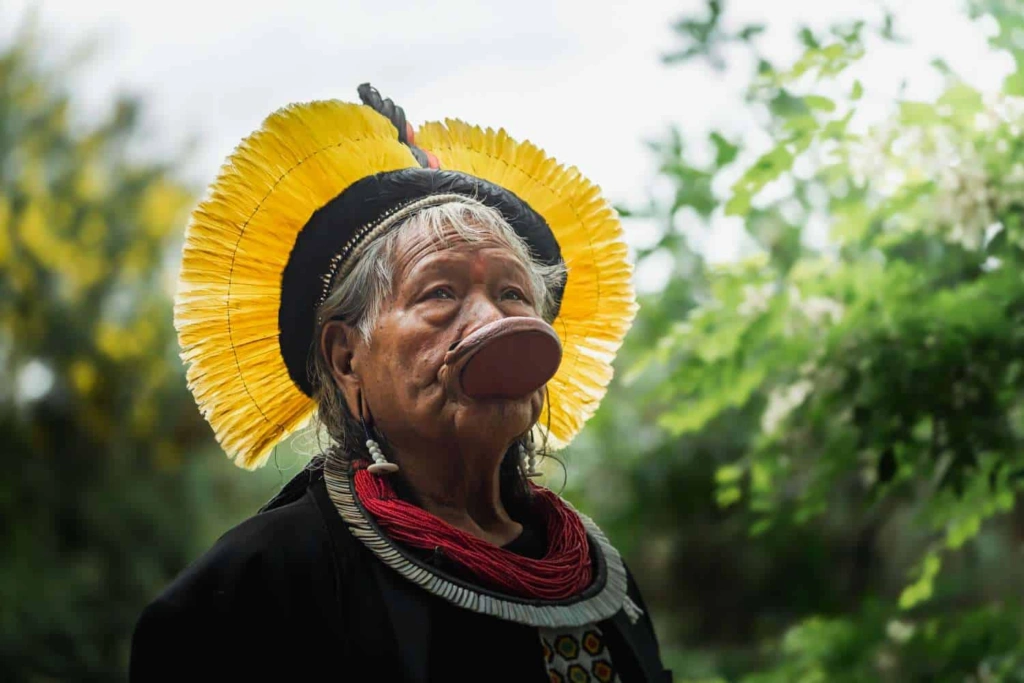
The area will be designated for the Mebengokre or Kayapo, Metyktire, and Yudja peoples.
On Wednesday, Brazilian President Luiz Inacio Lula da Silva signed a decree recognizing the ancestral lands of Chief Raoni Metuktire, one of the country’s most influential Indigenous leaders and an international figure in the defense of the Amazon, as Indigenous territory.
RELATED: Indigenous Land Demarcation Brazil: 72 Territories Advance Under Lula
Lula announced the decision during a visit to the state of Mato Grosso, where he met with the Indigenous leader who is currently battling terminal cancer. The president expressed his personal support for Raoni, 94, who is receiving palliative care at his residence after being hospitalized for several weeks with digestive cancer and a lung infection.
The decree is a preliminary step toward the final recognition of the Indigenous reserve and officially acknowledges an area of 362,243 hectares located between the Amazonian states of Mato Grosso and Para as ancestral territory.
The area will be designated for the Mebengokre or Kayapo, Metyktire, and Yudja peoples, who have historically inhabited the Amazonian region.
Demarcation of these lands was a long-standing demand of Raoni, considered one of the leading figures of Brazil’s Indigenous peoples. For decades, the chief has spearheaded national and international campaigns to protect the Amazon rainforest from threats such as illegal mining, drug trafficking, and deforestation.
Hoje tive a oportunidade de me reencontrar com o cacique Raoni, uma liderança histórica dos povos indígenas, por quem tenho profundo respeito e admiração.
Também assinei a portaria que reconhece a posse permanente dos povos Mebêngôkre e Yudjá sobre a Terra Indígena Kapôt… pic.twitter.com/TJrWRtwQbg
— Lula (@LulaOficial) November 19, 2026
The text reads, “Today I had the opportunity to meet again with Chief Raoni, a historic leader of Indigenous peoples, for whom I have deep respect and admiration.”
In his speech, Lula defended the decision and rejected arguments that questioned the size of the territory in relation to the number of inhabitants. The president maintained that the recognition responds to a historical principle and a matter of justice toward communities that occupied these lands long before the arrival of European colonizers.
However, the Brazilian president acknowledged that the process is not yet complete, as the government must resolve the legal status of approximately 200 agricultural holdings located within the boundaries of the newly recognized territory.
Indigenous land demarcation remains one of the most sensitive topics in Brazilian politics. Indigenous organizations are demanding greater speed in these processes, while sectors linked to agribusiness and rural land ownership often criticize the expansion of protected reserves.
Chief Raoni Metuktire dedicated his life to fighting for Indigenous land rights in Brazil. He’s now in palliative care after a cancer diagnosis. This is his legacy: pic.twitter.com/WDp5MGM7h5
— AJ+ (@ajplus) September 17, 2026
Raoni also played a significant role in the debates that led to the 1988 Brazilian Constitution, the fundamental law that, for the first time, recognized broad territorial, cultural, and political rights for the country’s indigenous peoples.
During the Free Land Camp, Brazil’s largest Indigenous mobilization, Raoni warned of global environmental degradation and called for a halt to the destruction of ecosystems.
The Indigenous leader urged the protection of the planet for future generations and reiterated that the defense of the Amazon is not just an Indigenous cause, but a responsibility shared by all of humanity.
Brazil is taking a major step toward improving workers’ rights, ending the 6-day workweek and guaranteeing two paid days off per week. The reform could reshape working conditions and reignite debate over work-life balance and labor rights.
Is a shorter workweek the way forward… pic.twitter.com/JiWiJHguMM
— teleSUR English (@telesurenglish) November 20, 2026
teleSUR: Joan Pablo Villalon Montenegro
Source: EFE
From teleSUR English via This RSS Feed.