

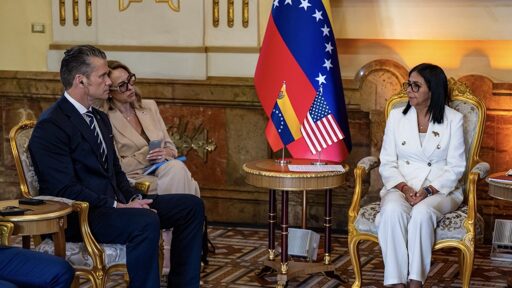

On November 18, 2026, acting President of Venezuela, Delcy Rodriguez, presided over the signing by US Secretary of War Pete Hegseth and Venezuelan Minister of Defense Gustavo González López of a military cooperation agreement in Caracas.
Speaking from the US Embassy in Caracas, Hegseth arrogantly stated that Venezuela “has gone from our most aggressive regional threat to a compliant security partner.”
Rubbing salt in the wound, Hegseth boasted that his trip was only “made possible” by the January 3rd operation that kidnapped President Nicolás Maduro and Cilia Flores, and left 32 Cubans and over 100 Venezuelans dead.
This he called “the single most sophisticated military operation in the history of Latin America,” which “solved a 27-year problem for this hemisphere in a matter of hours.”
He recounted that “exactly one year ago today” Maduro “stood on a stage not too far from here and yelled mockingly, ‘Come and get me!’” Hegseth added, “Well, we answered that call,” calling Maduro and Flores “narco-terrorists.”
The accord, announced during an unannounced visit, provides for the resumption of technical and military cooperation, including joint training, intelligence sharing, and access to new equipment and technologies for Venezuela’s armed forces. For Washington, it marks the return of a military relationship that had been interrupted for twenty-one years by the Bolivarian Revolution. For Venezuela, it represents a definitive close to the “anti-imperialist phase” articulated by Hugo Chávez in 2004-2005, and a de facto alignment with Trump’s project to renew total US control over Latin America and the Caribbean. All countries of the region now have military agreements with Washington, with the exception of Cuba and Nicaragua.
The significance of the signing cannot be understood without the historical record that preceded it.
The function of US military cooperation
US military cooperation with Venezuela has never been a neutral technical exchange. US military training shaped the officer corps that carried out state repression against Venezuela’s left for decades. During the 1950s, Washington backed the dictatorship of Marcos Pérez Jiménez, whose government was notorious for its brutality and whose security forces were trained and equipped by the United States. Later, the US Army’s School of the Americas trained thousands of Latin American officers, including Venezuelans, in counterinsurgency tactics, including interrogation, torture, and summary execution, and since the 1960s, the successive governments of the corrupt 4th Republic had been deploying those methods against the Communist Party and other left organizations, with the national police agency DIGEPOL responsible for extensive human rights abuses.
That same institutional lineage was on display in the February 1989 Caracazo, a mass popular uprising against IMF austerity measures, when the US-trained military was ordered to restore order, and hundreds of civilians were killed; as Chávez, himself a military officer, later said, the massacre “created consciousness among many military personnel, especially the younger ones,” and the officers who witnessed and carried out the repression were products of a system long tutored by the United States. The Caracazo became the breaking point that convinced Chávez and his co-conspirators in the MBR-200 movement that they “could not continue to defend a murderous regime,” setting in motion the February 4, 1992 rebellion.
Declassified Pentagon training manuals endorsed torture, extortion, and execution, and several Venezuelan generals who later participated in the 2002 coup against Chávez were graduates of the School of the Americas. This was not an aberration but a consistent feature of a security relationship designed to align Latin American militaries with Washington’s Cold War in a counterinsurgency strategy in which close to 200,000 people are estimated to have been forcibly disappeared for their left-wing political activism.
The most personal and politically charged example of this history is the 1976 torture and murder of Jorge Antonio Rodríguez, father of Delcy Rodríguez. Rodríguez, a socialist activist and leader of the Socialist League, was detained by Venezuela’s DISIP intelligence service and died in custody after what his family and numerous accounts describe as torture. As Craig Murray noted in Consortium News, the killing occurred at the hands of “the CIA-backed security services of the US-aligned [Carlos Andrés] Pérez regime”. That his daughter, now the acting president, would preside over such a military accord is a measure of the transformation imposed by the US on Venezuela’s political leadership since January 3rd.
Military transformation was key to the Bolivarian Revolution’s radicalism
In April 2005, on his program Aló Presidente, Chávez announced the indefinite suspension of all military exchanges with the United States. He stated that US military advisers stationed in Venezuelan bases had been “waging a campaign” among the Venezuelan military against his government and the Bolivarian Revolution. “All exchanges with US officers are suspended until who knows when,” he said. “There will be no more combined operations, nothing like that”. Chávez’s decision was a direct response to growing US hostility to the Bolivarian Revolution. In addition to the 2002 coup attempt against him, which senior US officials were closely linked to, US agencies provided continued funding of opposition groups, and cover for intelligence operations against the government. The suspension was an assertion of sovereignty, a refusal to allow a foreign power to maintain a military presence inside the country, while seeking to overthrow and undermine the constitutional order.
The expulsion of the US forces was a turning point in the radicalization of the Bolivarian Revolution, and set the stage for the transformation of the state apparatus. After the 2005 suspension of US military exchanges, Venezuela moved decisively to remake its armed forces as a sovereign institution. They purged the officer corps of those tied to the old US-aligned command structure and promoted a new military doctrine to erase the legacy of decades of US military instruction. This transformation tied the military directly to the Bolivarian project.
Chávez described the armed forces as being “at the very heart of the revolution,” and the institution was reconceived as a guarantor of the people’s democratic gains and national sovereignty rather than an instrument of external powers. The concept of unión cívico-militar, or the union of the masses and the military, first proposed by Chávez in 1999, became the military’s official doctrine. In a region with a long history of right-wing coups, all other progressive presidents elected in the “pink tide” were constantly looking over their shoulders, worried that their high command remained loyal to their oligarchies. Not so in Venezuela. Having broken the Venezuelan military away from the Pentagon and trained new layers of officers and soldiers in anti-imperialism, the Bolivarian state put down continued coup plots and did not snap under the highest-pressure scenarios.
For two decades, Venezuela refused to accept the presence of US military personnel and instead built security relationships with Russia, China, and other partners. But the US never abandoned its objective of regime change. Economic sanctions, diplomatic isolation, and covert action intensified. The decisive action came on January 3, 2026, when US forces conducted a military raid in Caracas, captured President Nicolás Maduro, and transported him to New York. Delcy Rodríguez, previously vice president, was sworn in as acting president. From that moment, Venezuela’s cooperation with the United States began not as a negotiated partnership between sovereign states, but as a relationship shaped by the reality of military threats and political coercion.
A different kind of change in course
The November 18 agreement formalizes that relationship. Hegseth described it as a “renewal of our defense partnership” and praised Rodríguez for “close cooperation” that allowed officials “to stabilize Venezuela and rid it of narco-terrorists”. The language is telling.
The agreement’s provisions, training, intelligence sharing, equipment, and technology are precisely the mechanisms through which the United States integrates a subordinate military into its own command and intelligence architecture. There is no suggestion that Venezuela will receive reciprocal access to US decision-making, or that the relationship will be governed by any principle other than Washington’s strategic agenda for total domination in the region.
The agreement must be situated within the broader US strategy that has come to be called the “Donroe Doctrine.” The term, a modification of the Monroe Doctrine, describes a renewed US claim to unilateral control over the Western Hemisphere. The doctrine aims to intervene directly in regional affairs, reinforce US military presence in Latin America and the Caribbean, and plunder resources to cut off China from natural resources, critical minerals, and supply chains. The January 2026 operation against Maduro was its first open application. The “Shield of the Americas,” launched in March 2026, is its institutional vehicle: a US-led multinational security and political alliance ostensibly formed to combat drug cartels, but which in practice commits member states to “the use of lethal military force” and to limiting “foreign geopolitical interference” in the hemisphere. The coalition’s motto, as announced by Hegseth, is “We do bad things to bad people.” Such language is the naked arrogance of US imperialism.
Venezuela’s signature on November 18 is therefore not merely a bilateral military agreement. The agreement commits Venezuela’s armed forces to interoperability with the US military, to intelligence sharing that will inevitably flow toward Washington’s regional command structures, and to a training relationship that will shape the doctrine and loyalties of a new generation of Venezuelan officers. In exchange, Venezuela receives equipment and technology.
It is normal for even the most revolutionary governments to seek normal, diplomatic and peaceful relations with the great capitalist powers. Existing in a system of states, they may even have mutually beneficial areas of cooperation, while remaining ideological and political adversaries. But that is not the context for this agreement. A government whose president was kidnapped after a foreign military operation, facing continued economic sanctions and the implicit threat of further intervention, cannot be said to have negotiated as a sovereign equal. The history of US military cooperation in Venezuela, from Pérez Jiménez to the School of the Americas to the 2002 coup, demonstrates that Washington’s security relationships in the region have only one purpose: control. There is no military threat posed to the U.S. from any country in Latin America – “mutual defense” in this context is an absurdity and a smokescreen. The November 18 agreement revives the long history of domination and compliance under a new name.
It marks a major turn in US-Venezuelan relations, but not toward equality or reconciliation. It formalizes a relationship of subordination, concluded under duress.
In that sense, Hegseth did tell the truth about one thing, how he began his remarks: “Just one year ago, my presence here would have been deemed impossible, almost unimaginable.”
From BT News via This RSS Feed.