

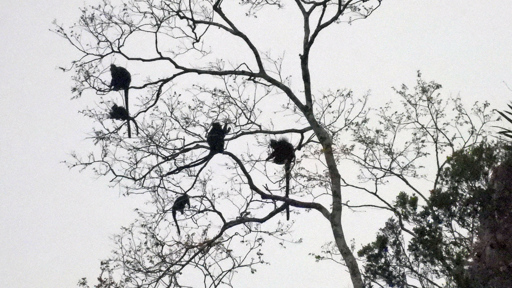
There is no body. No genetic evidence — yet. There are just photos, but some scientists say those photos show a distinct enough primate to declare it a new species: the short-tailed langur, or Trachypithecus brevicaudus. The proposed species was described in the Vietnamese Journal of Primatology and lives in the Annamite Mountains of Laos. “A photograph of a langur, published by the Saola Foundation, caught my attention because the animal’s tail is noticeably shorter than that of any other species within this group of limestone langurs,” said Tilo Nadler, lead author of the paper and a wildlife consultant for the Vietnamese government and various NGOs. This photo led Nadler and colleagues to investigate. They traveled to the area, a remote set of limestone karsts in Bolikhamxai province in central Laos, and took their own photos. “The first time I observed a group of these langurs, it was immediately clear to me that they were different from all the other limestone langurs I had previously encountered and knew well,” Nadler told Mongabay in an email interview. “It was a very exciting experience.” Male short-tailed langur of a group. Image by Tilo Nadler. But not all scientists agree that these photos prove a new-to-science species. “It could well be a new species, but I think the data that have been presented do not give sufficient support for this,” said primate expert Vincent Nijman, director of EcoVerde Global Consulting, who wasn’t involved with the paper. But Nadler said the encounter, and photos,…This article was originally published on Mongabay
From Conservation news via This RSS Feed.