

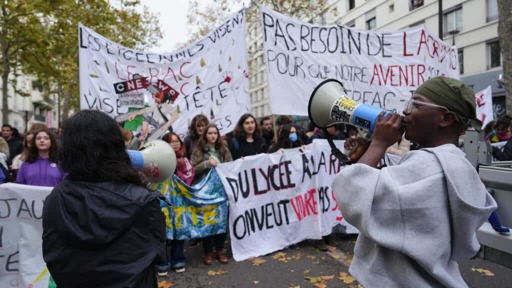
Across Europe, radical youth have surged onto the scene since early October, shattering capitalist normality and shaking up governments. From the revolutionary day of October 17 in France to Italy, and from Albania to Germany, Belgium, and Spain, we have joined thousands of other young people in the struggle for the most fundamental demands: decent conditions to study, and an end to mind-numbing discipline and academic pressure. We have taken a stand against racism and police violence, against budget cuts to public services, and against real estate speculation. Raising these issues in every country means confronting the central policy of European states and bourgeoisies: rearmament at a cost of hundreds of billions and the preparation of society for war.
Across borders, these struggles converge both because of the hatred and repression they provoke among our rulers and because of their common goals. Young people in Italy are calling for action “like in France”; in Germany, the tactics of blocking high schools and universities have been adopted from France and Italy. On November 20, at the call of a broad coalition of European organizations, young people in struggle across Europe are called to a youth strike against militarism, following the example of the German high school student mobilizations over the past year against the reintroduction of military service. This date must serve to show not only the face of a youth in struggle against its government but also that of a generation at war against an entire system.
For if our struggles are so subversive, it is because they are not limited to mere youth demands; they express a comprehensive anti-capitalist politicization and serve as the voice of anger throughout society. We have seen in Gaza what the weapons produced by the imperialist powers are used for, and we have seen how our governments support genocide and repress all those who dare to denounce it. In every country, we see governments attacking working conditions, forcing people to go to work while sick, raising the retirement age, and dismantling the eight-hour workday — all while bosses gorge themselves on dividends and public funds. It is to pay for war preparations, the bosses’ profits, and the cops who protect them that workers are killing themselves on the job just to barely fill up their cars or pay their rent — that hospitals and public transportation are collapsing, and our schools are falling into ruin. As our comrades in Germany sing, “The rich want war; the youth want a future.”
Faced with a capitalism in crisis that promises nothing but war and climate destruction, a future can only be won through a relentless struggle for socialist revolution — for the overthrow of the capitalist order and the building of a communist society. To achieve this, it is not enough merely to overthrow a government or overcome repression; we must overthrow the political and economic power of the capitalists, wrest control from them over the banks, industry, housing — in short, over the entire economy and the whole of society. The power to decide everything must return to those who keep this society running: the working people.
It is with this perspective in mind that, together with the youth organizations of the Permanent Revolution Current, we are fighting wherever we are to unite the struggles of the youth with those of the working class as a whole, so that the energy and radicalism of the youth can inspire the labor movement. In France, Italy, and Spain, the youth movement has already forced union leaderships to call for general strike days during the month of November. In Spain there had not been a joint strike by the major labor federations in 14 years; the outrage sparked by the eviction of Maricarmen Abascal — an 87-year-old driven from her home by real estate speculators — forced union leaderships to break out of their passivity.
These strikes marked the first convergence between the radicalism of the youth and hundreds of thousands of workers in the workplace. Nevertheless, the union bureaucracies have done everything in their power to prevent these strikes and are seeking to use them to negotiate crumbs with the governments. They are also determined to isolate the strike days to prevent the working class and the youth from organizing, developing ties, and going beyond their plans.
The union leaderships’ policy of class collaboration has sparked widespread debate within youth movements across Europe: Should we uncritically fall in line behind the union bureaucracies’ policy, or should we sever ties and demonstrate and fight separately? This debate is taking place on November 20 in Italy, in response to the CGIL’s call for a strike, but also in Germany, where Gen Z demonstrations will at times be separate from the Schulstreik (school strike) protests. It is also evident in France in the separation between the Saturday demonstrations — which seek to re-create the events of October 17 — and routine union strike days. The same was true in Spain during the November 11 strike, which some union bureaucrats even sought to frame as support for Sánchez’s socialist government.
This debate ultimately pits the masses against radicalism, as well as riotous protests against general strikes, and leads radicalized youth to turn away from unions and the workplace. Yet that is precisely where power lies in a capitalist society. As the Italian dockworkers and workers across Europe have shown, it is they who have the power to block arms shipments and paralyze the economy. A general strike is not merely a call for different sectors to go on strike; it is the primary political tool for paralyzing the ruling class and the economy and for inflicting a defeat on our governments and the bourgeoisie. That is why, as revolutionary communist youth organizations, we believe that mobilized youth have an immense responsibility to forge links with the labor movement — with both unionized and nonunionized workers — so that together we can overcome their leaderships, which seek to collaborate with the state and the bosses.
These links will not fall from the sky but must be consciously built through efforts at coordination and grassroots organization. To achieve this, we need activists organized in revolutionary parties within workplaces, neighborhoods, schools, and universities. Activists from the Permanent Revolution Current are working everywhere to develop solidarity between workers and students and to foster democratic coordination among the sectors engaged in struggle. Thus, in France, we have opened our universities to interprofessional assemblies bringing together union activists, college students, and high school students to give the strike days an active character. The same is true in Spain, where we have built united strike committees that have taken on the task of maintaining picket lines and carrying out blockades in solidarity with the strikers on November 11.
The union bureaucracies act as agents of capitalist policy within our class. They defend militarization as a source of jobs and pit workers against one another across national borders by defending “national” production alongside their countries’ bosses. The struggle against these bureaucracies is an essential task: neither bypassing them nor blindly following them — young people must bring their radicalism to the labor movement and fight alongside it.
This is the only way for the labor movement to assert itself as a class-based alternative in the face of the capitalist crisis. Otherwise, it will be the Far Right that capitalizes on the situation by relying on nationalism, its social demagoguery in response to the social attacks by traditional parties, and the sense of powerlessness in the face of the ruling class. Reformist parties propose moderate militarization and a few social concessions through illusory compromises with the bosses. They are the electoral counterpart of the union leaderships, and as such they promise nothing more than to continue the cycle of electorally co-opting struggles — a cycle that leads to demobilization and disillusionment, which in turn allows the international Far Right to thrive.
Building a powerful revolutionary movement is the only way today to halt the rise of the Far Right and the march toward war!
On November 20 and beyond, we will go on strike and take to the streets to fight militarization: Not a single euro, not a single life for their wars! We are fighting to end austerity cuts and to establish massive budgets for education and public services! To sever all ties between our educational institutions and the State of Israel and arms companies!
We are also fighting for a 400-euro wage increase for everyone and for the expropriation of arms manufacturers, major energy conglomerates, and real estate speculators.
This struggle can only succeed through the organization of a genuine general strike and the building of powerful revolutionary organizations. To defend this program and these perspectives, join the international struggle of the Permanent Revolution Current!
This is a slightly revised and translated version of the original statement, published on La Izquierda Diario on November 20.
The post “The Rich Want the War, We’ll Start the Revolution!” European Strike against the War on November 20 appeared first on Left Voice.
From Left Voice via This RSS Feed.