

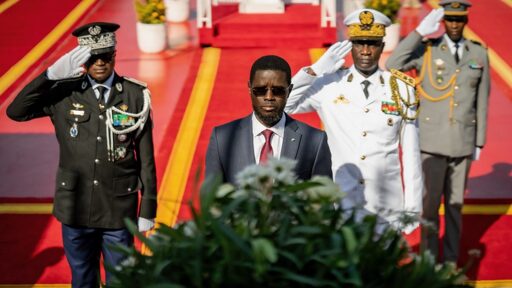

Senegal’s governing party, PASTEF-Les Patriotes, has struck President Bassirou Diomaye Faye off its membership list, formalizing its break with the man it carried to power in March 2024. Two days later, Faye bypassed the party’s parliamentary majority by bringing a rejected budget into force by decree.
At a meeting on Tuesday, November 17, 2026, PASTEF’s National Council (Conseil national) removed Faye and 31 others, among them serving ministers. Only releasing a brief communiqué, numbered C N°02/PASTEF/CN/2026:
“Pursuant to the provisions of Article 6 of the statutes of PASTEF-LES PATRIOTES, the National Council of the party, at its meeting of Tuesday 17 November 2026, formally noted the automatic loss of membership of PASTEF-LES PATRIOTES of the persons listed below … Accordingly, they are permanently struck off the party’s membership list.”
The list includes Yankhoba Diémé, minister of the Armed Forces, who stayed in Faye’s government in June despite the party’s boycott. It also includes Aldiouma Sow, a member of PASTEF’s National Political Bureau and minister-adviser at the Presidency.
A partnership that came apart
Faye and Ousmane Sonko emerged as a single political project. When Sonko was barred from the 2024 presidential race, he designated Faye, then PASTEF’s secretary-general, as the party’s candidate under the slogan “Diomaye mooy Sonko” (“Diomaye is Sonko”). Faye won in the first round and named Sonko prime minister.
The partnership broke down over governance and economic management. On May 22, 2026, Faye dismissed Sonko and dissolved the government, appointing the economist Ahmadou Al Aminou Lo as prime minister. PASTEF refused to join the new cabinet announced on June 1.
Read more: Senegal leadership rift escalates as President Faye removes popular Prime Minister Ousmane Sonko
Sonko then returned to the National Assembly, where lawmakers elected him speaker. PASTEF holds 130 of the Assembly’s 165 seats, and on June 6 its first ordinary congress re-elected Sonko party president unanimously.
Faye, for his part, moved to build his own base. On July 25, 2026, he launched Kiiraay – Les Patriotes Républicains, a party with no seats in the Assembly.
Read more: Political rift in Senegal deepens as parliament moves to limit presidential powers
A budget brought into force by decree
The split now runs through Senegal’s public finances. On November 3, the PASTEF majority rejected the government’s 2026 amending finance law (supplementary budget) in a plenary vote. From November 7, the Assembly’s Finance Committee went on to reject most of the items in the 2027 budget bill.
On Thursday, November 19, the presidency answered with a communiqué signed by Oumar Samba Ba, minister and secretary-general of the presidency:
“The President of the Republic, guardian of the Constitution and guarantor of the regular functioning of public authorities and of the continuity of the State, has decided to bring into force the draft amending finance law (supplementary budget) for the year 2026 by means of Decree No. 2026-2416 of 19 November 2026.”
The communiqué cites no specific constitutional provision for the decree. It covers only the 2026 supplementary budget; the 2027 budget remains stalled in Parliament.
The standoff comes as Senegal continues to face debt burdens in Africa. In February 2025, a Court of Auditors report found that borrowing had been under-reported for years under the previous government of Macky Sall. The IMF suspended its program after about $13 billion in undeclared debt came to light, and puts total public-sector debt at about 132% of GDP at the end of 2024. In September 2026, Senegal and the IMF agreed on a program of about $2.2 billion over 36 months, but the Fund’s board has not yet approved it.
What happened to the optimism
Faye and Sonko rose by mobilizing around mass youth unemployment, the rising cost of living, frustration with neoliberal policies, and anger at the political establishment. Those grievances had fueled years of protest and instability, and the pair’s victory raised hopes, in Senegal and across the continent, for a new kind of leadership.
After the separation, Sonko continued to command the grassroots base and kept his grip on the parliamentary majority, while Faye held the presidency. That meant Faye was always likely to face sustained pressure, both from Sonko and PASTEF.
From BT News via This RSS Feed.