

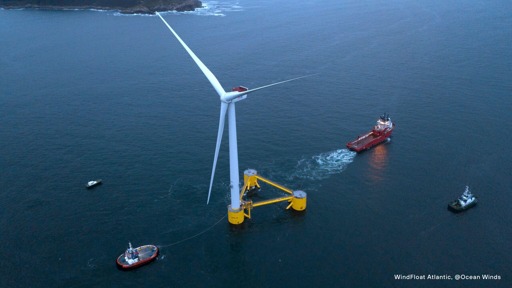
It’s a little-known, nascent sustainable technology on the verge of commercialization: Floating wind turbines deployed across deep ocean waters could unlock vast amounts of renewable energy in the coming decades. For some countries (including China, Japan, South Korea, the U.K. and EU), floating wind is already playing a role in plans to decarbonize national economies, owing either to a lack of viable fixed-bottom offshore wind sites, or due to limited space for land-based renewables. For now, the emerging floating wind industry consists chiefly of small-scale demonstration and pilot projects, totaling around 300 megawatts (MW) of global output, a capacity dwarfed by current worldwide fixed wind generation at nearly 100 gigawatts (GW). The largest floating wind farm currently is Hywind Tampen in Norway with 11 floating turbines producing 94.6 MW for use by oil and gas installations. Despite its current lack of scale, Louise Efthimiou, the floating offshore wind manager at World Forum Offshore Wind, still sees floating wind “as a very strong contender” for decarbonization, albeit on a smaller scale than fixed offshore sites. “We can acknowledge that floating wind will not necessarily represent the bulk of offshore wind,” she told Mongabay in a video interview. “But it does benefit markets who don’t have the choice to do other than floating wind … offshore because of their water depths and their environment.” The major hurdle is getting floating wind up and running at a commercial scale. “The technology works, but it’s still in a phase of innovation, and so that…This article was originally published on Mongabay
From Conservation news via This RSS Feed.