


By Mark Birnbaum, World BEYOND War, November 20, 2026
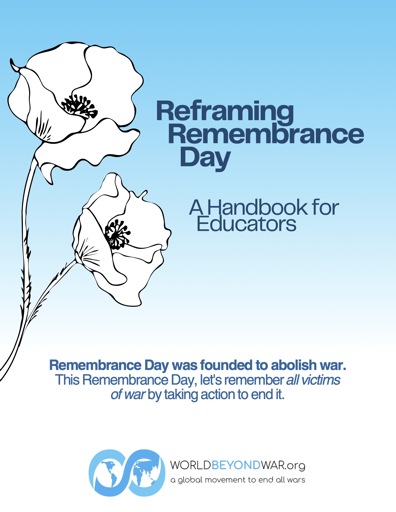
In anticipation of Remembrance Day, World BEYOND War created a brand new resource guide to promote the white poppy and its message of recognizing all victims of war: Reframing Remembrance Day: A Handbook for Educators.
Our new resource was covered by multiple Canadian media outlets. Though their articles were framed around the supposed controversy surrounding the use of the white poppy, their coverage nonetheless served to spread our message: abolishing war and recentering Remembrance Day on creating a peaceful future.
The National Post detailed how “…Canadians were confronted before this year’s Remembrance Day with a campaign advocating white pacifist poppies. An anti-war organization known as World Beyond War proposed on Nov. 6, what it called ‘an alternative to traditional, militaristic Remembrance Day education, centred around the White Poppy — a symbol meant to recognize all victims of war.
“‘World BEYOND War’s website messaging is that though Remembrance Day “was founded to abolish war, the way it is marked increasingly serves to glorify war, militarism, and violence. Most concerningly, school curricula across Canada still make the glorification of war and notions of bravery and sacrifice through military violence central to Remembrance Day.”‘”
The article later references commentary in the National Post from 2013: “If anything is clear in the great poppy debate, though, it’s this: the white poppy symbol, like the flower itself, is not native to Flanders as is its red cousin. Accordingly, it has never caught on as a symbol of remembrance. Perhaps major Canadian involvement in recent wars has caused it to blossom anew.”
Indeed, Canadians are growing increasingly angry and restive about Canada’s accelerated militarism.
The Toronto Sun gives an accurate summary of the handbook’s materials for teachers, “…that encourages them to ‘challenge militarism’ in the classroom on Remembrance Day.
“The handbook goes further, encouraging grades 1-3 students to ‘draw your own white poppies or make them from paper plates or cupcake holders. Put these poppies together in a display or garden.’
“It asks grade 4-6 students to ‘explore cultural promotion of war and militarism that surrounds us in our daily lives. This might look like toys sold at local stores, an annual air show … or other media that glorifies war, weapons and violence.’”
With the guide offering ideas for direct, nonviolent political action, theSun article aptly acknowledges World BEYOND War’s antiwar mandate, “…[as the guide] charges straight into activism, demanding that grades 7-12 students ‘lobby your member of Parliament – get your priorities straight!’”
Students are free to choose from an array of actions based on comfort level and degree of engagement.
An article from Newsweek recounts how, “…Reframing Remembrance Day in Canada: A Handbook for Educators […] offers teachers an alternative approach to lessons traditionally centered on soldiers, military service and wartime sacrifice.
“Its organizers argue that Remembrance Day should also encourage children to consider the experiences of civilians, the causes of conflict and ways to prevent future wars.
“The materials include age-appropriate activities intended to prompt discussions about peace, violence and the human consequences of armed conflict.
“Rather than simply recounting military history , the campaign encourages teachers to explore the wider effects of war on families, communities and people who never served in uniform.
“Supporters believe that focusing on the experiences of soldiers alone can leave children with an incomplete understanding of conflict.”
The post A Flurry of Media Coverage of WBW’s Reframing Remembrance Day Educators’ Handbook appeared first on World BEYOND War.
From World BEYOND War via This RSS Feed.