

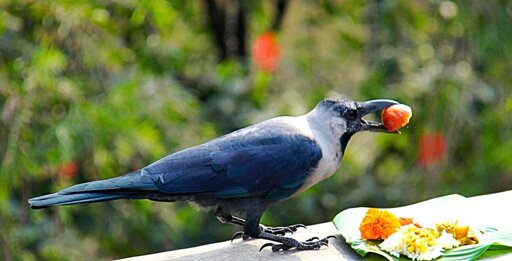
Every year around the Hindu festival of Diwali, or Deepavali, residents in Nepal observe Kaag Tihar, an annual festival day dedicated to worshipping house crows as divine messengers. However, in the country’s capital, rapid urban sprawl, habitat degradation and changing perceptions toward the bird are testing human-crow relations, reports Mongabay’s Gobinda Pokharel. Satellite analysis shows Kathmandu’s urban build-up area expanded by 124% between 1989 and 2018, while another study found municipal green space plummeted by 54% between 1975 and 2025. Meanwhile, the removal of more than 2,000 mature trees along major thoroughfares like the Kathmandu Ring Road has forced house crows (Corvus splendens) to nest on utility poles and electrical wires, according to a 2024 study led by Tribhuvan University researcher Dinesh Bhusal, in Nepal. “When old and large trees are cut down, specialist birds lose their habitats,” said Hem Bahadur Katuwal, a bird ecologist at the Xishuangbanna Tropical Botanical Garden, Chinese Academy of Sciences, southwest China. “Eventually, only functional generalist species, such as crows, which can survive under almost any conditions, remain.” Compounding the population shift is Kathmandu’s unmanaged refuse. Open dumping of waste along riverbanks and uncovered trash at meat shops provide abundant forage, attracting dense concentrations of crows and black kites (Milvus migrans). “Large quantities of discarded food and exposed waste from meat shops have contributed to the unusual increase in crows and kites in Kathmandu,” said Kamal Raj Gosai, an ornithologist and associate professor at Tribhuvan University’s Tri-Chandra Multiple Campus. Gosai, noted that crows act as…This article was originally published on Mongabay
From Conservation news via This RSS Feed.