


Bullets:
Samsung and SK Hynix are leading producers of the memory systems that drive consumer electronics, and have giant fabs in China to produce chips for the world’s largest electronics market.
They rely on advanced chipmaking gear from US companies, namely Applied Materials (AMAT) and Lam Research (LRCX).
But that equipment may be cut off at any moment by Washington, who controls the exports of any gear that contains even trace components or technology originating in the US.
The Korean companies are also now threatened by up-and-coming Chinese memory chipmakers, like Yangtze Memory Technologies (YMTC) and Changxin Memory Technologies (CXMT), who build their chips using domestic (non-US) suppliers and tools.
As Chinese chipmakers gobble up market share in China, and then in export markets, profound impacts will also be felt at Micron and AMD, who today enjoy booming gross sales margins.
Inside China / Business is a reader-supported publication. To receive new posts and support my work, consider becoming a free or paid subscriber.
Report:
Good morning.
Korean companies are caught in the crossfire of the Chip Wars, and the export bans from the United States on the most advanced semiconductor technologies, and also by China—who is pushing for all-domestic supply chains for semiconductors, and in the case of American technologies, especially so.
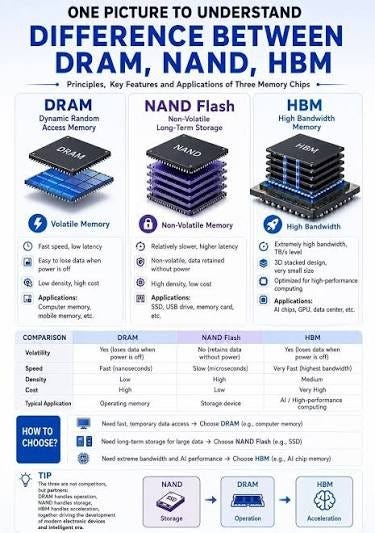
Samsung and SK Hynix are major manufacturers of DRAM and NAND flash memory chips that power portable devices, gaming consoles, laptops and PCs. They’re Korean companies, but they have giant fabs here in China, to supply the electronics industry here. In August, Reuters reported that they were evaluating chipmaking gear from AMEC, a Shanghai company. The South Korean firms are hedging “against the risk of tighter US export controls.”
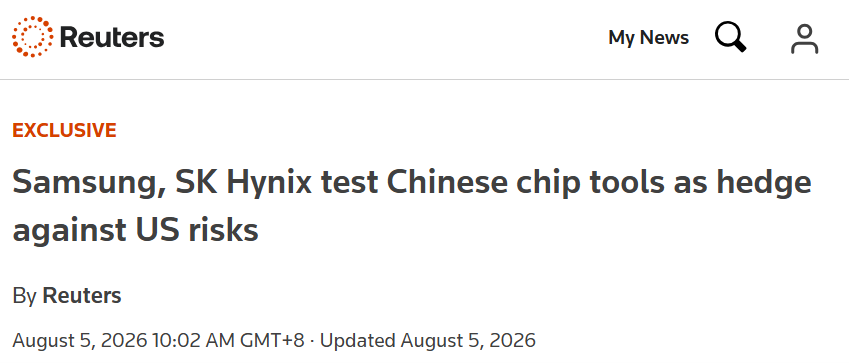
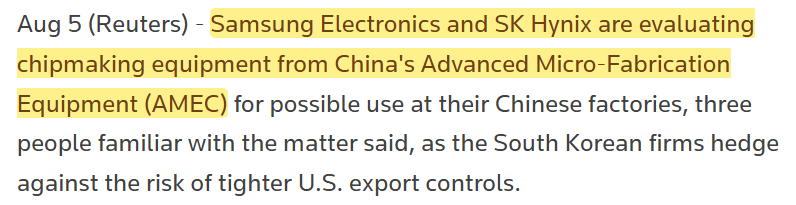
It began two years ago, when they were less sure that they would be allowed to import the top chipmaking tools from the United States. They included this disclaimer from Samsung and SK Hynix that neither has tested AMEC’s tools in their Chinese factories, and didn’t elaborate further. The sources for the story, and the regulators involved, are anonymous because of the “sensitivity of the matter.”
Last year Washington revoked the “validated end user” designation for Samsung and SK Hynix, and switched to a regime whereby licenses to use the equipment in China are approved annually. So the companies are looking for a strong Plan B so they can continue building chips for the China market, in case the US switches off their access to American gear. Applied Materials and Lam Research make key equipment for the manufacture of their RAM chips.
Were Samsung and SK to switch suppliers for their Chinese factories, from AMAT and Lam to domestic toolmakers, it would be a big problem for those US companies, and a boon to AMEC. Industry experts say that in certain chipmaking technologies, Chinese equipment makers are catching up fast, and do so at lower cost.
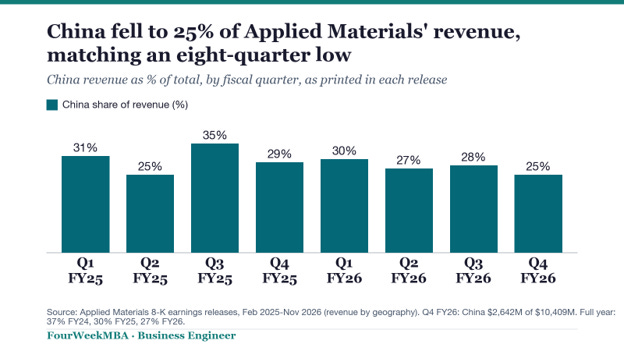
And there we see the size of the problem. Applied Materials realized $8.53 billion in sales in China last year, and that is 30% of the company total. Deutsche forecasts that four Chinese equipment makers will have a billion in revenues, each, which is over a quarter of the total Chinese market, and higher if we back out lithography.
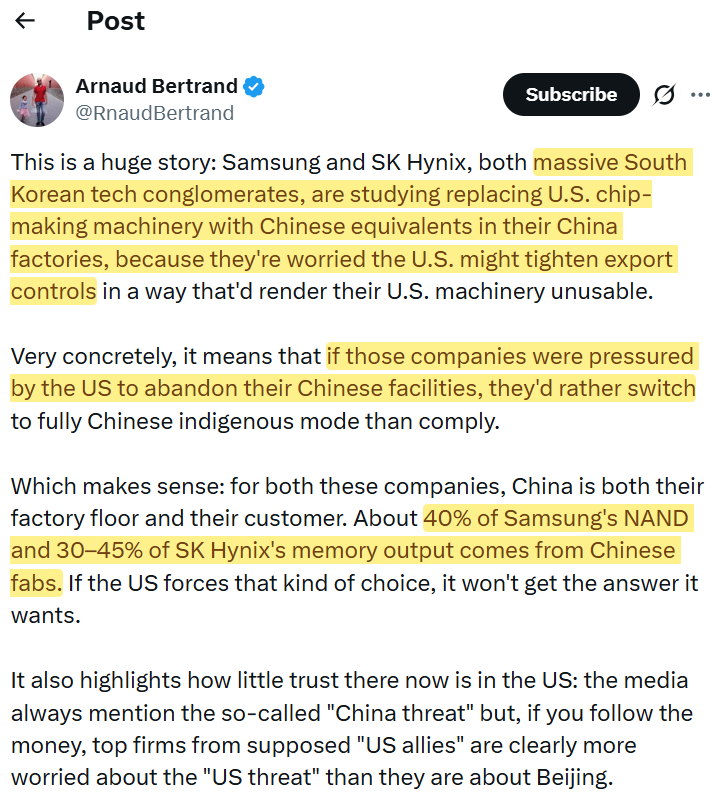
Only reason we heard about the issue in the first place is because we follow Arnaud, and he pointed out the dilemma for Samsung and SK Hynix. If Washington closes off access to chipmaking gear from US companies, Korean firms will either have to give up the Chinese factories completely, or find Chinese suppliers for that same equipment.
So they’re stuck either way. For those Korean firms, their Chinese fabs represent over a third of their total global production. And stockholders see the problem too. SK Hynix is one of the cheapest stocks in the world on a fundamental basis. It’s priced at 3 times forward earnings, so investors are selling shares, pricing in something that has already broken down.
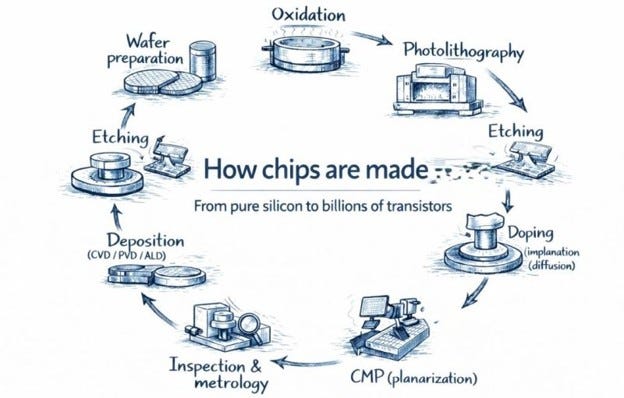
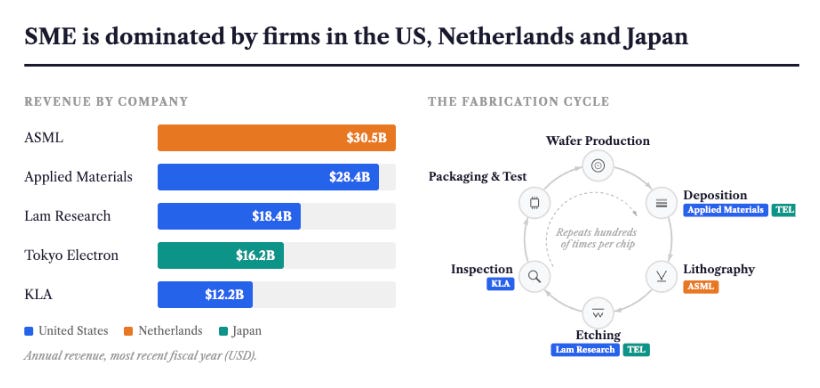
Chipmaking requires highly advanced tools for deposition, etching, and metrology. It is US companies that control those technologies used by Samsung and Hynix: Applied Materials, Lam Research, and KLA most notably. All the equipment that the Korean companies use to make chips—anywhere—falls under US export controls.
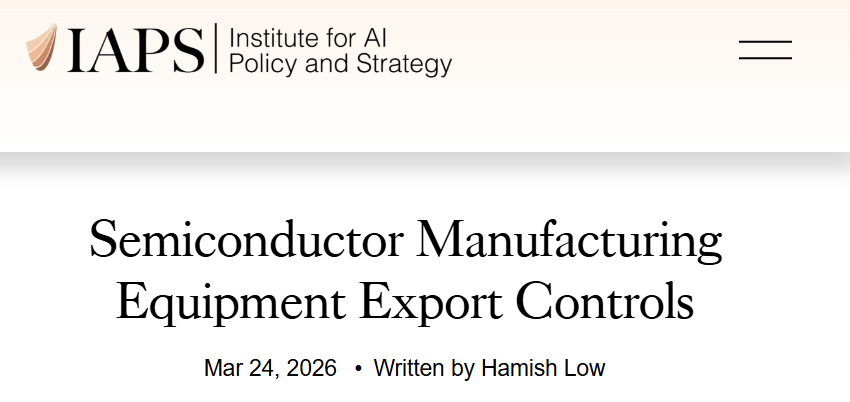
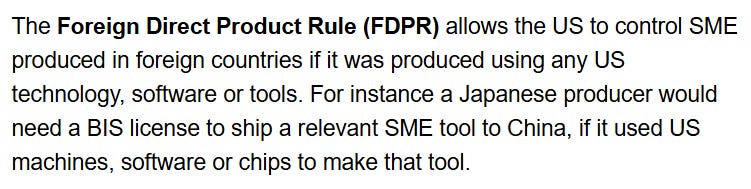
But Chinese companies also now manufacture those chipmaking tools, and Chinese regulators don’t want American tech used in Mainland China either. So the Koreans have no choice but to serve as beta testers for semiconductor manufacturing gear from China, for those fabs here. Chinese tools also cost less than the ones coming over from their US suppliers.
In August 2025, American regulators changed the licensing procedures for US gear, and analysts understood right away that those changes would be a boon to Chinese memory chip producers, like YMTC and CXMT. Samsung and Hynix had a no-questions-asked relationship with their vendors before; now it’s very tentative, subject to annual approvals.
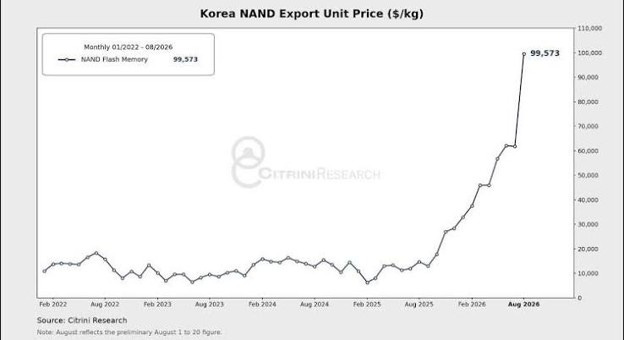
Meanwhile, memory prices are skyrocketing – up over 7 times since last year – because of massive demand from AI data centers. That is squeezing traditional electronics makers. According to TrendForce, rising memory costs are forecast to gut global smartphone production by about 10% this year, to roughly 1.1 billion units.
For networking gear, the cost jump is even more stark: memory used to be a minor 3% of a router’s total cost a year ago; now it’s over 20.
SK Hynix and Samsung build memory and have been benefiting from those giant price spikes. Gross margins at Hynix are over 80%; operating margins over 74%:
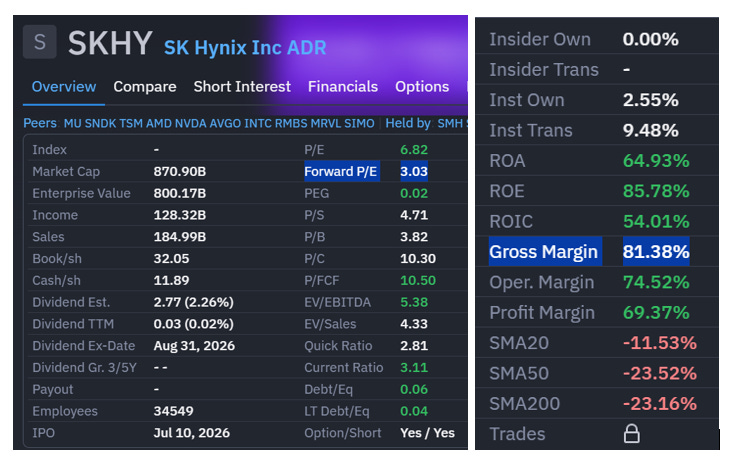
They have had a license to print money, but investors don’t believe it will last much longer. Samsung and Hynix have large investments and CAPEX in China, with production facilities in Xi’an, Wuxi, and Dalian. But the only way those plants produce high-quality and high-priced chips, is by virtue of a smooth flow of tools from the United States, which isn’t likely under the new regulations that we already know about—who knows how the fallout from the Nvidia saga is going to hit other exports.
Here though the regulators in Washington also have a problem: if the South Korean companies in China can’t get the equipment they need to build semiconductors, memory prices will move even higher in the short term, which will even further damage the consumer electronics markets, and probably deeply impact the AI data center buildouts too.
Samsung and Hynix are also being squeezed by competition here in China. Chinese memory makers are already much further down the road, in getting American gear out of their supply chains. YMTC is a Chinese company, and is ramping up chips fabs to compete directly against the Koreans, and is cutting out AMAT and Lam equipment. They’re now nearly 40% of China’s NAND market, and 14% of the global market share.
CXMT is another memory maker, who last month saw a breakthrough in 4F-Squared memory cell technologies. Depending on how quickly CXMT can commercialize their 4F-Squared, it’s a big problem looming for Samsung, Hynix, and Micron, and is yet another example of a Chinese company doing something that the export controls and trade restrictions were designed specifically to prevent. CXMT today has 10% of the total global share of the DRAM market.
Industry experts maintain that CXMT is not—yet—an existential threat to those Korean companies, because there are still improvements that the Korean firms can make to their existing chip architectures. To do that, however, they require access to the latest-generation chipmaking gear, and now all of that is on a short leash, held by regulators in Washington.
And there’s the other problem. Hynix and Samsung “have been working on 4F-Squared chips.” But CXMT’s gains in 4F-Squared happened, using domestic equipment. That’s to say that Korean fabs in China aren’t just looking at Chinese chipmaking gear in case they can’t bring in American equipment: it’s that their Chinese competition is using Chinese technology and making 4F-Squared chips.
Another disclaimer is necessary here. CXMT does have a tougher road in DRAM and High-Bandwidth Memory, compared to YMTC in NAND. So far CXMT’s cost per good die is high, compared to HBM4 chips from South Korean companies. But the writing is on the wall for that, too: as soon as CXMT can get its quality higher and costs lower, Huawei and other Chinese electronics manufacturers will probably dump the Korean suppliers that are dependent on American gear to build their chips.
Be Good.
Resources and links:
Samsung, SK Hynix test Chinese chip tools as hedge against US risks
https://www.reuters.com/world/china/samsung-sk-hynix-test-chinese-chip-tools-hedge-against-us-risks-2026-08-05/
US makes it harder for SK Hynix, Samsung to make chips in China
https://www.reuters.com/sustainability/society-equity/us-makes-it-harder-sk-hynix-samsung-make-chips-china-2025-08-30/
US approves Samsung, SK Hynix chipmaking tool shipments to China for 2026, sources say
https://www.reuters.com/world/china/samsung-wins-us-annual-approval-chipmaking-tool-shipments-china-source-says-2025-12-30/
Memory price surge of ‘more than 600%’ squeezes China’s device makers
https://www.scmp.com/tech/article/3343321/memory-price-surge-more-600-squeezes-chinas-device-makers
Memory breakthrough by China’s CXMT puts chip rivals on back foot
https://asia.nikkei.com/business/tech/semiconductors/memory-breakthrough-by-china-s-cxmt-puts-chip-rivals-on-back-foot
CXMT puts fifth-generation DRAM process into production
https://yangtzeer.com/news/heavy-hitters/cxmt-fifth-generation-dram/
China is making advanced memory chips without the world’s best tools
https://interestingengineering.com/inside-china/china-advanced-memory-chips-without-the-worlds-best-tools
Semiconductor Manufacturing Equipment Export Controls
https://www.iaps.ai/research/semiconductor-manufacturing-equipment-export-controls
Intel’s old NAND plant in China is now officially registered as SK hynix after US imposes new sanctions that limit fab upgrades in China
https://www.tomshardware.com/tech-industry/intel-dalian-plant-now-officially-sk-hynix
‘A high probability’: Congress pushes tighter export controls following Nvidia scandal
https://www.semafor.com/article/11/12/2026/a-high-probability-congress-pushes-tighter-export-controls-following-nvidia-scandal
China’s YMTC Becomes The World’s Third-Largest NAND Manufacturer, Clocking In Explosive Growth While Eyeing Samsung-Level Capacity
https://wccftech.com/chinas-ymtc-becomes-the-worlds-third-largest-nand-manufacturer-clocking-in-explosive-growth-while-eyeing-samsung-level-capacity/
China Intensifies Push to ‘Delete America’ From Its Technology
https://www.wsj.com/world/china/china-technology-software-delete-america-2b8ea89f
Supply Chain Brief: Market Conditions in 2026
https://www.versalogic.com/blog/supply-chain-brief-memory-market-conditions-in-2026/
Why Are Prices for Cars and Tech Suddenly Spiking? Blame AI Data Centers.
https://www.consumerreports.org/electronics/artificial-intelligence/ai-demand-for-ram-is-driving-up-prices-for-cars-and-tech-a1879694257/
Rise in memory chip costs puts pressure on retailers of laptops and smartphones
https://www.cnbc.com/2026/06/26/ai-memory-chip-shortage-consumer-electronics-prices.html
Inside China / Business is a reader-supported publication. To receive new posts and support my work, consider becoming a free or paid subscriber.
From Inside China / Business via This RSS Feed.