

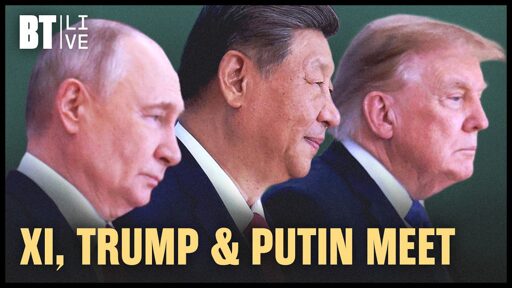

Xi Jinping, Vladimir Putin and Donald Trump met Thursday in Shenzhen on the sidelines of the APEC summit. But what isn’t making mainstream news about the shifts in global power? Marco Fernandes, Brazilian representative at the BRICS Civil Council and geopolitical analyst at Brasil de Fato, joins BT Live’s Zoe Alexandra to map out a world increasingly run through Beijing.
Fernandes breaks down the joint pledges on energy supply stability, reforming the UN, and avoiding nuclear war – and why oil market stability depends on Washington and Europe ending the wars driving the global energy crisis. He says the Jensen Huang scandal is a window into divisions within America’s tech elite over the future of AI, pitting Nvidia’s opposition to chip export controls and its embrace of open-source AI against China hawks in Congress and competitors like Anthropic.
In Ukraine, Fernandes points to Treasury Secretary Scott Bessent’s talks with Russian envoy Kirill Dmitriev as a sign of what’s really being negotiated behind closed doors. He warns that, given its devastated power grid and steel industry, Kyiv may not be able to keep fighting through the winter:
“We’re talking about a country that will no longer be a country after the end of this war,” Fernandes says. “It will be pieces shared out among BlackRock, Goldman Sachs and other major US and European companies.”
Plus: how Trump’s tariffs and sanctions have tested BRICS, and the new US deals with the Philippines, Malaysia, Thailand and Indonesia.
Watch full episodes of BT Live, join breakthroughnews.org as a member today!
#breakthroughnews
******
Rough transcript follows:
[Speaker 1:] If you talk to Iranians, they would say, “We never had such deep relations with both Russia and China as we have right now.” This happened because of the war, of course, because Russia and China did not let Iran down. There was a lot of military cooperation and other things that we don’t fully know. When we talk with people in Iran, they always say there was a significant strengthening of the relationship.
[Speaker 2:] US President Donald Trump touched down in China for the Asia-Pacific Economic Cooperation Summit. Earlier today, he participated in a highly anticipated meeting with Russian President Vladimir Putin and Chinese President Xi Jinping. Joining us to talk about the meeting, the Apex Summit, and where things stand in China-US relations, we are joined by Marco Fernandez, Brazilian representative at the BRICS civil council and geopolitical analyst at Brazil de facto. Marco, thank you so much for joining us.
[Speaker 3:] Thanks for having me, as always. It’s a pleasure to be here. We are hours out from the meeting that took place on the sidelines of the Apex Summit between Chinese President Xi Jinping, Russian President Vladimir Putin, and US President Donald Trump. What are your main takeaways from this meeting beyond maybe what was discussed? We’ve heard from early reports that the Ukraine war and the Iran war were not discussed in this meeting. But what message does it send to the world that Xi, Putin, and Trump met at this moment of great global upheaval?
[Speaker 2:] Well, first of all, we have to recognize that China is clearly becoming the center for global diplomacy right now. This is the second time that Trump goes to China this year, the second time that Putin goes to China this year, and the only time this year that Trump and Putin met in China. This tells a lot about the role of China right now.
Second, the fact that this meeting was in Shenzhen is very symbolic. Shenzhen is equivalent to Silicon Valley in the United States. It is a major hub for high-end technology, with companies like BYD, Huawei, and DJI. The location tells a lot about this meeting. We still don’t have all the readouts. The Kremlin has released theirs, the Chinese are launching theirs, but the US has not yet. We have some information about the meeting.
An important topic discussed was the reform of the United Nations, which everyone agrees on in meetings, but it never happens. Another interesting topic in the joint declaration was about ensuring more refined oil products and stable energy supplies. We are in a major global energy crisis, mostly because of two wars started by the United States and its allies, one in Ukraine and the other involving Russia and Iran. It’s meaningful that they are discussing keeping energy supplies stable, but we need the agreement of the United States and Europe, as they are currently disrupting energy supplies globally.
There were no big discussions about Iran and Ukraine, at least not publicly. There might have been some conversations in the corridors. They also agreed that nuclear war cannot be won and must never be fought.
[Speaker 3:] That’s not a small thing in this moment. You mentioned that this took place in Shenzhen, and it’s hard not to draw a line between the scandal that took place earlier this week with Jensen Huang, the former CEO of Nvidia. Putting aside the moral outrage we’ve seen in the United States, can you talk about the divide within the US ruling class regarding its approach to China, specifically chip manufacturing and AI? Days after the Jensen Huang scandal broke, we saw the US put export restrictions on Nvidia high-end chips. We’re seeing Sam Altman and Dario Amodei jockeying for tougher restrictions, while Elon Musk calls for Jensen Huang to be reinstated. How does AI development and chip technology play into this dispute between the US and China right now?
[Speaker 2:] We don’t have the full information. Only intelligence services know exactly what’s going on. We live in a sort of McCarthyism 2.0, where everyone who disagrees with us is either a Chinese or Russian spy. Concretely, Huang was against the chip export control, which is bad business for Nvidia as they rely on the Chinese market. They’re losing money because of export control.
There’s a huge debate about which AI model we should adopt: the closed code model like Anthropic or the open-source model that China is proposing. Huang was advocating for the open AI model. Nvidia is investing billions in open AI models, which disagrees with many powerful people in the United States. Today, one of the main headlines in Western media is the IPO of Anthropic, which raised $81 billion, the largest IPO in the history of capitalism. This is what’s at stake.
We don’t know exactly what happened with the Chinese spy allegations, but Huang was disagreeing with Chinese hawks in Congress and some of the big tech companies. Huang was being clever because he knows you can’t stop Chinese development. Despite export controls, China is developing its own chips and accelerating their development. Chinese AI is almost at the same level as Anthropic. If China adopts open AI models as good as Anthropic, what’s the future for Anthropic’s business? This might be why Huang was targeted and accused of being involved with a Chinese spy. It’s a major fight among the US big tech elite.
[Speaker 3:] I would clarify that OpenAI is the name of Sam Altman’s company, which is not open at all. I know you were referring to open-source. You’re used to being in East Asia where it’s normal to say open AI without associating it with Sam Altman. I wanted to get your opinion on a couple more things, Marco. This week, there have been developments in the Ukraine war. There are reports of peace talks happening, but also Ukraine bombed an important land bridge. Trump is being accused of caving to Russia. Do you think the meetings this week will impact the prospects of a negotiated settlement? Are we nearing a negotiated settlement, or is the war heating up?
[Speaker 2:] We still don’t know if there were real details about the Ukraine war in Shenzhen. There was a meeting between Scott Bessant, the Treasury Secretary of the United States, and Kirill Dmitriev, the head of the Russian sovereign fund. When these guys meet, they’re talking about business, economy, and economic agreements between the United States and Russia, which also relates to Ukraine.
Elbridge Colby, the Under Secretary for Defense, criticized Europe and Ukraine for deep attacks on Russian oil refineries and civilian targets. He said this might be causing the assertiveness of Russian attacks in recent months. If the war was still fought only on the Donbas front line, Russia might have kept the war going for some time. Russia was betting more on the European internal crisis to stop funding Ukraine than on a short-term resolution on the ground.
Ukraine, with the help of Palantir, started more effective attacks, damaging Russia’s refinery capacity by 25-30%, according to the International Energy Agency. Without that, Russia might not have reacted as they are now, moving towards a resolution by force, not diplomacy. Russia is trying diplomacy, but Ukraine and Europe don’t want it. Ukraine’s infrastructure is severely damaged, and the war is unsustainable after the winter. Ukraine is betting on weakening Russia, but they won’t succeed. The more the war continues, the more Ukraine’s infrastructure will be damaged, and more people will die. Ukraine is heading to a dead end, and it’s very sad.
[Speaker 3:] Really tragic stuff. Before we let you go, Marco, I want to get your thoughts on the Apex Summit. We are two years into the Trump administration, which has wielded economic warfare on the global south through tariffs and increased sanctions. What impact has this had on south-south cooperation? Have these attacks undermined efforts from blocs like BRICS and SCO to further economic and political cooperation within the south?
[Speaker 2:] That’s a complex question. Some US threats have affected some countries in BRICS. BRICS is not a homogeneous block, and some countries are more influenced by US requests or threats. As a group, BRICS didn’t make major progress at the last summit in Delhi. There was even regression in some financial discussions. However, independent of BRICS as a group, most countries in BRICS are strengthening their economic, diplomatic, and military ties.
For instance, Iran has deepened relations with Russia and China due to the war. Brazil decreased its economic relationship with the US and increased trade with China by 30%. The relationship with Russia is closer than ever. In February, there was a high-level commission meeting between Russia and Brazil, the first since 2015. The relationship is improving and strengthening, and this is seen with Indonesia and India as well.
Trump’s attacks might have specific results, but countries are increasing their relationships among each other. One important thing about APAC is that the US made significant agreements with Southeast Asian countries, like a $10 billion Boeing aircraft deal with the Philippines and $2 billion in US funding for weapons. The US is increasing its military presence in the Philippines, which worries China more than the Taiwan risk. Southeast Asia is becoming another focus of the US against China.
[Speaker 3:] Crucial analysis. Thank you so much, Marco Fernandez, for joining us here on BT Live. We will be following up with you soon as these developments are rapidly happening.
[Speaker 2:] Thanks for having me here. See you soon.
From BT News via This RSS Feed.