

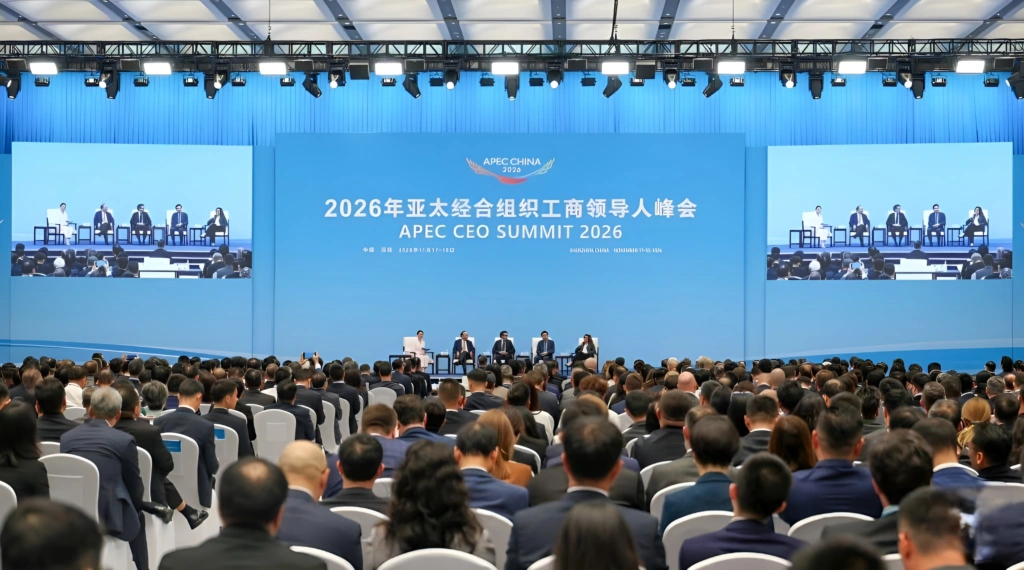
Hosted in China’s technology hub of Shenzhen, the annual summit produces new frameworks for customs digitalization and energy security.
On November 18 and 19, 2026, leaders from across the Pacific Rim gathered in Shenzhen, China, for the 33rd Asia-Pacific Economic Cooperation (APEC) Economic Leaders’ Meeting.
Hosted by China under the official theme “Building an Asia-Pacific Community to Prosper Together,” the summit brought together more than 2,000 political and business representatives, including executives from 115 Fortune Global 500 companies.
Shenzhen as the host city reflects its economic expansion over four decades, from a small coastal town into a major center for hardware manufacturing, clean energy, and digital infrastructure.
According to APEC data and international observers, the forum’s 21 member economies represent more than 60 percent of global gross domestic product (GDP) and approximately 40 percent of the world’s population.
Amid trade disputes and shifting alliances, the 2026 APEC Summit is the first venue to evaluate whether Pacific Rim economies can maintain coordinated regional integration or move toward fragmented trade blocks.
#China | President Xi Jinping welcomes world leaders to the 33rd APEC Economic Leaders’ Meeting in Shenzhen, with trade, regional integration, and geopolitical cooperation on the agenda.#APEC2026 #GlobalTrade #InternationalCooperation #teleSUREnglish pic.twitter.com/bEtUzLzjzH
— teleSUR English (@telesurenglish) November 19, 2026
Inside the Pacific Rim’s Economic Engine
The Asia-Pacific Economic Cooperation (APEC) forum was founded in 1989 to promote free trade, economic growth, and technical cooperation throughout the Asia-Pacific region.
Unlike traditional international organizations composed strictly of sovereign nations, APEC designates its participants as “member economies”. This distinction allows territories with separate customs and trade systems, such as Hong Kong and Chinese Taipei, to participate alongside sovereign states on economic matters without resolving diplomatic status disputes.
APEC operates on a distinct institutional model based on non-binding commitments, open dialogue, and consensus decision-making. Is a Forum that advocates for voluntary cooperation and peer review to reduce trade barriers and harmonize regulatory standards.
As noted by Antonio Basilio, Director of the APEC Business Advisory Council (ABAC) Secretariat, the forum’s objective is to enable businesses to conduct trade and investment under transparent and predictable rules.
The first annual Economic Leaders’ Meeting was established in 1993 and serves as the culmination of a political process that unfolds throughout the year. In 2026, when China hosts APEC, more than 300 preparatory meetings and ministerial conferences were held in various cities, including Guangzhou, Shanghai, Dalian, Suzhou, Hangzhou, Beijing, and Hong Kong, with over 10,000 participants.
These working groups and ministerial sessions addressed specific sectors such as food security, energy, finance, and customs procedures, resulting in nearly 50 practical policy outcomes before the leaders’ arrival.
The Shenzhen summit functions as the final executive stage where heads of government review these technical agreements, set multi-year regional priorities, and conduct bilateral diplomacy on pressing global economic issues.
The Powers Around the Pacific Table
APEC comprises 21 member economies distributed across four geographic sub-regions of the Pacific Rim. In East and Northeast Asia, the participating economies are the People’s Republic of China, Hong Kong, China, Chinese Taipei, Japan, and the Republic of Korea.
Southeast Asia is represented by seven members of the Association of Southeast Asian Nations (ASEAN): Brunei Darussalam, Indonesia, Malaysia, the Philippines, Singapore, Thailand, and Viet Nam.
Across the Pacific in the Americas, membership includes the United States, Canada, Mexico, Chile, and Peru. The remaining four participants span Oceania and Eurasia: Australia, New Zealand, Papua New Guinea, and Russia.
Additionally, three official observer organizations participate in APEC’s meetings and policy processes: the ASEAN Secretariat, the Pacific Economic Cooperation Council (PECC), and the Pacific Islands Forum (PIF) Secretariat.
This roster encompasses both advanced industrial economies and developing nations with varying income levels, resource bases, and trade models.
High-income economies such as the United States, Japan, Australia, Canada, and the Republic of Korea engage directly alongside major manufacturing and commodity exporters including China, Russia, Indonesia, Mexico, Chile, and Peru.
Because all 21 members hold equal standing within APEC’s consensus framework, developing economies in Southeast Asia and Latin America use the forum to negotiate supply chain standards, infrastructure financing, and market access alongside larger economic powers.
Ver esta publicación en Instagram
Una publicación compartida de teleSUR English (@telesurenglish)
Three Pillars Defining the 2026 Agenda
For its third turn as APEC host following summits in 2001 and 2014, China structured the 2026 agenda around three core priorities: openness, innovation, and cooperation.
According to the APEC Policy Support Unit’s August 2026 Regional Trends Analysis, regional economic growth was projected at 3.2 percent for 2026, supported by technology trade but constrained by elevated energy costs and trade policy uncertainty.
Against these economic conditions, host officials designed the Shenzhen agenda to address immediate trade bottlenecks and long-term structural shifts.
Under the first pillar, openness, APEC discussions focused on advancing market-driven regional economic integration and reviewing progress on the Free Trade Area of the Asia-Pacific (FTAAP) agenda, which marked its 20th anniversary in 2026.
Trade APEC ministers and senior officials prioritized maintaining resilient supply chains for essential goods, supporting reform of the World Trade Organization (WTO), and completing the final review of the third Supply Chain Connectivity Framework Action Plan.
The second pillar, innovation, focused on artificial intelligence (AI), the digital economy, and cross-border technological standards. Working groups examined practical measures to expand paperless trade, standardize customs data formats, and establish mutual recognition for electronic commercial documents.
Policy APEC discussions also addressed cross-border data flows, privacy protections, digitally delivered services, and expanding AI capacity-building so small and medium-sized enterprises (SMEs) across developing member economies can participate in digital commerce.
The third APEC pillar focuses on targeted shared resource security, environmental sustainability, and inclusive growth. Drawing on outcomes from 10 specialized ministerial meetings held throughout 2026, covering energy, food security, finance, transport, forestry, and women’s economic empowerment, leaders reviewed frameworks to stabilize regional energy markets, strengthen agricultural supply systems, and promote low-carbon industrial transitions.
Ver esta publicación en Instagram
Una publicación compartida de teleSUR English (@telesurenglish)
Competing Visions on the Shenzhen Stage
During the APEC CEO Summit and the Economic Leaders’ Meeting held from November 17 to 19, heads of government outlined distinct positions on global trade rules, technological governance, and regional security.
Chinese President Xi Jinping framed the summit’s central choice as whether to open doors or close doors, and whether to work together or against each other.
Reporting that China’s economy grew by 4.6 percent in the first three quarters of 2026 under its 15th Five-Year Plan, Xi called for the elimination of trade barriers, support for the World Trade Organization, and the creation of a World Association for Bay Areas Economic Cooperation.
Leaders from Southeast Asia and East Asia focused on supply chain stability and digital rules. Malaysian Prime Minister Anwar Ibrahim criticized unilateral trade restrictions, stating that governments cannot claim to promote trade and investment if those policies apply only to their own country.
Singaporean Prime Minister Lawrence Wong urged members to prevent the Asia-Pacific from splitting into competing economic blocs and highlighted electronic trade document exchange and practical cooperation on artificial intelligence.
South Korean President Lee Jae Myung stated that the benefits of artificial intelligence must translate into innovation for all, while Thai Prime Minister Anutin Charnvirakul pointed to Shenzhen’s economic trajectory as an example of open-market development.
Other major powers addressed broader economic and geopolitical shifts. Russian President Vladimir Putin stated that containment policies negatively affect Western economies, advocated for a larger Eurasian partnership, and described Shenzhen as a model of regional development.
Canadian Prime Minister Mark Carney stated that Canada was prepared to take practical steps toward financial cooperation with China, while Australian Prime Minister Anthony Albanese noted the scale of Shenzhen’s urban transformation since his first visit in 1998.
Meanwhile, U.S. President Donald Trump held bilateral and trilateral discussions on the sidelines of the summit, noting in media remarks that he and Xi Jinping agreed on the importance of establishing guardrails for artificial intelligence.
#China | At the APEC CEO Summit, President Xi Jinping called for deeper regional integration and multilateral cooperation amid growing trade tensions and protectionism.#APEC2026 #GlobalTrade #Multilateralism #teleSUREnglish pic.twitter.com/doegea0dTt
— teleSUR English (@telesurenglish) November 19, 2026
New Deals and the Road Ahead
At the conclusion of the plenary session on November 19, the 21 member economies adopted the 2026 APEC Leaders’ Shenzhen Outlook.
This consensus declaration reaffirmed APEC’s voluntary, non-binding operating principles, committed members to strengthening supply chain resilience, and endorsed continued market-driven economic integration toward the Free Trade Area of the Asia-Pacific.
Leaders also formally welcomed the APEC Trade Digitalization Cooperation Framework (2027–2030), an action plan designed to standardize policy exchanges, expand paperless trade, and facilitate cross-border e-commerce and digitally delivered services. In addition, the declaration affirmed the protection of intellectual property rights and encouraged technical exchanges to help member economies meet environmental and trade objectives.
After a meeting in Shenzhen on November 19, Chinese President Xi Jinping, Russian President Vladimir Putin, and U.S. President Donald Trump issued a joint Declaration Toward Peace.
In this four-point statement, the three countries affirmed that a nuclear war cannot be won and must never be fought, and agreed to conduct dialogue on reducing nuclear risks and preventing nuclear proliferation; at the same time, the text did not establish a formal denuclearization framework or resolve ongoing regional conflicts.
As the Shenzhen meetings concluded, APEC’s rotating chairmanship transferred to Viet Nam for the 2027 host year. Because APEC operates without binding enforcement mechanisms, the implementation of the 2026 Shenzhen Outlook and the 2027–2030 Trade Digitalization Cooperation Framework will depend on voluntary domestic adoption and bilateral follow-through by individual member governments.
Sources: apec2026.cn – BBC – TeleSUR – Al Jazeera – Xinhua – CGTN – RT – TRT World – Anadolu Agency – CNN – apec.org – DW – France 24 – EFE – Reuters – La Radio del Sur
From teleSUR English via This RSS Feed.