

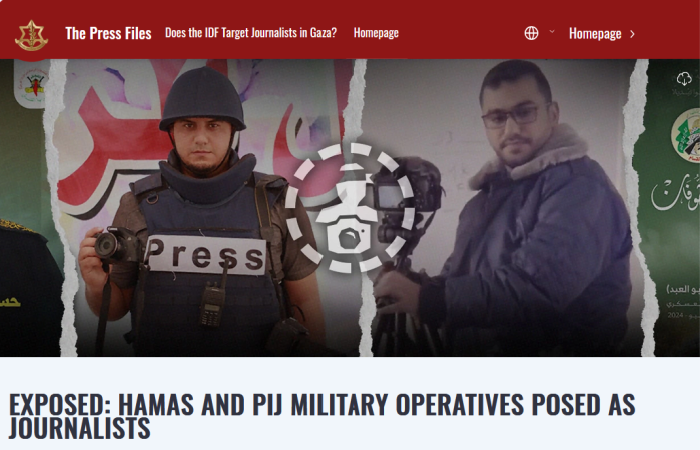
The IDF’s “Press Files” ignore most of the journalists Israel has been accused of murdering, and contain dubious evidence regarding the minority of accusations they do address.
FAIR contributor Bryce Greene (11/1/24) reported in 2024 that the New York Times, Washington Post and Wall Street Journal each published credulous articles about Hamas’ purported operations before the October 7 attacks, “based on different sets of documents handed to them by the Israeli military.”
As Greene wrote:
Documents received directly from intelligence agencies should always be treated with skepticism, and that’s especially true when their government has a well-documented history of blatant lying.
In 2026, the New York Times once again treated a set of IDF documents with credulity—this time helping to justify the murder of Palestinian journalists.
On October 1, 2026,the IDF released “The Press Files,” presenting what it called “evidence” for its longstanding, dubious claims that most of the estimated 191 journalists it has killed in Gaza from 2023–25 were actually militants from Hamas and other Palestinian resistance groups.
One day later, the New York Times (10/2/26) published an article headlined “Israel Lists 170 Killed in Gaza It Says Were Militants Posing as Media Workers.” Times breaking news reporter Ephrat Livni took the IDF’s documents largely at face value, despite Israel’s well–documented history of lying to advance its genocidal agenda. And, as it turns out, there was every reason to doubt the IDF’s latest set of claims.
‘Unverifiable snippets’
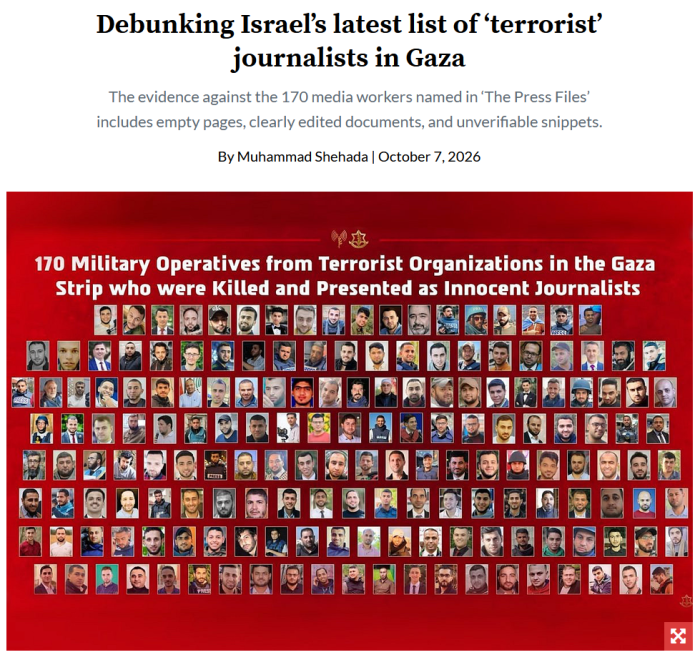
Muhammad Shehada (+972, 10/7/26): “Even if one were to blindly accept that each of the journalists included in ‘The Press Files’ was a militant, the army has no accusations whatsoever against at least 113 more journalists whom it killed in Gaza during the past three years.”
Israel-based +972 Magazine (10/7/26) published an article by Muhammad Shehada, a visiting fellow at the European Council on Foreign Relations, headlined “Debunking Israel’s Latest List of ‘Terrorist’ Journalists in Gaza.” The subhead said the evidence included “empty pages, clearly edited documents and unverifiable snippets.”
The IDF listed 170 alleged “military operatives” masquerading as journalists. The Committee to Protect Journalists (CPJ), meanwhile, listed 191 journalists killed. Shehada cross-referenced these two lists, and found that more than half (92/170) of the people on the IDF’s list are not on CPJ’s list of the journalists killed by Israel. And 113—nearly three-fifths—of the people on the CPJ’s list of journalists killed by Israel are not accounted for on the IDF’s list.
According to Shehada’s count, “the overwhelming majority” of the 78 names that appear on both lists “have no [militant group] obituaries or incriminating pictures attached to their files” in the IDF dossier.
Of the IDF’s 170 names, Shehada noted that there were:
- 59 journalists whose “pages are devoid of any evidence or documentation whatsoever.”
- 42 cases “in which the Israeli army does not provide any credible incriminating evidence.”
- Five cases in which “there is a clear mismatch between what the Israeli army claims and what the snippet says.”
- Three cases in which the “snippets have been clearly edited with no original version provided.”
He wrote that there were 49 cases in which the “Israeli Army’s evidence consists of obituaries allegedly published by Hamas or Palestinian Islamic Jihad on their Telegram channels, claiming the deceased individuals as members.” Shehada conceded that “this is the strongest evidence” in the files, but argued that “it is still far from conclusive”—and pointed out that only nine of these individuals are actually on CPJ’s most updated list, which was recently externally audited, with some names added and others removed.
‘No supporting evidence’
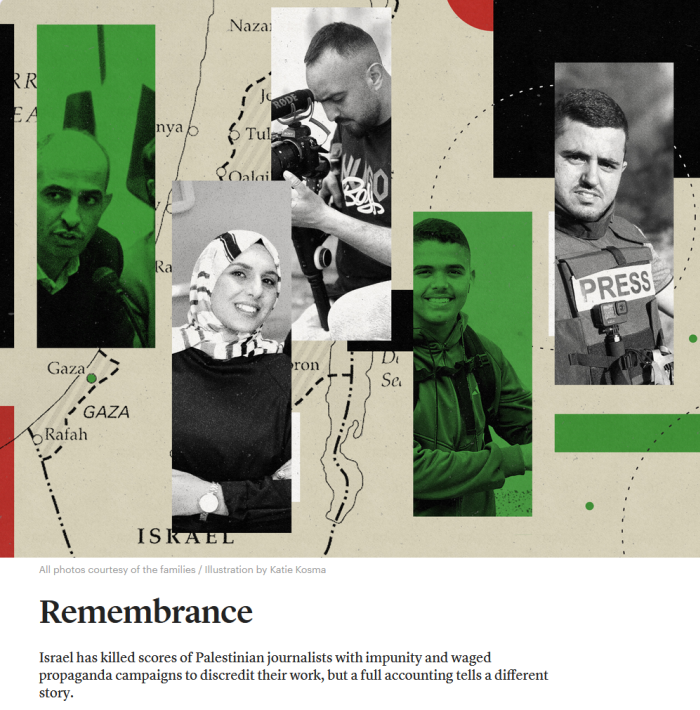
Azmat Khan (CJR, 10/7/26): “We have seen the Israeli government, a network of pressure groups, and even the press parrot anomalies, disproportionately focus on unverified allegations, and fail to accurately reflect the work of journalists.”
Shehada wasn’t alone in challenging the IDF’s claims. The Columbia Journalism Review (10/7/26) also published an article that challenged the IDF’s narrative. Journalist Azmat Khan—who won a Pulitzer Prize for the New York Times—noted that
at least 19 allegations are attributed only to “multiple intelligence sources,” for which no greater detail is provided; many others are based on single lines from unverified documents that list an individual as once having been affiliated with an armed group.
Shehada’s +972 article noted that
even a researcher at the hasbara organization HonestReporting—which has long accused Gazan journalists of being Hamas operatives, without any basis—admitted that for 102 of the 170 names in the army’s list, “the detail drops off sharply.”
Meanwhile, British-based New Arab (10/13/26) challenged the inclusion of two Palestine-based journalists on the IDF’s list in a powerful piece headlined “’Killed Twice’: Gaza Families Fight to Clear the Names of Journalists Branded Militants by Israel.”
In the piece, Gaza-based journalist Ismail Nofal interviewed the father of Ahmed al-Louh, who was killed in December 2024 by an Israeli strike that hit a civil defense post in a refugee camp while he was working as a photojournalist for Al Jazeera. The IDF listed al-Louh “as a military operative in Hamas’s armed wing,” but Nofal noted that they provided “no supporting evidence”; its “only image linked to an internal address and did not load.” (The IDF’s page has since been edited to list al-Louh as instead affiliated with Palestinian Islamic Jihad—again, with no evidence offered.)
Nofal also interviewed the brother of Ahmed Khaireddine, who was a camera operator for Al-Quds Al-Youm when he was killed in December 2023 by an Israeli strike that hit his home in northern Gaza. The New Arab noted that the IDF described Ahmed “as an Islamic Jihad commander,” but his brother, who is also a journalist, said the photo on the page was fabricated, and that he had “never seen it in his life.”
NYT leads with IDF claims
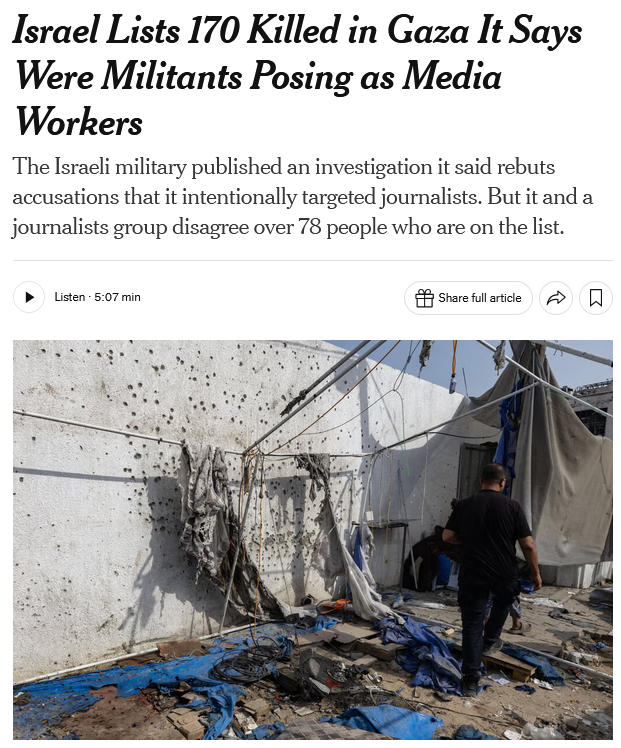
Citing a Israeli military spokesperson, the New York Times‘ Ephrat Livni (10/2/26) reported that “Israel had found more than 100 members of Hamas and dozens of operatives from Palestinian Islamic Jihad, as well as other militant groups, who had been labeled members of the media were actually combatants.”
Most US corporate media outlets didn’t find the IDF’s poorly sourced claims worth reporting. Indeed, FAIR only found two other articles about the files in US media, published by Fox News (10/5/26; re-published by Yahoo News, 10/5/26) and DC-based Jewish Insider (10/2/26). (The files were also barely covered in foreign media outside of Israel, except for an inflammatory opinion article in the conservative British Spectator—10/3/26.)
But the piece the New York Times (10/2/26) published the day after the “Press Files” release ran under a headline that took the Israeli claim at face value: “Israel Lists 170 Killed in Gaza It Says Were Militants Posing as Media Workers.”
The subhead, like the piece itself, took a “both-sides” approach, giving essentially equal weight to the claims of both Israel and the CPJ: “The Israeli military published an investigation it said rebuts accusations that it intentionally targeted journalists,” it began. “But it and a journalists group disagree over 78 people who are on the list.”
That framing of the disagreement implied that the remaining 92 names on the IDF’s list supported its claims, when in fact those names weren’t even on CPJ’s list.
The Times‘ Ephrat Livni also used the word “rebut” in her first sentence to refer to the IDF’s investigation—a word choice that suggests a credible case. She cited the IDF report and two named Israeli military spokespeople, as well as “the Israeli military” and “Israeli military officials”; on the other side, she cited the CPJ, CPJ chief executive Jodie Ginsberg, and “journalist groups like CPJ, the United Nations and news organizations.”
Livni repeated at least six times Israel’s claims that the journalists were actually military operatives, starting with the lead:
The Israeli military has published an investigation saying that 170 people killed in the war in Gaza who had presented themselves as journalists were actually militants, rebutting accusations that it targeted journalists in violation of international law.
She lightly hinted at—using hedges like “said to have been found” and “purporting”—the questionable evidence presented by the IDF, writing that
some of the entries in the Israeli report have photos, social media posts or records said to have been found in Gaza purporting to show membership in a militant group, while others are based on intelligence the Israeli military says it cannot share.
But it’s the responsibility of a journalist to interrogate a major claim that is based on “intelligence” by an interested state. Instead, Livni and the Times seemed more interested in repeating the IDF’s claims as a he said/she said story rather than doing the requisite legwork to try to confirm or deny them. Livni wrote simply, “Neither list has been independently verified by the New York Times.”
To be sure, she acknowledged in one paragraph that “78 people appear on both the Israeli military’s list and CPJ’s, meaning that for the most part, the two lists do not overlap.”
But Livni’s takeaway from the differences between the IDF and CPJ’s lists was not that the IDF’s list is unlikely to be reliable or newsworthy, but that the agency and press freedom organization “disagree about whether the people were really journalists or militants.”
Since Livni’s article was published—and since +972, New Arab and CJR have published their revelations—the Times hasn’t published a follow-up piece that more critically examines Israel’s claims.
‘Don’t lead with unsubstantiated claims’
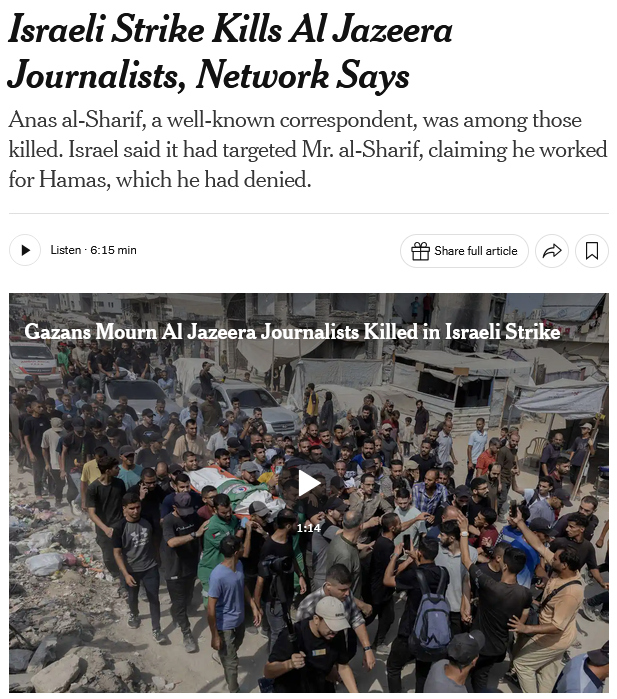
Columbia journalism professor—and New York Times Pulitzer winner—Azmat Khan (CJR, 10/2/26) offers this Times piece by Ephrat Livni to her students to see how many problems they can spot.
The New York Times would have done well to heed advice from the Arab and Middle Eastern Journalists Association (10/6/26), which urged news organizations not to repeat the IDF’s claims about the “Press Files” without independent verification or to “allow posthumous accusations to substitute for investigations into killings.”
AMEJA noted that the IDF’s claims have been disputed by “independent press-freedom researchers” and CPJ’s case-by-case research. It added:
The IDF’s public database itself relies on varying evidentiary standards: some are undisclosed documents the military says it recovered, and others simply cite unknown “multiple intelligence sources.” Journalism standards from leading organizations, such as NPR, SPJ, Reuters and the Associated Press, all require independent verification rather than reliance on a single source, official or otherwise. None of these standards exempt governments or military sources, including the Israeli Defense Forces, from that scrutiny.
CJR’s Khan (10/7/26) similarly stated that
the approach journalists should be taking has seemed obvious: Don’t lead with unsubstantiated claims that are not supported by evidence. Instead, examine recurring trends, identify patterns and report hard truths. No anomaly or extrapolated event can overshadow what the broad sample tells us, what the big-picture truth really is.
The Times’ uncritical coverage is nothing new: The paper has previously minimized or ignored Israel’s mass murder of journalists (FAIR.org, 5/1/24, 5/22/25). Establishment media as a whole have long helped justify Israel’s killing of journalists by dutifully echoing Zionist talking points (FAIR.org, 8/22/25).
Khan—who noted that she has “spent more than a decade investigating the civilian toll of air strikes”—is acutely aware of this distorted reality:
Far too often, mainstream news outlets—including the one that I write for, the New York Times—have only covered the killings of Palestinian media workers in select circumstances, such as when Israel has accused the slain journalists of involvement with Hamas. Those unverified allegations often make up a significant portion of the story, leaving at the margins the journalist’s work, their character, how their families and friends remember them, the hardships they endured as they worked through hunger and grief, or their hopes, their love lives, their mistakes and regrets—the ordinary and extraordinary things that made them human.
Khan cited a 915-word Times article (8/10/25) about Israel’s killing in August 2025 of Al Jazeera reporter Anas Al-Sharif, along with several other journalists, that she said she uses as an example at courses she teaches at Columbia University, “asking students to annotate it for problems.” She noted that 402 words “focused on allegations that Al-Sharif was, in the words of the Israeli military, a ‘terrorist’ who ‘posed as a journalist,’” while only 60 words were devoted to “Al-Sharif’s or his colleagues’ abundance of documented reporting.”
That article was also bylined by Livni, as FAIR (8/22/25) has pointed out.
By uncritically citing Israeli government documents and then failing to follow up when new evidence arises, the New York Times is continuing to manufacture consent for Israel’s ongoing slaughter of journalists.
From FAIR via This RSS Feed.