


Lee en español aquí
Across China, one of the world’s largest direct voting processes is underway. Throughout 2026 and 2027, more than one billion eligible voters are being called upon to elect over 2.6 million delegates to county and municipal people’s congresses. From the capital, Beijing, to the vast rural areas, the elections are being held on a scale rarely seen elsewhere; yet this facet of the Chinese political system remains little known abroad.
In late September, in Li’an Village near Wuxi, Jiangsu Province, eastern China, election preparations took an unusual form. During a rural music festival at Yushan Farm, elected officials served freshly ground coffee to local farmers and visitors. Among them was Lu Jinlian, a deputy to the municipal People’s Congress, who sat with residents in what organizers called a “countryside lounge” to discuss village development and encourage people to register and prepare to vote.
The coffee wasn’t served at a polling station, nor was it simply an election-season gesture. The once-abandoned farm now hosts agricultural activities, musical performances, and community life. Its transformation has also brought residents and their elected representatives closer together to address practical concerns, such as farm access and unlit paths between fields. According to local reports, the representatives followed up on these requests and helped bring about improvements. Such exchanges are part of the regular work of the Li’an Representative Liaison Station, which organizes these monthly activities, taking discussions out of its office and into the orchards, farms, and fields – among the people.
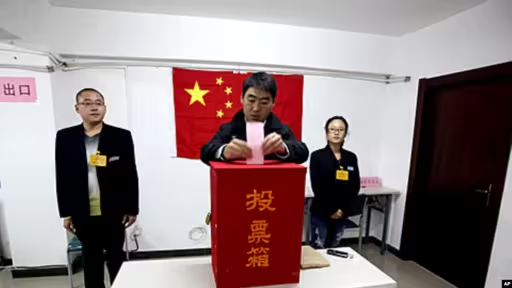
In Beijing, the same electoral process unfolded on a metropolitan scale. On November 6, the capital set up 13,054 polling stations to elect 4,898 district deputies and 11,137 borough deputies. Voting took place in residential communities, workplaces, university campuses, and state institutions, including Zhongnanhai, where President Xi Jinping cast his ballot. Luo Ling, a centenarian resident of Dongcheng District, voted from her wheelchair. At Tencent’s Beijing headquarters, food delivery drivers joined company employees at a polling station located inside the office building.
This system spans a country with 503,000 administrative villages and 112,000 urban communities . At the end of 2020, county and municipal deputies comprised 94.5% of the 2.62 million representatives serving at the five levels of the people’s congresses. Village committees have their own elections and responsibilities, distinct from those of the people’s congresses. However, the importance of representation extends beyond simply conveying local concerns to government officials. The people’s congresses oversee the work of the government, review budgets and development plans, and elect and supervise local officials. In principle, serving the people means not only responding to immediate needs but also representing their interests in decisions about the direction of economic and social development.
Formally established in September 1954, five years after the founding of the People’s Republic of China, the people’s congress system currently operates at five levels. Citizens directly elect deputies to county or urban district congresses and to municipal congresses, each serving a five-year term. City and provincial congresses, as well as the National People’s Congress (NPC), are indirectly elected by the lower-level congresses. This process will result in a new national legislature in 2028. Meanwhile, the Communist Party of China (CPC) is also preparing for its 21st National Congress in 2027 through a separate electoral process within the Party. Together, these institutions form part of the political organization of China’s socialist state, although the Party and the people’s congress systems have distinct but complementary functions.
In accordance with China’s electoral law, citizens aged eighteen and over are eligible to vote and run for office. The Communist Party of China (CPC) and the eight other political parties operating within the CPC’s political system can nominate candidates for the People’s Congresses, as can mass organizations and groups of ten or more voters acting jointly. Some of the rules governing this electoral system include the requirement that more than half of registered voters participate, that a candidate receive more than half of the votes, that there be more candidates than seats, and that the ballot be secret. It is through these provisions that a process is established whereby residents can nominate and elect their representatives to local institutions, rather than representatives simply being appointed from above.
In Beijing, the municipal election office reported that the vast majority of candidates were nominated by groups of ten or more voters – 85% of the 7,337 district-level candidates and 90.8% of the 16,683 borough-level candidates – while the remainder were recommended by political parties and mass organizations. Women comprised 46.3% and 48.5% of the respective candidate lists. Before the vote, groups of voters discussed the preliminary candidates, after which the election committees determined and published the final lists. Meetings were also organized for candidates to introduce themselves and answer voters’ questions. In Shijingshan District, four candidates met with residents who asked them about services for the elderly, property management, and children’s sports activities. This nomination, consultation, and selection process reveals an aspect of popular participation that is unique to China’s political system and little known outside the country.
In Li’an, talks between lawmakers and residents began long before the election season. Lu Jinlian also runs a rural café , where she and lawmaker Qiang Tianyu brought together village representatives, farmers, and young people who had returned to their hometowns to start businesses. Between 2012 and 2025, more than 13 million people across China returned to or moved to rural areas to start businesses, including a growing number of young graduates and professionals.
In June, participants discussed how to link agriculture with tourism and create new livelihoods in rural areas. Among the five proposals that emerged from these discussions was a cycling route connecting local orchards, guesthouses, and tourist attractions, with lighting to encourage visitors to stay longer. These were proposals, not finished projects, but they reflect the concerns residents were raising with their representatives and were part of a month-long series of people’s congresses across Yangjian Township, which involved more than 500 people in dozens of events designed to gather public input. Through their participation in the people’s congresses, delegates have channels to incorporate these concerns into discussions about development plans, government spending, and the work of the government, linking villagers’ everyday worries to broader decisions about the future of rural areas.
When the festival arrived in September, lawmakers leveraged these relationships to encourage voter turnout. During voter registration in October, Yangjian Township divided its territory into electoral districts, posted notices, conducted door-to-door visits, and reached out to residents who worked far from home, often in other cities – a critical issue in a country where labor migration has transformed the relationship between rural and urban centers. Reaching people who might easily miss a notice on the village bulletin board requires mobilization and creativity, from phone calls and home visits to public discussions around a coffee table at the local festival.
The right to representation has itself changed during China’s socialist construction. Under the 1953 election law, each rural deputy to the National Congress represented eight times more people than an urban deputy. While this ratio decreased in subsequent decades, it was in 2010 that the law was amended to allocate seats on the same population basis in both urban and rural areas. The reform did not eliminate inequalities between rural and urban areas, but it marked an important step in the country’s ongoing efforts to overcome the historical gap, a central challenge of socialist construction.
The Chinese government understands that elections, consultation, decision-making, and oversight are all part of “people’s democracy throughout the entire process.” The leadership of the Communist Party of China (CPC) is enshrined in the Constitution, while elections to people’s congresses choose representatives for organs of state power, rather than determining which party governs the country. Deputies are expected, through the people’s congresses, to incorporate the concerns of their constituents into decisions about public resources and development, and to oversee the work of the government. While experiences from Li’an village to the capital, Beijing, offer a glimpse into these processes, they do not reveal how all conflicting demands are resolved or which proposals ultimately receive funding.
Across China, more than a billion eligible voters are participating in elections that will determine who will represent them in these institutions for the next five years. In Li’an, villagers are discussing how to develop agricultural production, how young people can earn a living in the countryside, and how public investment can improve their community. These are questions that extend far beyond a single village. They are part of China’s ongoing effort to transform the relationship between the people and the institutions of state power, and to determine who participates in shaping the country’s future.
Tings Chak (翟庭君) is the deputy coordinator for Asia of Tricontinental: Institute for Social Research and editor of Wenhua Zongheng: Journal of Contemporary Chinese Thought.
This article was written by Globetrotter.
From BT News via This RSS Feed.